
Diagnosis asks whether the glucose in the blood is higher than the body can keep it. Type 2 diabetes is diagnosed from blood glucose or HbA1c, and three tests answer that question, each reading the same balance at a different time. A fasting value reads the level at rest, when the body’s own glucose output and its use of glucose are in balance. A glucose load reads how well the body disposes of a sudden supply, the one a meal brings. HbA1c reads an average over months, because glucose attaches to haemoglobin inside red cells, and the amount attached depends on the glucose level and on how long each cell lives. Each test has its own threshold, and the diagnosis is made above it.
What does a fasting value show?
The first test is the simplest, a reading taken at rest. Fasting plasma glucose is measured after at least 8 hours without calories. After a fast of that length, the body is in its post-absorptive state, when its own glucose output and its use of glucose are in balance, as the normal glucose homeostasis note explains.
Diabetes is diagnosed at a fasting plasma glucose of 126 mg/dL (7.0 mmol/L) or higher. A normal fasting value is below 100 mg/dL (5.6 mmol/L). A fasting value shows the resting balance, so what happens when glucose arrives after eating?
Why is a glucose load needed as well?
The second test gives the body a load and times the response. The body normally disposes of a glucose load after eating, as the normal glucose homeostasis note explains. In type 2 diabetes that disposal is impaired, and one reason is that, after a meal, insulin normally holds back the liver’s glucose output, and in type 2 diabetes that hold is lost, as the pathophysiology note explains.
The 2-hour value is measured during the oral glucose tolerance test (OGTT). The patient drinks a 75 g glucose load after an overnight fast, and plasma glucose is measured 2 hours later. Diabetes is diagnosed at a 2-hour plasma glucose of 200 mg/dL (11.1 mmol/L) or higher. A normal value is below 140 mg/dL (7.8 mmol/L).
The rule is to ensure a carbohydrate intake of at least 150 g/day for 3 days before the test. Without adequate carbohydrate intake, the glucose response is falsely flattened.
Both of these tests depend on a single day’s readings. Is there a test that does not?
What does HbA1c add?
HbA1c answers that by averaging over time rather than by one moment. It reports the average glucose over the preceding 2-3 months. Glucose attaches to haemoglobin over the life of the red cells, so the amount attached builds up over that time rather than reflecting one moment. Because it is an average, a single meal or a fast does not change it much, and that is why HbA1c needs no fasting.
Diabetes is diagnosed at an HbA1c of 6.5% or higher. A normal HbA1c is below 5.7%.
The average depends on how long the red cells live. A red cell that lives a shorter time has less time to collect glucose, so the average reads falsely low. HbA1c can therefore mislead when red-cell survival is altered, for example in anaemia, haemoglobinopathies and pregnancy. Glucose tests are used instead of HbA1c in those situations.
So when is one result enough, and when must there be two?
Is one abnormal result enough?
A single reading can be out of line, so the rule depends on how clear the high glucose is. Any single test has variability in how the sample is handled and measured, so a value above the cut-off may fall below it when measured again.
In an asymptomatic person, a single abnormal result is therefore not enough, and the diagnosis requires two abnormal results. A second result shows whether the abnormal value holds. The two results may come from the same sample, for example HbA1c and fasting plasma glucose measured together, or from two different samples.
When the high glucose is unequivocal, there is no doubt for a second result to settle. A random plasma glucose of 200 mg/dL (11.1 mmol/L) or higher, plus classic symptoms of hyperglycaemia, establishes the diagnosis. Symptoms of high glucose appear when the kidney cannot hold back the glucose, as the presentation note explains. The same random value in a hyperglycaemic crisis also establishes the diagnosis. In both cases, a single abnormal result confirms it.
What about a result that is high but short of the diabetes line?
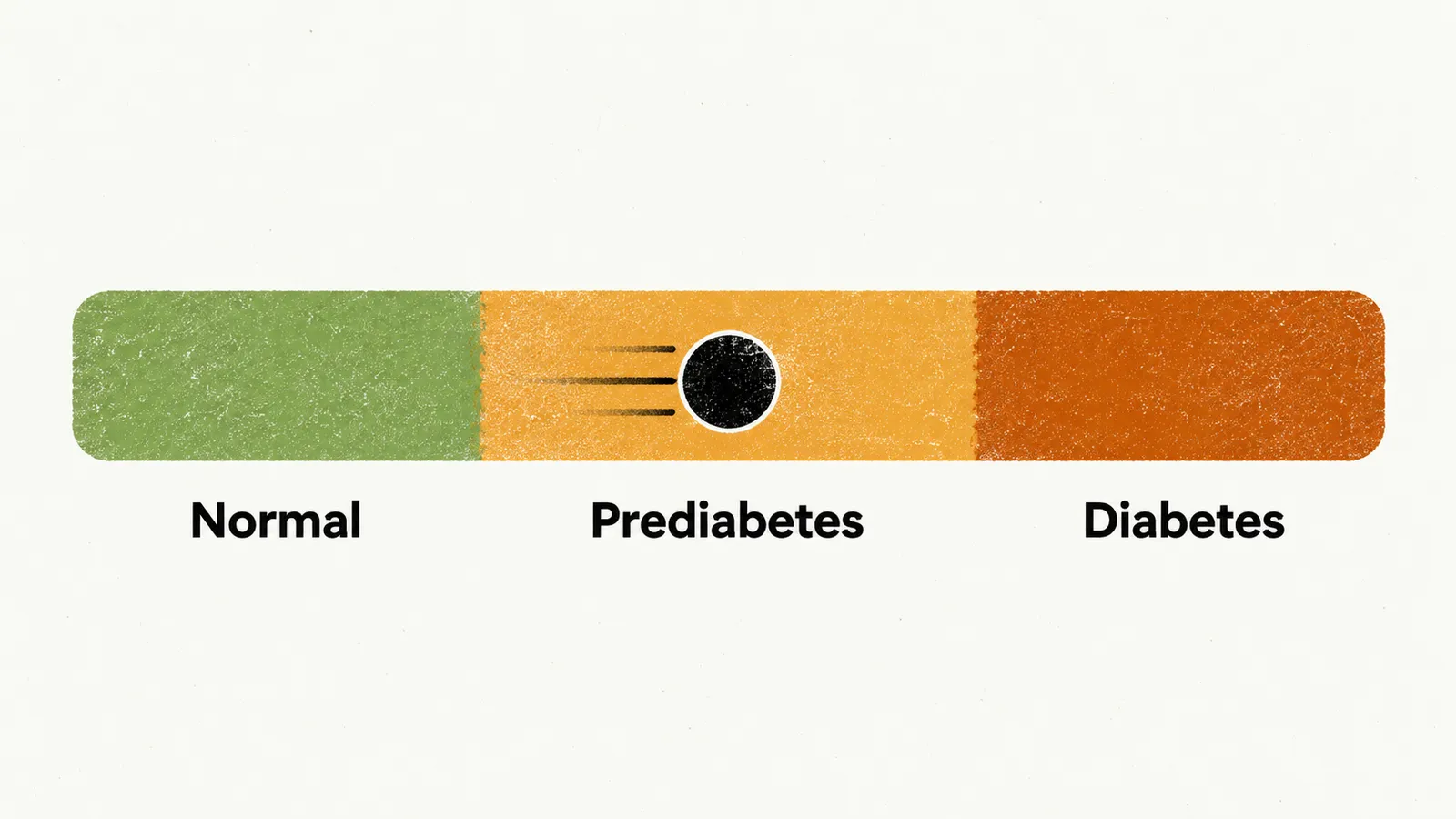
What lies between normal and diabetes?
The same cut-offs that diagnose diabetes mark a band just below it. Prediabetes is an intermediate state, with glucose higher than normal but not yet in the diabetic range, so it is the band on the same scale that lies between normal and diabetes. It is defined by any one of three ranges:
- fasting plasma glucose of 100-125 mg/dL (impaired fasting glucose, IFG);
- 2-hour plasma glucose of 140-199 mg/dL (impaired glucose tolerance, IGT);
- HbA1c of 5.7-6.4%.
A value in this band is not yet diabetes, but it signals a high risk of going on to diabetes, which is why the prediabetes thresholds also flag who should be retested. Adults with prediabetes should be tested at least yearly, because their yearly risk of progression to diabetes is several percent.
Who should be tested at all?
Who should be tested, and when?
Testing is aimed at people, using the risk factors already set out, and screening is targeted, not universal. The same risk factors that make the disease more likely decide who should be screened and when testing should begin, as the risk factors note sets out.
Screening should be offered to all adults from age 35. It should start earlier in adults who are overweight or obese and have at least one risk factor for type 2 diabetes.
How often the test is repeated depends on the result:
- Adults with a normal result repeat screening at least every 3 years, and sooner if symptoms appear or risk changes, such as weight gain. Weight gain is one of the changes that raise risk, as the risk factors note explains.
- Adults with prediabetes are tested at least yearly.
- Adults who have had gestational diabetes are tested at least every 1-3 years. A pregnancy with gestational diabetes is itself a risk factor for later diabetes, as the risk factors note explains.
Why test before symptoms appear?
Why test before symptoms?
Finding it early matters. Hyperglycaemia often precedes the diagnosis by years. While the beta cells keep up, glucose can stay raised without overt disease, because overt diabetes appears when that compensation fails, as the pathophysiology note explains. Damage to the blood vessels can already be present by the time the disease is recognised, as the presentation note explains, and vascular damage may already be present at diagnosis.