
The kidney filters glucose out of the blood and takes it back, up to a limit, so normally little or none reaches the urine. When glucose rises past that limit, the excess stays in the urine and holds water there. The person passes large volumes of urine and then has to drink to replace the water. Cells also need insulin to let glucose in. When insulin works poorly, less glucose enters, the tissues run short of fuel, and they burn fat and protein instead. Thirst and passing urine come from water lost through the kidney, and weight loss can come from fuel that does not reach the tissues.
Why is it usually silent?
If symptoms come from glucose spilling and from cells starving, the first question is why high glucose causes nothing at first.
Type 2 diabetes usually develops silently. Hyperglycemia builds over years, and the beta cells make up for a falling insulin response for a long time, with overt diabetes appearing when that compensation stops keeping pace, as the pathophysiology note sets out. Because the rise is gradual, the classic symptoms of high glucose may never appear. When they do, they may be put down to ordinary tiredness or ageing.
Most people with newly diagnosed type 2 diabetes have none of these symptoms, and no sign of catabolism. In practice, diagnosis is often made from a routine blood test or a screening test rather than from the patient’s complaint. Raised glucose is discovered another way: an unrelated blood test shows it, or the person is screened because they have risk factors for the disease. Hyperglycemia commonly predates the diagnosis by several years.
Around 2 in 5 adults with diabetes worldwide do not know they have it, a large fraction.
Why are the first symptoms thirst and passing urine?
The picture says the first effect is water lost through the kidney, so the question is what carries the water out.
The symptoms follow from glucose that the kidney cannot retain. The kidney takes back filtered glucose up to the renal threshold, as the pathophysiology note sets out. That threshold is about 180 mg/dL (10 mmol/L). Above it, filtered glucose exceeds what the tubule can take back, and the excess spills into the urine as glycosuria.
Glucose in the urine drags water with it by osmosis. The glucose stays in the urine and holds water there. This osmotic diuresis produces polyuria, passing large volumes of urine. Liver glucose output keeps running overnight, as the pathophysiology note sets out. The polyuria includes passing urine at night.
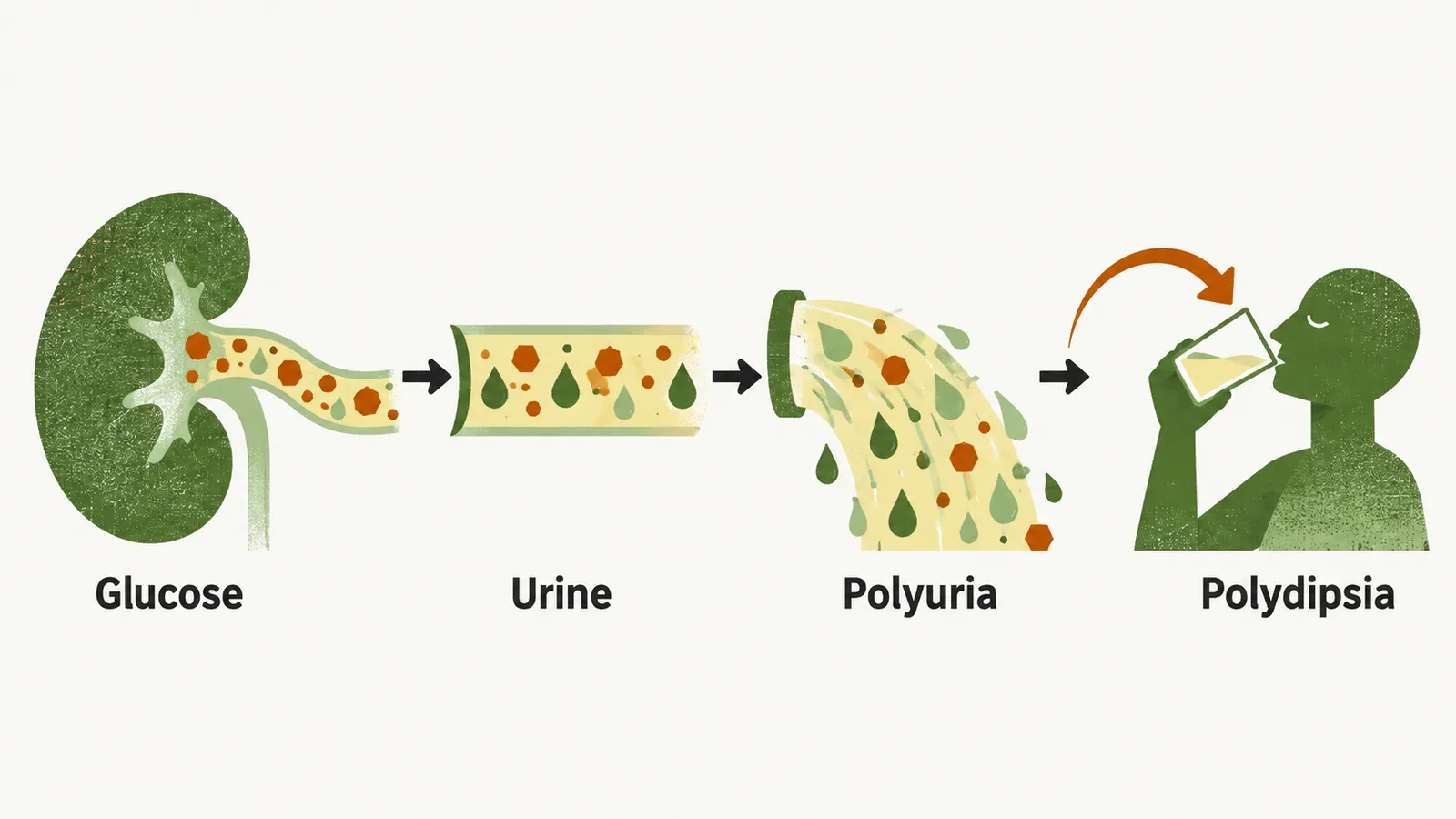
The water lost in the urine leaves the body short. Fluid loss drives polydipsia, the compensatory thirst that makes the person drink.
Why do the cells run short of fuel?
The glucose that does not leave in urine is glucose the cells do not take up, so the question is what the tissues burn instead.
Glucose enters cells poorly. Insulin is what moves glucose into muscle, and that movement is blunted in type 2 diabetes, as the pathophysiology note sets out. Insulin is also an anabolic hormone, and it holds fat cells back from breaking down their stored fat, as the normal glucose homeostasis note sets out. With less insulin action, tissues lean more on fat and protein for fuel. Fatigue is common.
Marked hyperglycemia can produce weight loss, because glucose and the water with it leave in the urine while fat and protein are used for fuel. Weight loss is more prominent in type 1 diabetes. Type 1 diabetes is absolute insulin deficiency, so the brake on fat breakdown is absent. In type 2 diabetes some insulin is still present, which is why the loss is usually less marked.
Why does vision blur, and why does it pass?
Glucose also moves into the lens of the eye.
Blurred vision is common. It is caused by osmotic swelling of the lens as glucose moves in and out of it. Blurred vision is usually temporary.
Why infections and slow healing?
The same high glucose acts on the tissues it bathes.
Recurrent infections, such as genital or urinary candidiasis, are a way the disease announces itself. Glucose in urine and in genital fluid feeds Candida, and high glucose also weakens the immune cells that control it. Poor healing of minor wounds is another way the disease announces itself. Recent evidence suggests that impaired wound healing is related to poorly regulated glucose.
Why can the first clue be a complication?
The same high glucose damages small vessels, and that damage can come before diagnosis.
High glucose damages small vessels and their nerve supply. Because hyperglycemia commonly predates the diagnosis by several years, this damage can already be present when the diagnosis is made. So sometimes the first clue is a complication that has already developed: retinopathy, neuropathy, or a foot ulcer.
Why can the first presentation be an emergency?
Sometimes the high glucose builds to an emergency rather than a slow course. This is rare. The emergency in type 2 diabetes is usually the hyperglycemic hyperosmolar state.
It involves severe hyperglycemia, with plasma glucose often above 600 mg/dL, and extreme hyperosmolality, above 320 mOsm/kg. These cause profound dehydration and an altered mental state.
There is little or no ketosis. Some insulin is still present, and this residual amount is enough to suppress fat breakdown and ketone production, though not enough to hold glucose down. So the picture is high glucose without much ketosis.
The state typically occurs in older people with type 2 diabetes. Lower fluid intake in older people worsens the dehydration. It is often triggered by infection, myocardial infarction, stroke, or a period of poor fluid intake. Poor drinking adds to the water loss.
Why can ketoacidosis also happen in type 2 diabetes?
Diabetic ketoacidosis can also occur in type 2 diabetes. When insulin is short, fat breakdown in adipose tissue and ketone production in the liver both increase.
It occurs particularly in people who are ketosis-prone or under severe physiological stress. In ketosis-prone type 2 diabetes, the pathogenesis is believed to be a stress-induced, reversible beta-cell dysfunction.
The hyperosmolar state and diabetic ketoacidosis are both medical emergencies, and both have substantial mortality if untreated. If the disease is often silent and can arrive as an emergency, how is it found while it is still silent?