Acute diarrhea in European children is mostly viral. Most cases need no microbiological diagnosis.
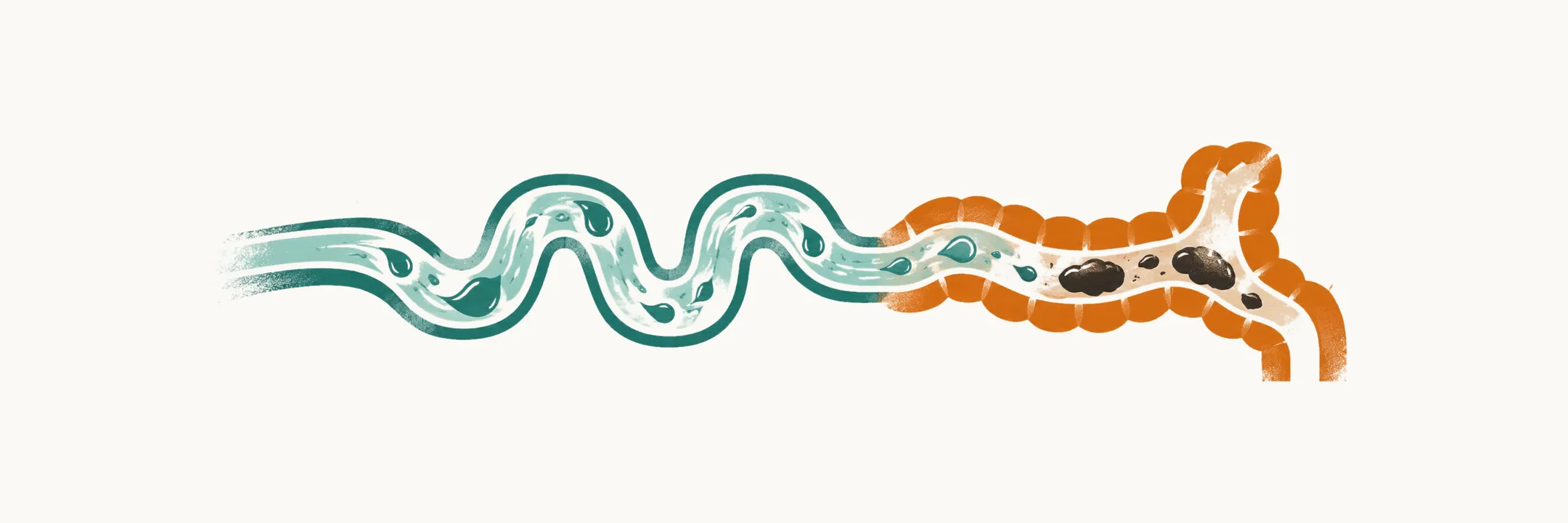
Germs reach the child by mouth and settle somewhere in the bowel, and the place where they settle decides the pattern of illness. Most of the water is taken back in the small intestine, as the earlier note showed. The colon comes after it and processes what the small intestine leaves. An organism that works on the absorbing lining of the small bowel gives a watery illness. An organism that gets into the lining of the colon gives a different illness, with frequent small stools that carry blood and mucus. So the question is which organisms produce which pattern, and why.
Which viruses cause most cases?
If most cases are viral, which viruses are they? Rotavirus is the most frequent single agent across Europe, and norovirus has long been in second place. In countries with high rotavirus vaccine coverage, norovirus is becoming the leading cause of medically attended gastroenteritis. Norovirus accounts for around 10–15% of hospital admissions for acute gastroenteritis in European children.
Which bacteria cause some cases, and why do they matter?
After the viruses, what are the less common bacteria? Bacterial causes are less common overall, led by Campylobacter or Salmonella, depending on the country.
This minority matters out of proportion to its frequency. Some bacteria must invade the lining and multiply within it to cause disease, which is a different injury from the watery kinds. Children in this group become septic. An antibiotic either helps them or harms them. The stools of these children need culturing.
A pathogenic enteric organism can be isolated from the stool of roughly 45–75% of children with acute gastroenteritis. That proportion depends on how intensively the search is made.
What about parasites?
After the bacteria, the remaining group is the parasites. Protozoa are uncommon. Giardia or Cryptosporidium carriage in European day-care settings is around 1–3%, and protozoan carriage is frequently asymptomatic.
Why look at the pattern rather than the percentages?
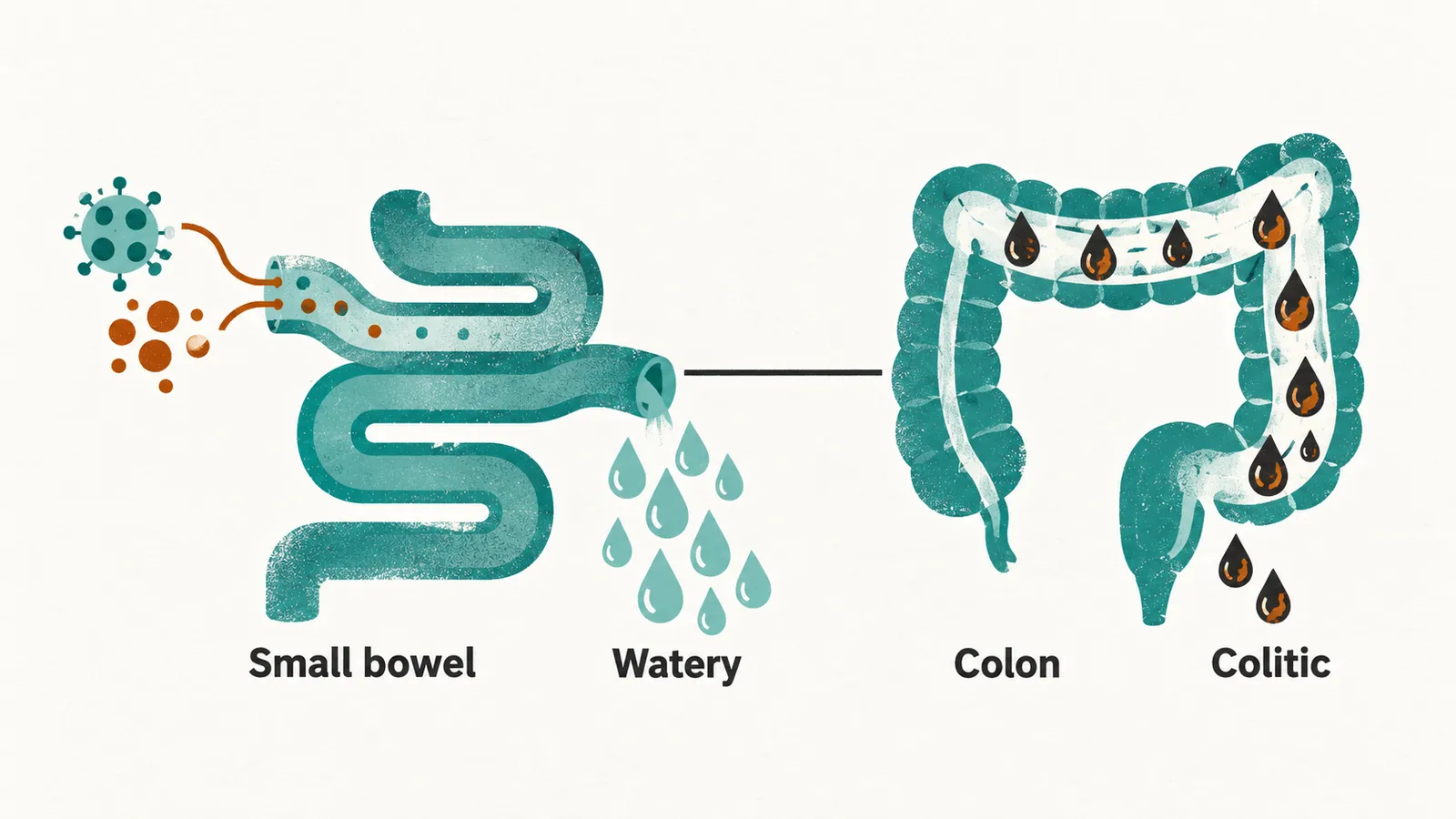
The percentages of how often each cause accounts for community cases vary with country, age, season and vaccine coverage. So what is more useful? A more useful structure is the pattern each class of organism produces. The patterns follow the part of the bowel that an organism affects, because the small intestine and the colon do different jobs and an organism that hits one part disturbs its job.
What does the watery pattern look like?
The watery group is the small-bowel group. Viruses that damage the absorbing lining of the small bowel produce the osmotic route the earlier note explained. An enterotoxin acting on the intact lining makes it secrete fluid, the secretory route the earlier note explained. Enterotoxigenic E. coli works this way.
The watery pattern is produced by rotavirus, norovirus, adenovirus and enterotoxigenic E. coli. The child has watery diarrhea and vomiting, with no blood.
Are all the viruses in the watery group alike?
The watery group is one pattern, but its viruses are not interchangeable. Rotavirus sits at the severe end of the group. Compared with other viral infections, it produces higher fever, more diarrheal episodes and longer-lasting diarrhea. Norovirus differs: vomiting predominates and may be frequent and severe.
What does the colitic pattern look like?
The other pattern is injury to the colon. Organisms that injure it, with inflammation as the result, produce a colitic pattern. Shigella, Campylobacter, Salmonella and Shiga toxin-producing E. coli cause it. The child has frequent small-volume stools with blood or mucus, fever and abdominal pain.
The colitic pattern is not a diagnosis, however. It describes the picture, and more than one kind of organism can produce it.
Why is STEC the standard counterexample?
Shiga toxin-producing E. coli (STEC), named for the Shiga toxin it produces, is the standard counterexample. The bacterium makes a toxin, and the toxin injures the colon. Shiga-like toxins induce hemorrhagic colitis, so blood is the expected sign. Bloody diarrhea with low or no fever is typical.
Antibiotics are not recommended for STEC unless epidemiology suggests shigellosis.
What do the bedside features tell you?
Blood and fever point toward or away from invasion, but only as tendencies. Blood in the stool shifts the differential towards an invasive bacterial cause. High-grade fever with numerous small-volume bloody stools, abdominal pain and systemic upset favour bacterial colitis. Vomiting and respiratory symptoms favour viral illness.
These bedside features are tendencies, not diagnostics.
What about illness that lasts?
Not every illness is acute, so a third group comes next. It tends to cause protracted illness rather than acute illness. Giardia, Cryptosporidium and enteroaggregative E. coli belong here. The diarrhea is persistent rather than acute, and it belongs to a different workup.
Whatever the organism, what is the danger?
The protracted group is different, but every acute pattern shares the same danger. Whatever the organism, the water that is not taken back is lost, as the earlier note showed. The danger to the child is fluid loss.
Which children are most at risk?
Since the danger is the fluid, which children lose it faster, or are more often exposed? Host factors predict deterioration better than the identity of the organism. Younger age, inadequate intake during the illness, and underlying chronic disease or immune deficiency all raise the risk of severe dehydration. Younger children reach dehydration sooner, as the earlier note showed.
Children with immunodeficiency, inflammatory bowel disease, renal disease or other chronic conditions start from a higher baseline. Day-care attendance increases exposure.
Why is a young infant more at risk?
Young age is the first risk factor, and breast milk helps to explain it. The younger infant is at higher risk mainly because of immune immaturity and feeding mode. The infant is not at higher risk because the gut mucosa is immature: intestinal mucosa is functional early in life.
The newborn’s host defence is relatively weak, and breast milk compensates. It supplies secretory IgA, lactoferrin, oligosaccharides and a microbiota that protect against enteric infection. Predominantly breast-fed infants accordingly have a lower risk of severe or prolonged diarrhea.
How large are these risks?
The effect of feeding practice is large enough to appear directly in odds-ratio data. The figures come from a case-control study comparing children who developed dehydration with children who did not. An odds ratio above 1 means the factor was more common among children who became dehydrated.
- Withdrawal of breastfeeding during the diarrheal illness: odds ratio 6.8 (Bhattacharya 1995).
- More than 8 stools per day: odds ratio 4.1.
- Severe undernutrition: odds ratio 3.1.
- Age 12 months or under: odds ratio 2.7.
- More than 2 vomiting episodes per day: odds ratio 2.4.
- No oral rehydration solution given during the illness: odds ratio 2.1.
All six figures come from a single case-control study of 379 children under 2 years with acute watery diarrhea. They describe associations in that population, not universal multipliers.
Which of these risks can be changed?
The two most modifiable entries are the ones the study names: no oral rehydration solution, and withdrawal of breastfeeding. Oral rehydration solution given early reduces the risk of reaching hospital with a serious deficit. Stopping breastfeeding during the illness does the opposite, because it removes the protection that breast milk gives against enteric pathogens. That is why breastfeeding continues throughout rehydration and throughout any dietary modification.
Does a risk factor mean dehydration?
Risk factors say which children are more likely to become severely dehydrated. Whether a particular child already is dehydrated, and how badly, is judged at the bedside. So how do you judge how dehydrated this child is right now?