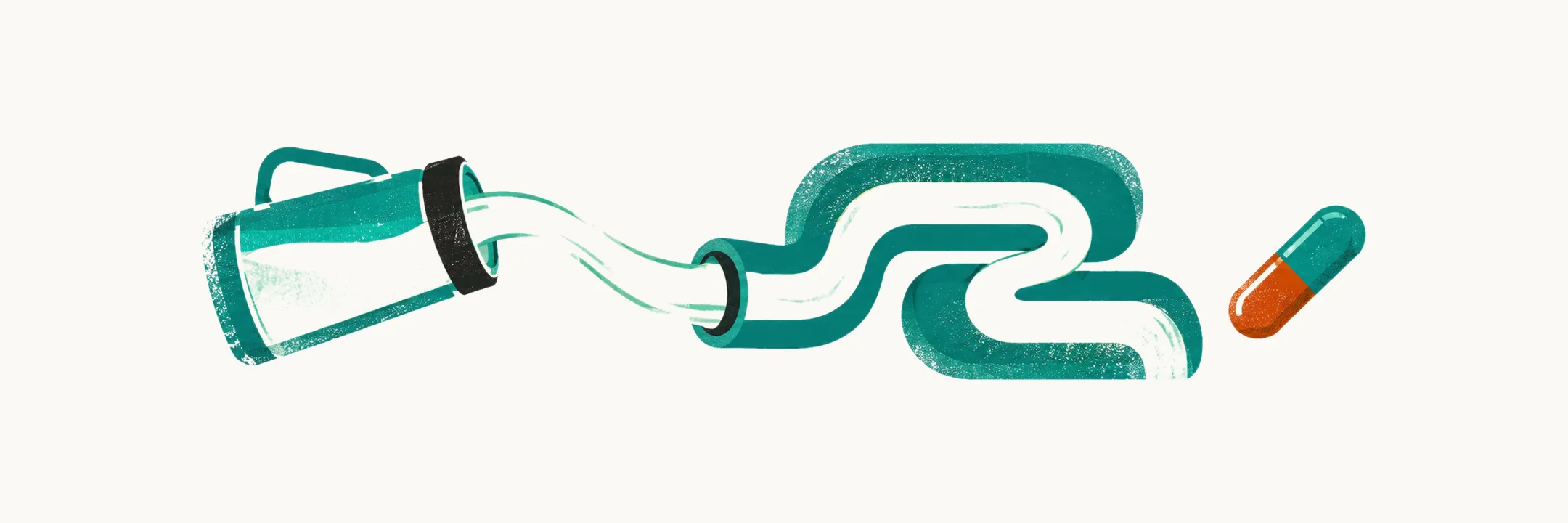
Treatment of acute gastroenteritis in a child has three layers, and they come in order. The first is rehydration, which replaces the water and salts the child has lost, as the Rehydration Management note explains. The second is feeding. The third is drugs, and it is the smallest layer: a drug belongs there only where a specific indication exists, such as a bacterium that the drug treats.
Several of the things people reach for first are the ones the evidence most clearly withholds. Several recommendations run against common instinct, and the note keeps coming back to them. Rehydration comes first, so feeding is the next question.
Where does the advice come from?
The main European guideline is written by ESPGHAN and ESPID, the European paediatric gastroenterology and infectious diseases societies. It grades each recommendation twice: once by its strength, and once by the quality of the evidence behind it. The two grades are separate, so a strong recommendation can rest on low-quality evidence. The rest of the note reports the guideline’s advice, so each grade is worth reading as a pair.
Why should a child keep eating?
Fasting does not rest the gut in any useful way. It also adds nutritional risk without shortening the illness. Feeding restores the gut’s absorptive workload, and the water the bowel does not take back is the water that is lost, as the Pathophysiology note showed. Prolonged fasting adds risk without shortening illness.
When does feeding start again?
If fasting does not help the gut, the question is how soon feeding can restart. Early resumption of feeding is recommended: a strong recommendation, on low-quality evidence. An age-appropriate diet is started during or after the initial rehydration, conventionally at 4 to 6 hours. The instinct to withhold food until the diarrhea stops is the one this advice replaces.
Does breastfeeding stop during diarrhea?
The same food question applies to the youngest children. Breastfeeding continues throughout rehydration and throughout any dietary change. Breast milk carries factors associated with protection against infection, as the Etiology note set out. Interrupting breastfeeding during a diarrheal illness is one of the strongest risk factors for severe dehydration, so the instinct to stop breastfeeding until the diarrhea passes is wrong.
Breast milk contains lactose. The guideline nonetheless recommends continuing regular feeding with no dietary change, including milk.
What about formula, milk and drinks?
Formula does not need to be diluted, and a modified milk formula is usually unnecessary. The BRAT diet (bananas, rice, applesauce, toast) has not been studied and is not recommended.
Beverages with a high sugar content should not be used. Sugar the gut cannot absorb adds to the osmotic load rather than relieving it, as the Rehydration Management note explains. That is why juice, soda or a sports drink is a poor substitute for an oral rehydration solution.
Why does milk sugar matter after diarrhea?
The case for changing milk feeds rests on lactose. Viral enteritis damages the small-bowel mucosa, and the brush-border lactase falls. When the absorbing lining loses its enzymes, the sugar it would have split stays in the lumen and holds water, as the Pathophysiology note showed. The result is an osmotic diarrhea layered on top of the original diarrhea.
What do the lactose-free feed trials show?
The trial evidence points to a benefit of lactose-free feeds, but it is drawn mainly from children in hospital. A Cochrane systematic review found that young children given lactose-free rather than lactose-containing feeds had diarrhea lasting on average about 18 hours shorter. The mean difference was −17.77 hours (95% CI −25.32 to −10.21), from 16 trials and 1467 participants, on low-quality evidence. Treatment failure was roughly halved with lactose-free feeds: RR 0.52 (95% CI 0.39 to 0.68), from 18 trials and 1470 participants, on moderate-quality evidence.
Most of these trials were in inpatients. The two outpatient trials showed no significant effect on duration. So the recommendations are narrower than the mechanism suggests, and they match this split between settings.
Which children should have lactose-free feeds?
The answer depends on the setting. Routine lactose-free feeds are not recommended in the outpatient setting: a strong recommendation, on low-quality evidence. In hospitalized children under 5 years, lactose-free formulas can be considered: a weak recommendation, on low-quality evidence. For diluted lactose-containing milk, there is insufficient evidence either way.
For an older child, a lactose-restricted diet means dropping cow’s milk and dairy. It does not mean dropping the breast.
Why are most children not given antibiotics?
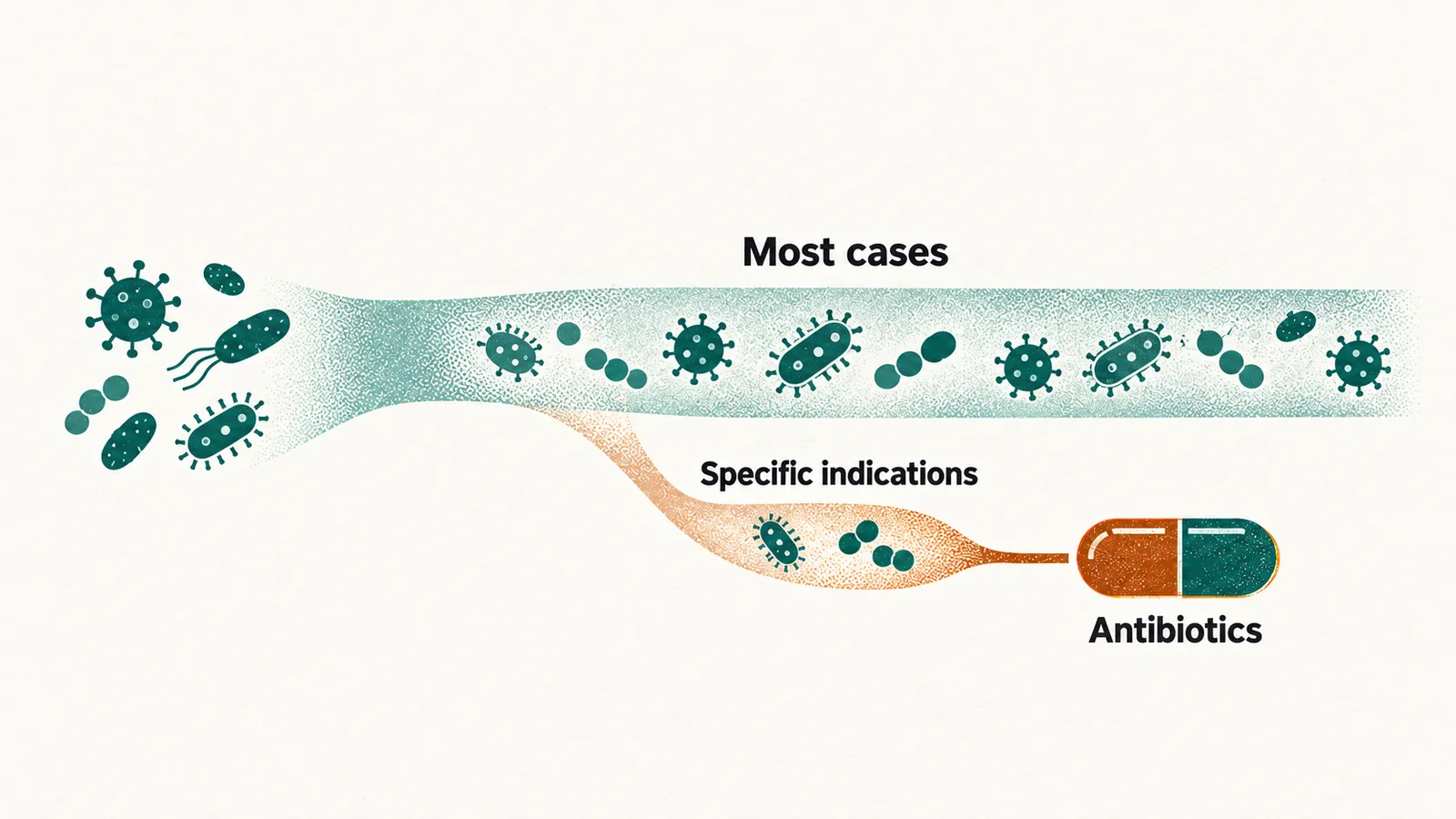
Most gastroenteritis is viral and self-limited, as the Investigations note set out, and most illness is self-limited regardless of the organism. So anti-infective therapy should not be given to the vast majority of otherwise healthy children with acute gastroenteritis, and antibiotic therapy for acute bacterial gastroenteritis is not needed routinely.
The common instinct is an antibiotic just in case. The guideline sets that instinct aside.
Which infections do antibiotics treat?
From the general rule, the next question is which organism earns an antibiotic. Antibiotics for acute bacterial gastroenteritis are given only for specific pathogens or in defined clinical settings.
Shigella and cholera
Shigella and cholera are the clearest cases where the organism is the target, and treatment is recommended for both. Invasion of the lining causes blood and frequent small stools, as the Etiology note set out. Antibiotics are recommended for proven or suspected Shigella. The first-line oral azithromycin course is 5 days: 12 mg/kg on day 1, then 6 mg/kg for 4 days. For cholera, antibiotics are recommended when it is confirmed or suspected by travel history. Secretion driven by a toxin acting on an intact lining is a separate route, as the Pathophysiology note showed.
Campylobacter
For Campylobacter, treatment is recommended mainly in the dysenteric form and to reduce transmission. The antibiotics are most effective when started within 3 days of onset. The drug is azithromycin, chosen against local resistance patterns.
Nontyphoidal Salmonella
Here treatment depends on whether the child is at high risk of bacteremia. In an otherwise healthy child, antibiotics should not be used. They do not improve symptoms or prevent complications, and they prolong faecal excretion.
Children who are immunocompromised, or have an underlying disease such as sickle cell disease, are more likely to have bacteremia. In a high-risk child, antibiotics are suggested to reduce the risk of bacteremia. The high-risk groups are:
- neonates and infants under 3 months
- immune deficiency
- asplenia
- immunosuppression
- inflammatory bowel disease
- achlorhydria
Shiga toxin-producing E. coli
This is a bloody infection where the usual reflex is withheld. Bloody stool ordinarily suggests treatment, but antibiotic therapy is not recommended in Shiga toxin-producing E. coli. The Shiga-like toxin injures the colon, so blood is the expected sign, as the Etiology note set out. Bloody diarrhea with low or no fever is typical of this infection, and antibiotics are not recommended unless the epidemiology suggests shigellosis.
Results conflict on whether treating such gastroenteritis changes the risk of hemolytic uremic syndrome. A proposed explanation for why antibiotics might add to the harm in this infection is set out in the Etiology note. Because the results conflict, the guideline withholds a recommendation on the basis of hemolytic uremic syndrome.
Other watery diarrhea
Watery diarrhea without travel or cholera exposure does not get antibiotics.
When are antibiotics given by vein?
The antibiotic question ends on the route. Parenteral rather than oral antibiotics are recommended in these situations:
- the child cannot take oral medication
- an underlying immune deficiency comes with fever
- severe toxemia or suspected bacteremia
- neonates and young infants under 3 months with fever
Do probiotics help?
Probiotics are live microorganisms given for a health benefit. Selected probiotics can be used in children with acute gastroenteritis as an adjunct to rehydration therapy: a strong recommendation, on moderate-quality evidence. As a group they reduced the duration of diarrhea by approximately one day. They do not substitute for rehydration, because the water the bowel does not take back is still the water that is lost.
Which probiotics work?
Strain matters for how far the evidence applies to a product. The guideline names Lactobacillus rhamnosus GG and Saccharomyces boulardii as probiotics whose use should be considered. Both are strong recommendations with low-quality evidence. Lactobacillus reuteri DSM 17938 has a weak recommendation on very low-quality evidence.
The effect is strain-specific, so efficacy and safety cannot be extrapolated from one probiotic to another. A product without one of the named strains has correspondingly weaker support. Effective strains may also reduce the length of hospital stay in admitted children.
Which drugs reduce the stools?
The probiotics were adjuncts. The next question is which drugs act on the bowel itself. Drugs that aim to reduce stools work in different ways, and the recommendations differ with the mechanism.
Racecadotril
Racecadotril works on secretion, which contrasts it with loperamide. It can be considered in the management of acute gastroenteritis: a weak recommendation, on moderate-quality evidence. It is an antisecretory drug. It inhibits enkephalinases. Enkephalins act on delta receptors and inhibit water and electrolyte secretion into the lumen, so prolonging enkephalin action reduces intestinal secretion.
An individual patient data meta-analysis covered 9 randomized trials in 1348 children. Racecadotril significantly shortened diarrhea compared with placebo, with almost twice as many children recovering at any given time. There was no difference in adverse events.
Loperamide
Loperamide is not recommended in the management of acute gastroenteritis in children: a strong recommendation, on very low-quality evidence. It is a mu-opioid receptor agonist that slows intestinal motility. It is not an enkephalinase inhibitor, and it is not the antisecretory drug this guideline endorses. The instinct to give an antidiarrheal to stop the stools is the one the guideline rejects.
Adsorbents
Diosmectite is an adsorbent. It can be considered: a weak recommendation, on moderate-quality evidence. Combined with L. rhamnosus GG it is no better than the probiotic alone. Other adsorbents, bismuth subsalicylate and antimotility agents are not recommended.
What about zinc and ondansetron?
Zinc and ondansetron are the two further drugs. The guideline’s advice on each depends on setting or on safety questions that remain open.
Zinc
Zinc depends on whether the child is short of it. Zinc plays a role in immune function and in regulating intestinal epithelial cells, and a review describes its effect on the duration of diarrhea. It reduces diarrhea duration in children over 6 months where zinc deficiency is common. Where zinc deficiency is rare, no benefit is expected. The only European randomized trial of zinc found no difference. Routine zinc is not a European recommendation.
Ondansetron
Ondansetron depends on a safety question. It may be effective against vomiting related to acute gastroenteritis. The guideline withholds a final recommendation pending safety clearance in children, because of a warning about severe cardiac effects. No other antiemetic has evidence to support it.
Which complications still happen?
Even when fluids, feeding and drugs are handled well, a minority of children still develop complications. Some come from the fluid loss, some from the organism, and a few from the treatment itself. Which complications still happen when care is right, and which of them settle without treatment?