
Acute diarrhea means looser, more liquid or more frequent stools than usual, for less than 7 days. It is diagnosed from the history and the examination. A child with an uncomplicated illness needs no test.
Which result would change the plan?
Acute diarrhea usually ends by itself, and the child is at risk from the fluid lost. So the useful question about any test is not what could be measured, but which result would change the plan.
A result is worth waiting for in three situations:
- it names an organism that would be treated;
- it gives a sodium concentration that changes the rate of fluid;
- it points to an alternative diagnosis that the illness does not explain.
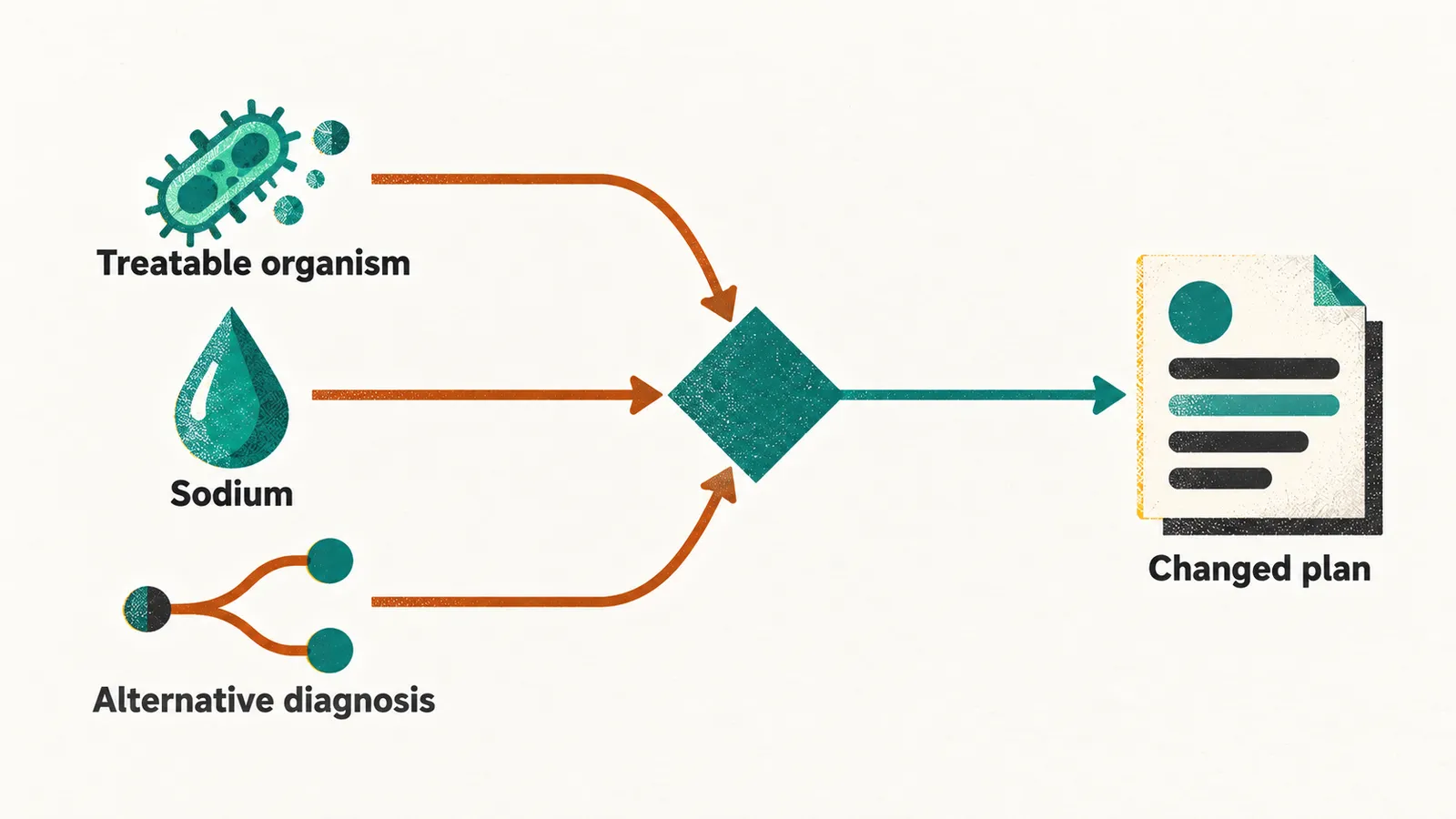
Most results do none of these.
Why do most children need neither a stool test nor an antibiotic?
If a result would not change the plan, the test is not sent. That is why microbiological investigation is not routine. It usually does not change treatment, because most gastroenteritis in an otherwise healthy child is self-limited, whichever organism is responsible. Fluid and feeding are the same whichever germ is involved. As the Etiology and Risk Factors of Acute Diarrhea in Children note says, whatever the organism, the danger to the child is fluid loss.
The same reasoning covers antibiotics. Most cases are self-limited, so an antibiotic has little to act on in most children. The decision to give one rests on the clinical picture. In the bacterial minority an antibiotic either helps or harms, as the Etiology note sets out. Antibiotics are reserved for defined pathogens and defined children, as set out in Refeeding and Drug Therapy in Acute Diarrhea. The distinction between bacterial and viral cause is not pursued with tests because it rarely changes treatment.
When is a stool sample worth sending?
A stool investigation is worth considering when the child is extremely unwell, or when septicemia is suspected. The Etiology note points out that children from the bacterial minority are the ones who become septic. Other situations follow.
Blood or mucus in the stool
A stool investigation is worth considering when there is blood or mucus in the stool, in particular severe bloody diarrhea. Blood in the stool shifts the differential towards an invasive bacterial cause, as the Etiology note explains.
Travel, chronic illness or immune deficiency
It is also worth considering after recent travel to an at-risk area, or when there has been possible exposure to cholera. And it is worth considering in a child with an underlying chronic condition or an immune deficiency, where the pathogen may need specific treatment.
Diarrhea that is not settling, or a doubtful diagnosis
The last situation is diarrhea that has not improved by day 7, or that is uncertain enough for another diagnosis to be under consideration. Here the diagnosis of acute gastroenteritis itself is in doubt. The Etiology note adds that persistent diarrhea from Giardia, Cryptosporidium or enteroaggregative E. coli belongs to a different workup.
Why the organism matters in these cases
In most of these situations, the identity of the organism could change what is done for the child. That is what separates them from the ordinary child, for whom it usually would not.
What changes when the organism is Shiga toxin-producing E. coli?
A result that names the organism can change what is watched for. When Shiga toxin-producing E. coli (STEC) is identified, the child needs monitoring for hemolytic uremic syndrome rather than empirical antibiotics. STEC is the usual cause of hemolytic uremic syndrome, so the result tells the team which child to watch. The Etiology note gives the antibiotic side: antibiotics are not recommended for STEC unless epidemiology suggests shigellosis.
Hemolytic uremic syndrome is a rare complication. It begins with damage to small blood vessels, and the toxin is understood to injure the lining of those vessels. Red cells are torn as they pass through the damaged vessels, and platelets are used up there. So the red cell count and the platelet count fall, and the kidneys are injured. The features to watch for are described in Complications and Outcome of Acute Diarrhea and Dehydration.
Why does a stool sample matter for a group of children?
The same reasoning applies when several children are ill. Outbreak stool sampling is done in a day-care center, school, hospital or residential setting. When one organism is found in several children who share a setting, it points to a shared source. Identifying the organism and the source is what allows the outbreak to be controlled. So the specimen is sent for public health reasons, not for the individual child.
Could inflammatory markers replace the stool test?
The stool test is not replaced by a shortcut, but shortcuts have been tried. Inflammatory markers have been tested as a quick answer to the question of bacterial or viral cause.
CRP and procalcitonin
CRP is not recommended for distinguishing a bacterial from a viral cause. Procalcitonin is not recommended either. Bacterial and viral gastroenteritis have overlapping symptoms, so a blood marker of inflammation has no clean line between them. A raised CRP can be found in bacterial gastroenteritis, and a normal CRP does not exclude it. The result therefore does not settle the question that prompted it. The studies that tested these markers were not of high quality.
Calprotectin and lactoferrin
Fecal calprotectin and lactoferrin are not recommended for this purpose at all. They reflect what goes on in the gut lining, and several different processes there can raise them. They were developed for inflammatory bowel disease and are raised in many conditions, so a raised level cannot name a cause of diarrhea.
When is a blood test worth taking?
Blood tests are reserved for what changes the fluid. Blood chemistry is not part of the routine assessment of gastroenteritis. It is useful in a small number of situations, where a measurement would change the rate, composition or route of fluid therapy. Hyponatremia or hypernatremia alters the rate at which fluid may be given, which is the reason for measuring. Plasma sodium decides whether the deficit is replaced with sodium-poor or sodium-rich fluid, and so how quickly sodium may safely be corrected, as the Pathophysiology of Acute Diarrhea and Dehydration note explains.
When a drip is started
When intravenous fluid is being started, electrolytes are measured in every child on intravenous therapy and during that therapy. The measurements are plasma sodium, potassium, urea, creatinine and glucose.
Who else needs the sodium?
Electrolytes are also measured in all severely dehydrated children. They are measured too in moderately dehydrated children whose history and examination are inconsistent with the severity of the diarrheal illness.
When the child has signs of high sodium
Some features suggest hypernatremia: jittery movements, increased muscle tone, hyperreflexia, convulsions, drowsiness or coma. The Clinical Assessment of Acute Diarrhea and Dehydration note explains why high sodium produces these brain signs. With such features, the sodium measurement is urgent rather than optional, because the sodium decides how fast fluid may be given.
When the child is in shock
When shock is suspected or confirmed, venous acid–base status and chloride are added to the measurements.
Can a test replace the bedside grade?
The test answers a narrow question, and the grade comes from the bedside. In hypernatremic dehydration the usual signs are less prominent, so the degree of dehydration is easily underestimated. A normal serum bicarbonate lowers the likelihood of a deficit above 5%. But no laboratory test so far can estimate the percentage of weight lost in general practice, and a percentage of weight lost needs a reliable pre-illness weight, which is often unknown. None of these measurements replaces the severity grade. Each measurement answers a narrow question and nothing more.
What happens once the result is back?
The sodium concentration decides how fast a deficit may be corrected, and the arithmetic is in Rehydration Management in Acute Diarrhea. Recognising the sodium pattern before the result returns is a clinical skill, taught in the Clinical Assessment note. The decision to escalate care is triggered more often by the child’s appearance and course than by a test, and the criteria are in Admission and Shock Management in Acute Diarrhea. So how do you tell when a child needs admission, and when shock has started?