Fever with rash is one of the most common presentations in paediatric practice. That is why a method is worth having: the six look alike at a glance, so the diagnosis is reached by narrowing.
Why is a febrile rash hard to name?
At a glance the six classic exanthems look broadly similar: an irritable, febrile child covered in red spots. What separates them is the mechanism behind the rash, not appearance alone. So the approach is to narrow the field with history, then read the rash against what remains.
Four axes carry almost all the discriminating information:
- Exposure: known contact, nursery or school outbreak, recent travel, vaccination status. This is answered from history.
- Age: which of the six occurs at this age. This is answered from history.
- Season: whether the time of year fits. This is answered from history.
- Rash characteristics: morphology, distribution, relationship to fever and any enanthem, meaning the same kind of eruption on a mucous membrane. This is answered from examination.
Age and rash characteristics do most of the work. Exposure and season narrow the differential, but neither confirms or excludes anything on its own. History can be taken before the rash is even seen, so it comes first.
What can history remove before the child is examined?
Age is the strongest of the historical axes. A primary infection falls on whoever is not yet immune, so several of the six have a characteristic age band, and age narrows the field before the child is examined.
- Under 3 months: rarely any of the six, because maternal antibody is still protective.
- 6 months to 2 years: roseola infantum (human herpesvirus 6, HHV-6).
- School-age children: scarlet fever (group A Streptococcus) and fifth disease (parvovirus B19).
- Any age, unvaccinated: measles, varicella and rubella. These children are not immune, so the infection can reach them at any age.
The first row has a consequence. A febrile rash under 3 months is a different problem: serious bacterial illness has to be considered before any diagnosis of a viral exanthem, because a viral exanthem is not yet the likely explanation at this age.
Exposure is a question to ask, and the answer shifts probability, but a contact does not confirm a diagnosis and its absence does not exclude one.
Season adds less than age does. Parvovirus B19 infection is more frequent in late winter, spring and early summer. Respiratory-transmitted infections, scarlet fever among them, cluster when children are crowded together indoors. Measles and roseola occur year-round in susceptible populations. Season is therefore the weakest of the four axes: it can narrow the differential, but it should never settle the diagnosis by itself.
How is the rash read at the bedside?
Once history has narrowed the field, the rash narrows it further. Examination reads it in four steps: the type of lesion; where it appears and how it spreads; when it appears relative to the fever; and whether there is an enanthem in the mouth. Each step removes some of the six.
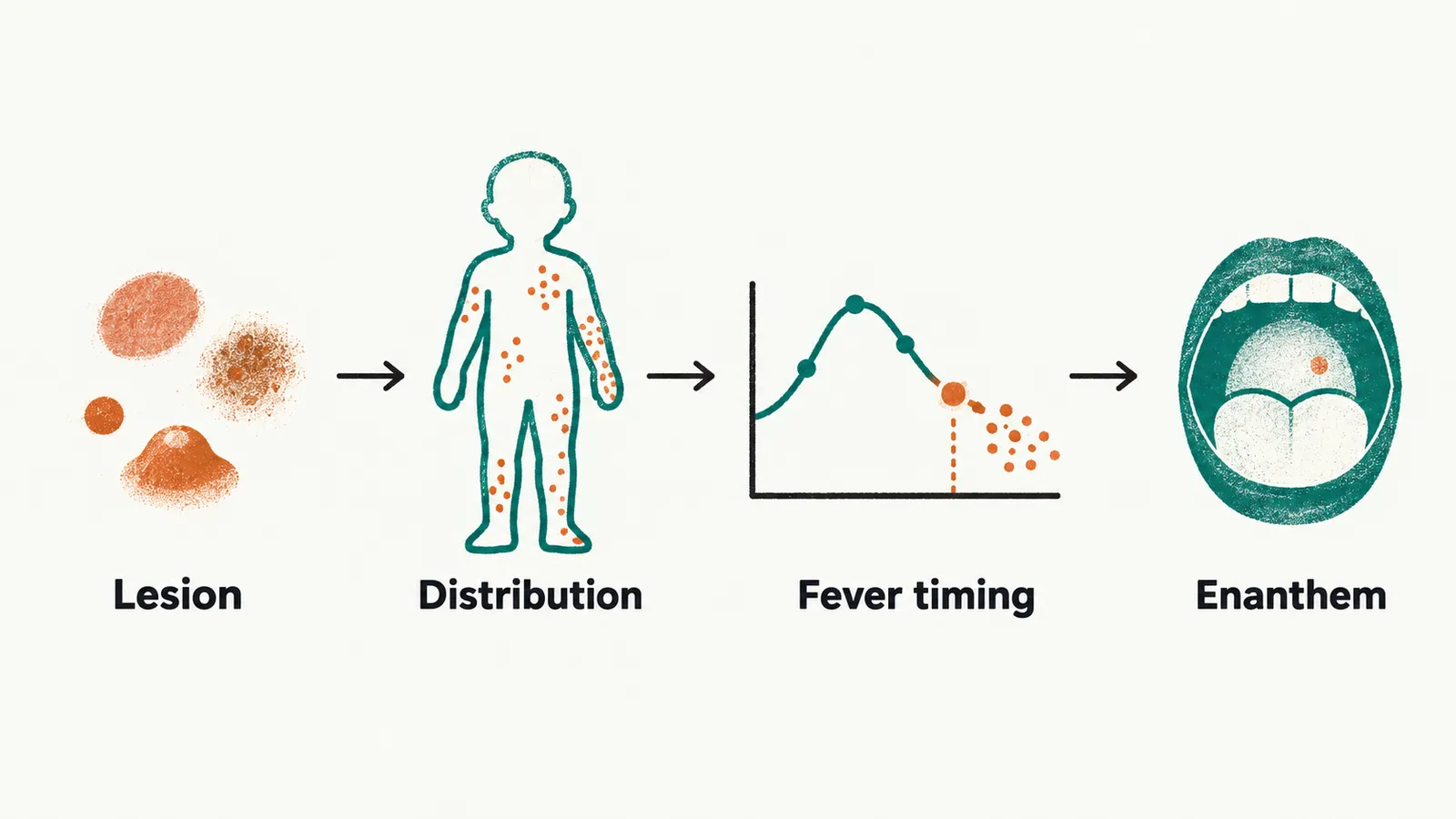
The first step is morphology: is the rash maculopapular or vesicular? Vesicles of clear fluid, above all when present in crops at different stages of evolution, make varicella the working diagnosis. If the lesions are macules and papules, the rest of the assessment decides which of the other five it is.
A haemorrhagic rash, meaning bleeding into the skin, is not the picture of any of the six. It takes the child out of this framework altogether and into the emergency pathway.
The second step is distribution. Each rash spreads over the body in a recognisable pattern, and that pattern is how it is recognised. Three direction words recur: cranio-caudal means from the head downwards, centrifugal means from the trunk outwards to the face and limbs, and centripetal means concentrated on the trunk more than on the limbs.
- Measles: head, then trunk, then limbs (cranio-caudal).
- Scarlet fever: trunk, spreading outwards, accentuated in the flexures, sparing the perioral area.
- Roseola: trunk, then face and limbs (centrifugal).
- Fifth disease: , then a lacy reticulated (net-like) rash on the limbs.
- Varicella: trunk-dominant, centripetal, with lesions at several stages.
- Rubella: face first, fading within about 3 days.
Does the rash come before, during or after the fever?
The same rash reads differently according to when it arrives. In roseola there is fever for several days, then the rash appears as the fever breaks. In measles, scarlet fever and varicella the fever comes first and the rash appears while the fever continues. In most other exanthems the rash and fever appear together, without a preceding febrile phase.
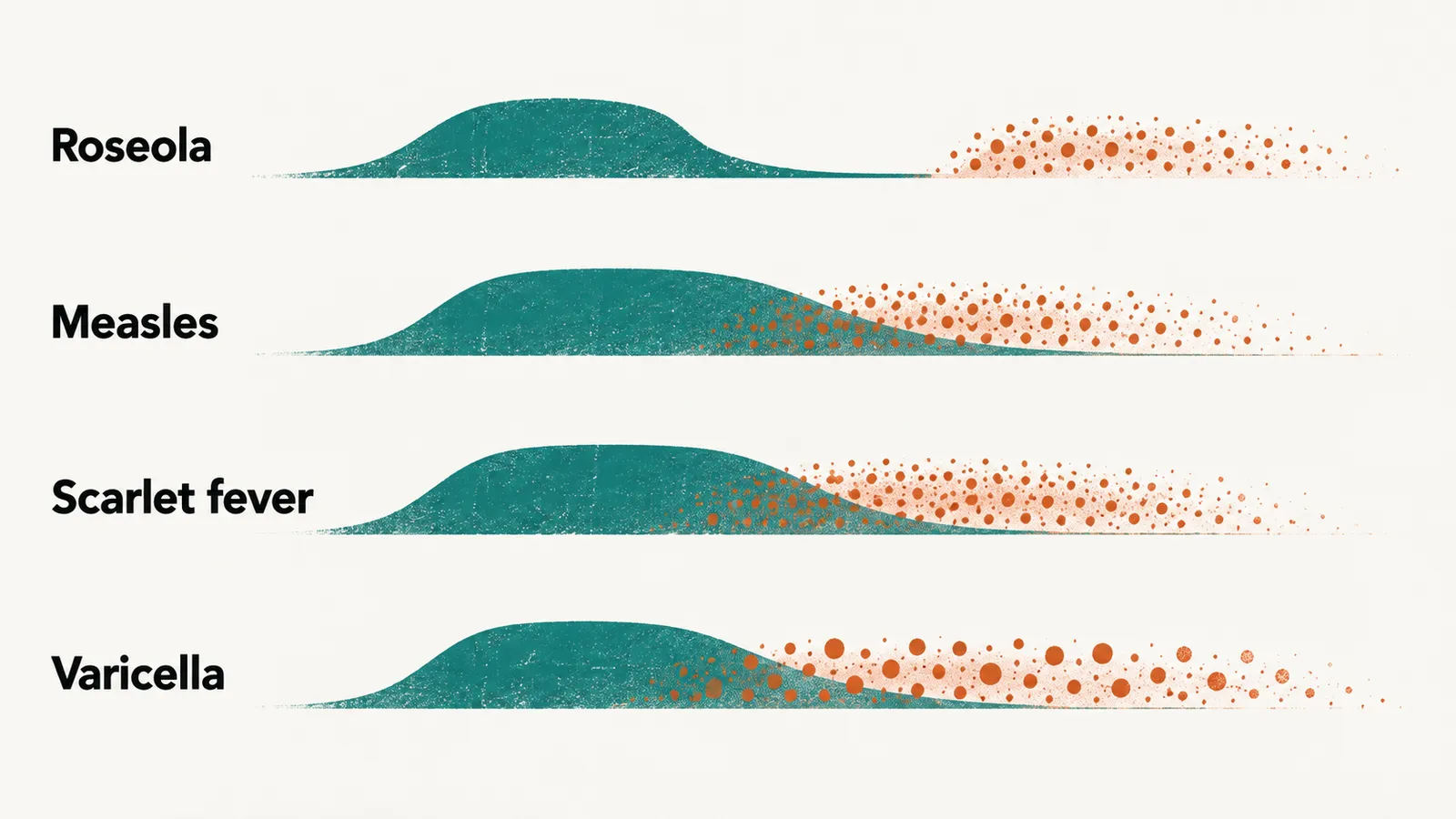
In two diseases the fever has gone by the time the rash appears: fifth disease and rubella show no fever then. In rubella the rash comes with mild or no fever. In fifth disease the child is well and the fever has already resolved, because the fever belongs to the earlier viraemic phase, when virus is circulating in the blood.
For roseola, the viraemia gives the fever. As the antibody response rises the viraemia falls, the fever subsides and the rash appears, which suggests an immune-driven rash rather than a direct viral effect.
What does the mouth show?
After the skin, the mucosa. An enanthem, when present, is the most specific finding, because the lesion on the mucosa is specific to some diseases and so narrows the field more than the skin does.
- Measles: Koplik spots, small white lesions on the buccal mucosa.
- Scarlet fever: strawberry tongue, a white coating with red papillae, later a red tongue with prominent papillae.
- Rubella: palatal petechiae or small red spots.
- Varicella: palatal vesicles.
- Roseola and fifth disease: no enanthem.
Koplik spots are bluish-white spots on a red base. The bluish look is thought to reflect dilated veins around gland ducts and the white part cell destruction. They appear during the prodrome, the symptomatic phase before the rash, and disappear as the rash appears, because the mucosal spots lose their characteristic look as the skin rash progresses. They are therefore visible only in a narrow window.
What do the six look like side by side?
The rash findings gather into one comparison.
| Disease | Pathogen | Rash | Distribution | Enanthem |
|---|---|---|---|---|
| Measles | Measles virus | Maculopapular | Cranio-caudal | Koplik spots |
| Scarlet fever | Group A Streptococcus exotoxin | Maculopapular, sandpaper-like | Trunk and flexures, outwards | Strawberry tongue |
| Rubella | Rubivirus | Maculopapular, faint | Face downwards, lasting about 3 days | Palatal spots |
| Fifth disease | Parvovirus B19 | Maculopapular, slapped cheek then lacy | Cheeks then limbs | None |
| Roseola | HHV-6 | Maculopapular, pink | Trunk then face and limbs | None |
| Varicella | Varicella-zoster virus | Vesicular, in crops | Centripetal, multiple stages | Palatal vesicles |
Once one diagnosis is likely, the practical questions follow: how long the child is contagious, whether the diagnosis needs confirming, what treatment and prevention exist, and which complication to watch for. Infectiousness often precedes the rash, so the child spreads the disease before the diagnostic rash appears and isolating after the rash comes late. IgM marks a recent infection, and RT-PCR detects the virus’s genetic material in a swab or sample.
| Disease | Contagious window | Confirmation | Treatment and prevention | Main complication |
|---|---|---|---|---|
| Measles | About 4 days before to 4 days after rash onset | Clinical suspicion; laboratory confirmation (IgM or RT-PCR) for every suspected case | Supportive, vitamin A; MMR | |
| Scarlet fever | During the acute illness; ends 24-48 hours after starting antibiotics | Rapid antigen test, nucleic acid test or throat culture | Antibiotics; no vaccine | Acute rheumatic fever, glomerulonephritis |
| Rubella | About 7 days before to 7 days after rash | Serology or PCR if needed; the rash is not specific | Supportive; MMR | Maternal-fetal infection (outside this family) |
| Fifth disease | Before the rash, during the viraemic phase | Clinical; serology or PCR if needed | Supportive; no vaccine | , fetal hydrops |
| Roseola | Viraemic phase, before the rash | Clinical | Supportive; no vaccine | Febrile seizures |
| Varicella | 1-2 days before the rash until all lesions have crusted | Clinical | Antivirals in risk groups; varicella or MMRV vaccine | Zoster, later in life |
Roseola, fifth disease and varicella are diagnosed clinically. Roseola is the clearest case, because routine testing is unnecessary with a classic presentation.
When must the framework be dropped, and when is a test needed?
The framework fits only these six, so two situations should interrupt it immediately: a haemorrhagic rash and drug exposure.
A haemorrhagic rash means petechiae that do not blanch, purpura or ecchymoses in a febrile child. It is not the usual presentation of any of these six. Meningococcal and other invasive bacterial disease, severe measles, haemorrhagic fevers and coagulopathy belong at the top of the list, so the child needs urgent assessment and treatment rather than diagnostic refinement.
Drug exposure in the preceding days or weeks is the second interrupting situation, because many maculopapular eruptions are drug reactions. A history of atopy with intense pruritus and rapid improvement when the trigger is withdrawn points to a drug reaction.
When the framework does apply, it also tells the clinician whether a test is needed. A well-appearing child with a characteristic rash and matching age and exposure history does not need laboratory confirmation. A child who is unwell, or whose rash does not fit any pattern, does need laboratory confirmation.
Confirming the diagnosis settles the label, but the label does not show how severe each disease can be. Why does measles, which looks like the most ordinary of these, behave so differently?