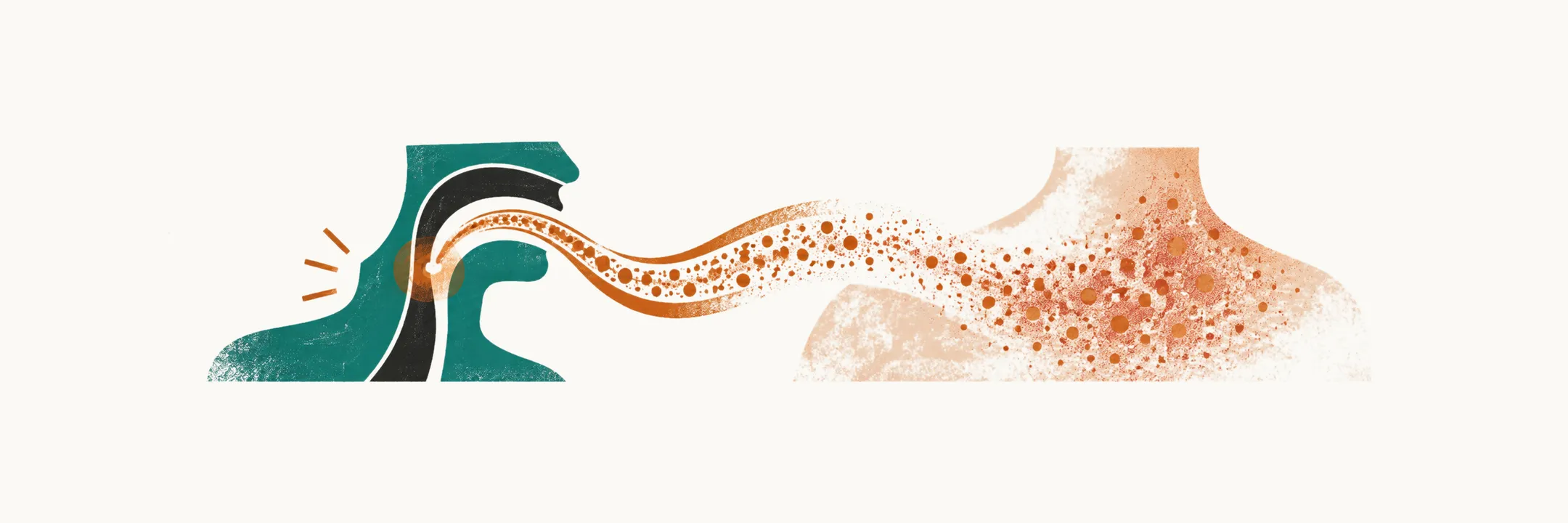
What is scarlet fever, and why does the rash come after the sore throat?
Of the six classic childhood exanthems, scarlet fever is the only one that is bacterial. It is also the only one confirmed with a swab, and the only one for which treatment is not optional. Its most important late complication is acute rheumatic fever, and that complication is prevented by treatment given in the right window. So the diagnosis matters more than the discomfort of the illness itself.
The cause is Streptococcus pyogenes (group A Streptococcus, GAS). The bacteria are in the pharynx, sometimes in a wound or the skin. They do not cause the rash by invading the skin. The rash needs an infecting strain that produces a pyrogenic exotoxin, also called erythrogenic toxin. The toxins of this organism act as superantigens, potent T-cell activators, and are responsible for the erythematous rash and the strawberry tongue. This is why only toxin-producing strains matter here.
The exanthem is a delayed-type immune reaction to the circulating toxin. The bacteria stay in the throat while the toxin travels in the blood, so the infection and the rash are in different places. That is consistent with the rash appearing a day or more after the sore throat.
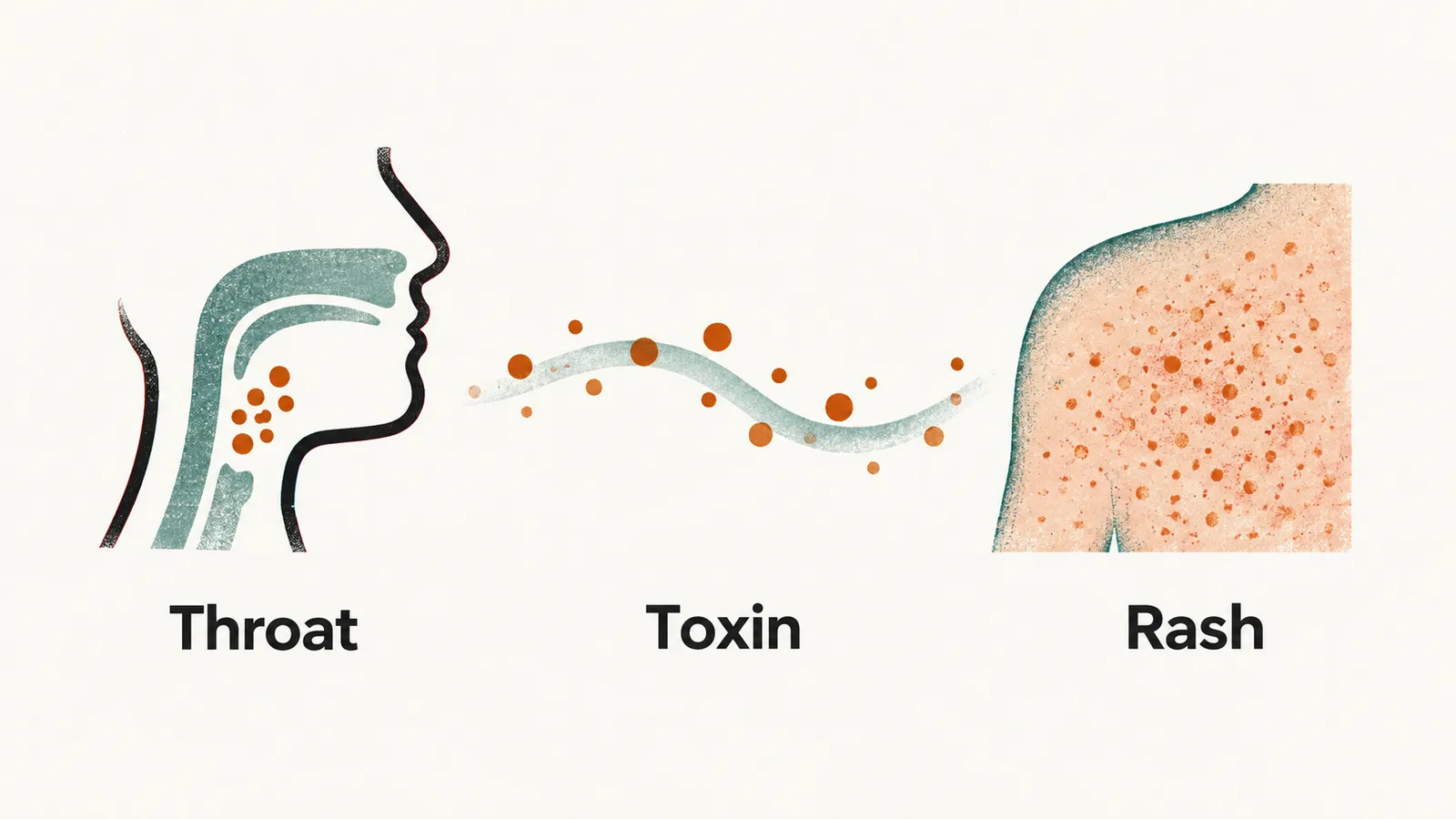
The same reasoning explains a puzzle. Two children infected with the same strain may develop pharyngitis alone or pharyngitis with the rash. The difference lies in the immune response to the toxin, not in the severity of the infection. Scarlet fever is therefore not a more dangerous infection than streptococcal pharyngitis in itself.
Who gets it, and how does it spread?
A throat infection spreads wherever children are together. Scarlet fever is spread by respiratory droplets, and close contact with a person who has scarlet fever or another group A streptococcal infection is the strongest risk factor. Crowded settings amplify transmission: schools, childcare centres, shelters and military facilities. In temperate climates incidence rises when children spend more time indoors together.
It is most common in children aged 5-15 years and uncommon below 3 years. The high rate in school-age children fits the school setting, where transmission is higher. The incubation period after exposure is approximately 2-5 days.
What does the illness look like?
The throat comes first, then the tongue gives the first clue, then the rash.
The illness usually opens as pharyngitis with abrupt fever and sore throat. The pharynx is hyperaemic, and the tonsils may carry a white-yellow exudate. The cervical lymph nodes are tender. Headache, vomiting and abdominal pain are common in children, and the abdominal pain can be prominent enough to raise other diagnoses.
The tongue is the most useful early finding, because it can be seen before the rash. The tongue is an enanthem, the same eruption as the skin rash but on a mucous membrane. It begins coated white with swollen red papillae showing through: the “white strawberry”. After the coating desquamates, the tongue is red with prominent papillae: the “strawberry tongue”.
The rash appears around the time the coating clears. It is erythematous and blanching, which fits dilated skin vessels. It is sandpaper-like to the touch and made of small papules roughly 1-2 mm across. It characteristically begins on the trunk and spreads outwards to the limbs. It is accentuated in the skin creases: the inguinal, axillary, antecubital and abdominal folds (groin, armpit, front of elbow, abdomen). It is traditionally described as beginning in the groin and pubic area (the “underpants” distribution). The palms and soles are usually spared. The area around the mouth is also spared, so it stands out as circumoral pallor against flushed cheeks. The rash persists about a week and is followed by desquamation, sometimes with lamellar peeling of hands and feet.
Four signs are worth recognising by name:
| Sign | What it is |
|---|---|
| Strawberry tongue | White coating with red papillae, later a red tongue with prominent papillae |
| Pastia’s lines | Accentuation of the rash in the flexural creases, sometimes with petechiae |
| Circumoral pallor | A pale ring around the mouth against flushed cheeks |
| Sandpaper texture | Fine, rough papular feel to the blanching erythema |
Some teaching sources also describe a yellowish tinge to the blanched imprint after pressing the rash, the “yellow hand sign”. It is attributed to capillary fragility. It is a described teaching sign rather than a validated discriminator, so it should not be relied on by itself.
How is it confirmed?
There is no organism in the skin to find, so the test is on the throat. Scarlet fever is confirmed by demonstrating group A Streptococcus: a rapid antigen detection test, a nucleic acid amplification test, or a throat culture. The rapid antigen test is less sensitive than the others, so it misses some infections.
Age sets the follow-up. Children over 3 years have the highest rates of scarlet fever and the highest risk of acute rheumatic fever after untreated infection. In children over 3 years, a negative rapid test should therefore be followed by a throat culture.
Some laboratory findings support the diagnosis without confirming it: neutrophilic leucocytosis and a raised ESR. The ASO titre is the level of antibody against a streptococcal toxin. Antibodies take time to appear, and the titre rises over the following 2-3 weeks, so it is useful only retrospectively.
Why does treatment last ten days?
Antibiotics have two jobs. The first is to treat the pharyngitis, which can be seen. The second, and the more important, is to prevent acute rheumatic fever, which cannot be seen, and that job sets the length of the course. Penicillin or amoxicillin is the antibiotic of choice, and group A Streptococcus has never been reported to be resistant to penicillin.
| Drug | Regimen |
|---|---|
| Penicillin V, oral | Children 250 mg two or three times daily, 10 days |
| Amoxicillin, oral | 50 mg/kg once daily (maximum 1,000 mg), or 25 mg/kg twice daily, 10 days |
| Benzathine penicillin G, intramuscular | 600,000 units if under 27 kg; 1,200,000 units if 27 kg or more; single dose |
Symptoms usually settle within 2-3 days, but the course is not shortened for that reason. The full 10 days is what prevents acute rheumatic fever. Treatment started more than about 10 days after symptom onset still treats the pharyngitis but no longer prevents the rheumatic complication.
For the penicillin-allergic child the alternatives are:
- cephalexin
- cefadroxil
- clindamycin
- azithromycin
- clarithromycin
Cephalexin and cefadroxil should be avoided in immediate-type penicillin hypersensitivity. Resistance to macrolides and clindamycin occurs and varies geographically, so the choice is better guided by local susceptibility data than by convenience.
How long is a child contagious, and what are the public-health rules?
Treatment also ends the child’s contagiousness. A child with scarlet fever is contagious during the acute illness, until 24-48 hours after antibiotics are started. That is why exclusion is tied to antibiotics: children should be excluded from school or childcare until they have taken appropriate antibiotics for at least 24 hours.
Scarlet fever is a notifiable disease in several European countries. Post-exposure prophylaxis is not routinely recommended for household contacts.
What can go wrong, and why weeks later?
Treatment is meant to stop the second group of complications before it begins. The complications divide into those caused by spread of the infection and those caused by the immune response to it.
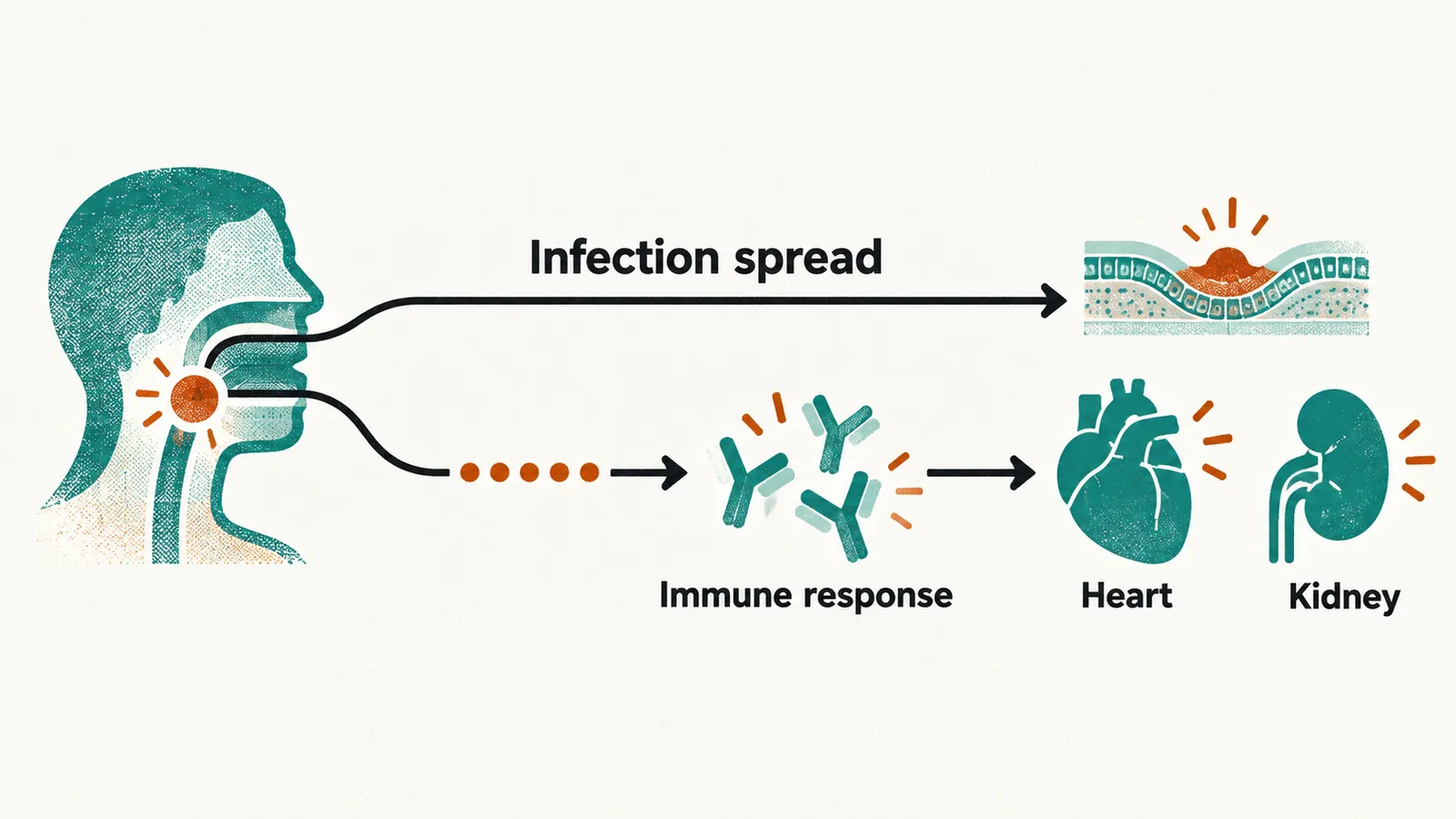
The first group is suppurative, following local or haematogenous spread of the infection. It includes:
- cervical lymphadenitis
- peritonsillar and retropharyngeal abscess
- otitis media
- invasive group A streptococcal disease with sepsis, cellulitis, pneumonia, septic arthritis or osteomyelitis
The immune-mediated complications appear weeks after the acute illness, because they come from the immune response and not from bacteria in the affected organ. Acute rheumatic fever is the most important of them, and it is the one the ten-day course prevents. It typically appears about 1-5 weeks after the preceding pharyngitis or skin infection. It is still a leading cause of acquired cardiac valve disease where access to antibiotics is limited.
Post-streptococcal glomerulonephritis appears about 10 days after pharyngitis, or up to 3 weeks after a skin infection. It is more often associated with skin infection than with pharyngitis.
PANDAS, the paediatric autoimmune neuropsychiatric disorders associated with streptococcal infections, is the obsessive-compulsive-disorder (OCD) and tic-spectrum presentation described after streptococcal infection. The entity remains debated, and its evidence base is weaker than for the other two.
What links these complications is molecular mimicry. Streptococcal antigens share epitopes with human cardiac, renal and neurological tissue. Antibodies raised against the bacterium therefore cross-react with host tissue. The infection is dealt with quickly, but the immune response can turn on the host weeks later.
What about a rash too faint to name at the bedside, whose importance lies in who is not immune?