Fifth disease, or erythema infectiosum, is a classic exanthem whose sharpest clinical consequences lie outside childhood. The reason is a single feature of the virus: parvovirus B19 stops red cell production. The people who depend on a high rate of red cell production notice it most.
What does the virus do, and why is it usually harmless?
Parvovirus B19 is a small DNA virus of the family Parvoviridae, the smallest DNA virus known to infect humans. A genome that small does not carry enough genes to direct its own replication, so the virus relies on dividing host cells. Its tropism is unusually narrow: it infects erythroid precursors in the bone marrow, the cells that mature into red cells. It needs a receptor on their surface, and the same receptor may also be found on a few other cell types, which is why the picture is narrow rather than exclusive.
The virus targets above all proerythroblasts, an early stage of maturation. The affected proerythroblasts become enlarged and die, so erythropoiesis arrests at that stage and the later stages of red cell maturation do not happen.
What this costs the person depends on how much they depend on ongoing red cell production. A normal red cell lives long enough that a pause in production does not empty the circulation. Healthy children compensate through marrow reserve and have no haematological problem; the visible illness is the rash. So who cannot wait out the pause?
Who cannot wait?
The arrest of production is the same in everyone. What differs is how fast red cells have to be replaced.
People with chronic haemolysis (sickle cell disease, hereditary spherocytosis, thalassaemia) rely on continuously high reticulocyte output; reticulocytes are young red cells that the marrow releases. Their red cells live much shorter lives, so when the marrow stops releasing reticulocytes, the loss of red cells in the circulation is rapid. The result is , with rapidly worsening anaemia.
Fetuses are in a similar position. They have a short red cell lifespan and limited reserve, and fetal erythropoiesis is shut down effectively. Severe fetal anaemia can progress to high-output cardiac failure and hydrops fetalis, an abnormal accumulation of fluid in the fetus. The fetus also cannot mount an adequate immune response, which fits with infection persisting there.
Two mechanisms therefore decide who develops a complication: the arrest of red cell production, which matters in proportion to the person’s dependence on it, and the immune response, which produces joint symptoms.
| Group | Complication | Mechanism |
|---|---|---|
| Healthy children | No complication in most cases; occasional transient arthralgia | Immune response |
| Healthy adults, more often women | Polyarthropathy syndrome | Immune response |
| Chronic haemolytic anaemia | Transient aplastic crisis | Arrest of red cell production |
| Pregnancy | Fetal anaemia and hydrops fetalis | Arrest of red cell production in the fetus |
| Immunocompromised | Chronic anaemia, pure red cell aplasia (failure of red cell production alone) | Arrest of red cell production that persists, because the person cannot clear the virus |
At the bedside, a child with chronic haemolysis normally maintains a high reticulocyte count, and parvovirus B19 removes it. Over 5-10 days the child develops pallor, weakness and lethargy with severe anaemia. The blood film shows severe anaemia with no reticulocyte response, the paradox that defines the condition: the normal answer to anaemia is more reticulocytes, but the precursors that would make them are gone.
Aplastic crisis is usually self-limited over 1-2 weeks, as the marrow recovers, but transfusion is often required until it does. In most immunocompetent people aplastic crisis happens only once, because immunity afterwards is protective.
Most children have none of these problems and show only a rash. Why does that rash come at the end of the illness rather than the start?
Why is the rash the end of the illness, not the start?
The illness is biphasic, and the two phases are separated in time because two different things are happening, each with its own clinical meaning: virus in the blood first, then the immune response.
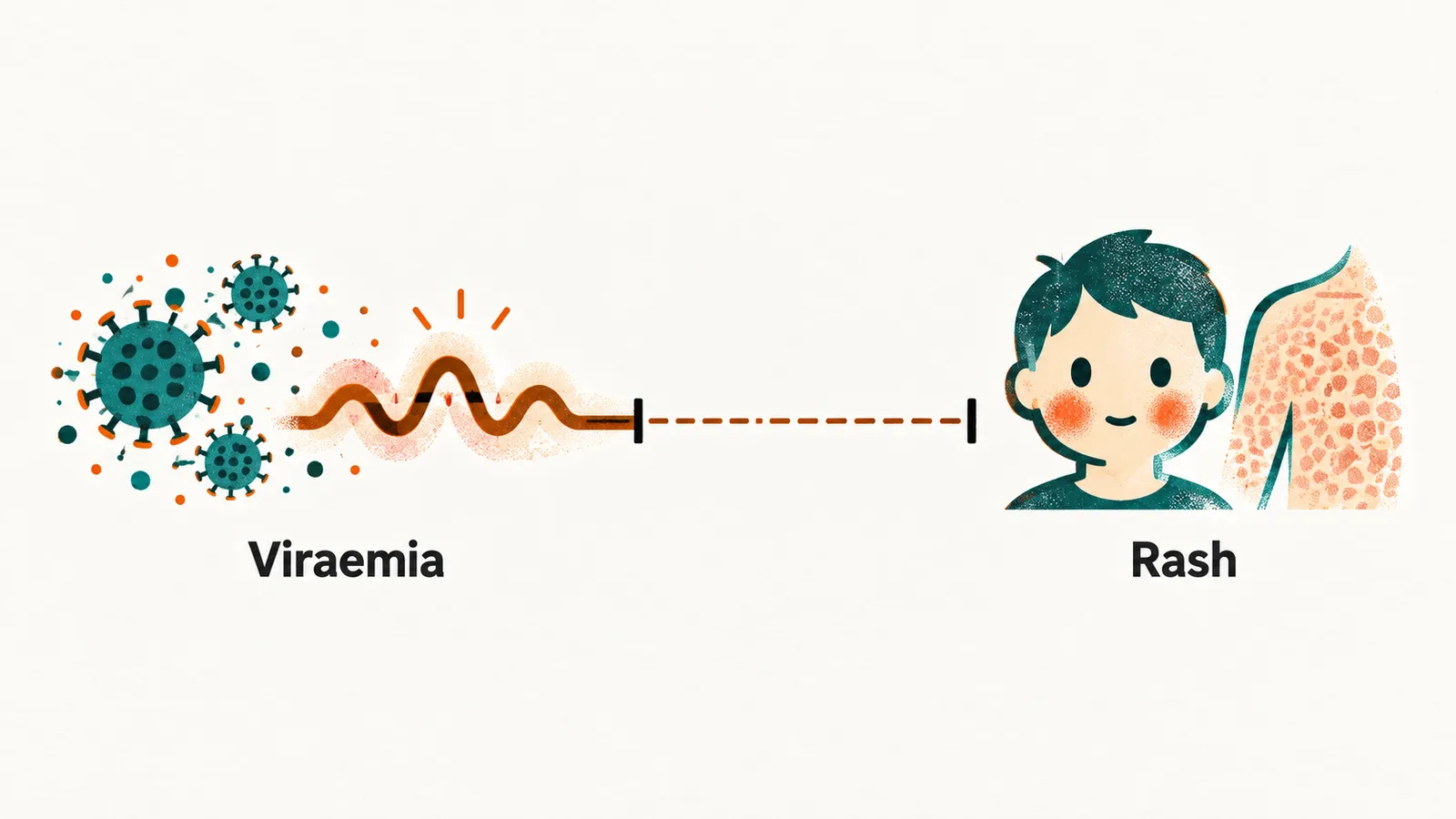
The first phase begins about a week after inoculation, with intense viraemia (virus circulating in the blood). The child has a non-specific flu-like illness: fever, malaise, headache and myalgia. The haematological changes of this phase are reticulocytopenia and a fall in haemoglobin, which are the production arrest described above, and sometimes leucopenia or thrombocytopenia. This is the contagious phase, spread by respiratory droplets. The child looks like any child with a flu-like illness, so the child is shedding virus before anyone knows what the illness is.
The second phase follows roughly a week later. The rash is thought to be immunologically mediated, with immune-complex deposition rather than viral invasion of the skin. It appears as the viraemia resolves. So by the rash phase the child is afebrile, well and no longer infectious.
This explains why fifth disease is usually over by the time it is diagnosed. The child is well, afebrile and no longer contagious when the rash appears, and the people who were exposed were exposed during the week beforehand. The name comes from the historical numbering of the classic exanthems: fifth, after measles, scarlet fever, rubella and the now-discarded Duke’s disease. The synonym erythema infectiosum is more descriptive, but the numbering survived in clinical use and in the name of the illness.
What does the rash look like when it does arrive?
What does the rash look like?
The slapped cheek is an erythematous, well-demarcated, non-painful malar rash over the cheekbones. It often spares the area around the mouth. It is the diagnostic feature.
A second rash follows on the trunk and limbs: macular, with a lacy, reticular pattern. It is often more prominent on the extensor surfaces, spares the palms and soles, and is often itchy. The rash can fade and reappear over weeks. Recurrence is provoked by sunlight, heat, exercise or emotion. This behaviour is characteristic and a useful diagnostic pointer. There is no enanthem and no desquamation.
In adults, particularly women, the second phase may be dominated by joints rather than skin. This fits the second phase being the immune response, which produces the joint symptoms and is thought to produce the rash. The picture is a symmetric small-joint polyarthropathy of the hands, feet and knees, lasting 1-3 weeks and occasionally months.
The slapped-cheek distribution can resemble the malar rash of systemic lupus erythematosus. Age, absence of scaling and absence of systemic features such as serositis or renal disease separate them.
The rash comes late, but the virus has been spreading since the first phase. Why does a pregnant household contact matter?
Why does a pregnant household contact matter?
A pregnant woman is the person in the household who carries the one who cannot wait. The virus can reach the fetus across the placenta, with vertical transmission in approximately 17-33% of maternal infections. The risk of transmission and of severe fetal effects is highest in mid-pregnancy. The fetus cannot mount the reticulocyte response that protects the child, so severe fetal anaemia leads to the high-output cardiac failure and hydrops described above.
When fetal anaemia or hydrops develops, intrauterine transfusion substantially improves survival, with reported survival of 67-84% with transfusion against 30-50% without. The transfusion treats the anaemia, which is the problem that has to be corrected.
The timing is the trap. The diagnosis is worth making in a household with a pregnant woman even though the child needs nothing. A pregnant woman whose child is in the febrile, flu-like phase is exposed at the point of maximum contagiousness. By the time the child has slapped cheeks, the window for her has usually closed. So her assessment belongs to the febrile phase, not the rash.
When does anyone actually need a test, and what is done?
When is a test needed, and what is done?
A healthy child with a textbook slapped-cheek rash and lacy eruption needs no test, because a result would change nothing. Confirmation matters in aplastic crisis, in immunocompromised patients, in pregnancy and in fetal samples, where it affects care.
- Parvovirus B19-specific IgM measures recent infection.
- Parvovirus B19-specific IgG measures past infection or immunity.
- PCR can detect viral DNA, finding the virus itself.
- Immunohistochemistry can identify viral antigen in fetal or placental tissue.
There is no specific antiviral. Healthy children need no treatment, no isolation and no exclusion from school, because they are no longer infectious once the rash is visible. For the cases that do need treatment, the therapy replaces what the virus took or supplies what the host cannot make: transfusion is used for severe aplastic crisis, intrauterine transfusion for fetal hydrops, and intravenous immunoglobulin for chronic parvovirus B19 infection in immunocompromised patients.
What if the rash arrives only after the fever has gone, in an infant who looked well throughout? Roseola Infantum is that illness.