Roseola infantum, also called sixth disease or exanthem subitum, is a fever lasting several days in an infant who still looks well, followed by a rash as the fever breaks. It is the most recognisable of the six classic exanthems and the mildest. The fever is frightening, but the illness is not.
Why does the rash come last?
Human herpesvirus 6 (HHV-6), a herpesvirus most children meet once in infancy, spreads in the blood after the first contact. This viraemic stage is the fever. As the antibody response rises, the virus in the blood falls, the fever stops and the rash appears. That sequence suggests the rash reflects the immune response rather than the virus acting on the skin. The illness therefore follows two distinct steps: fever first, then rash.
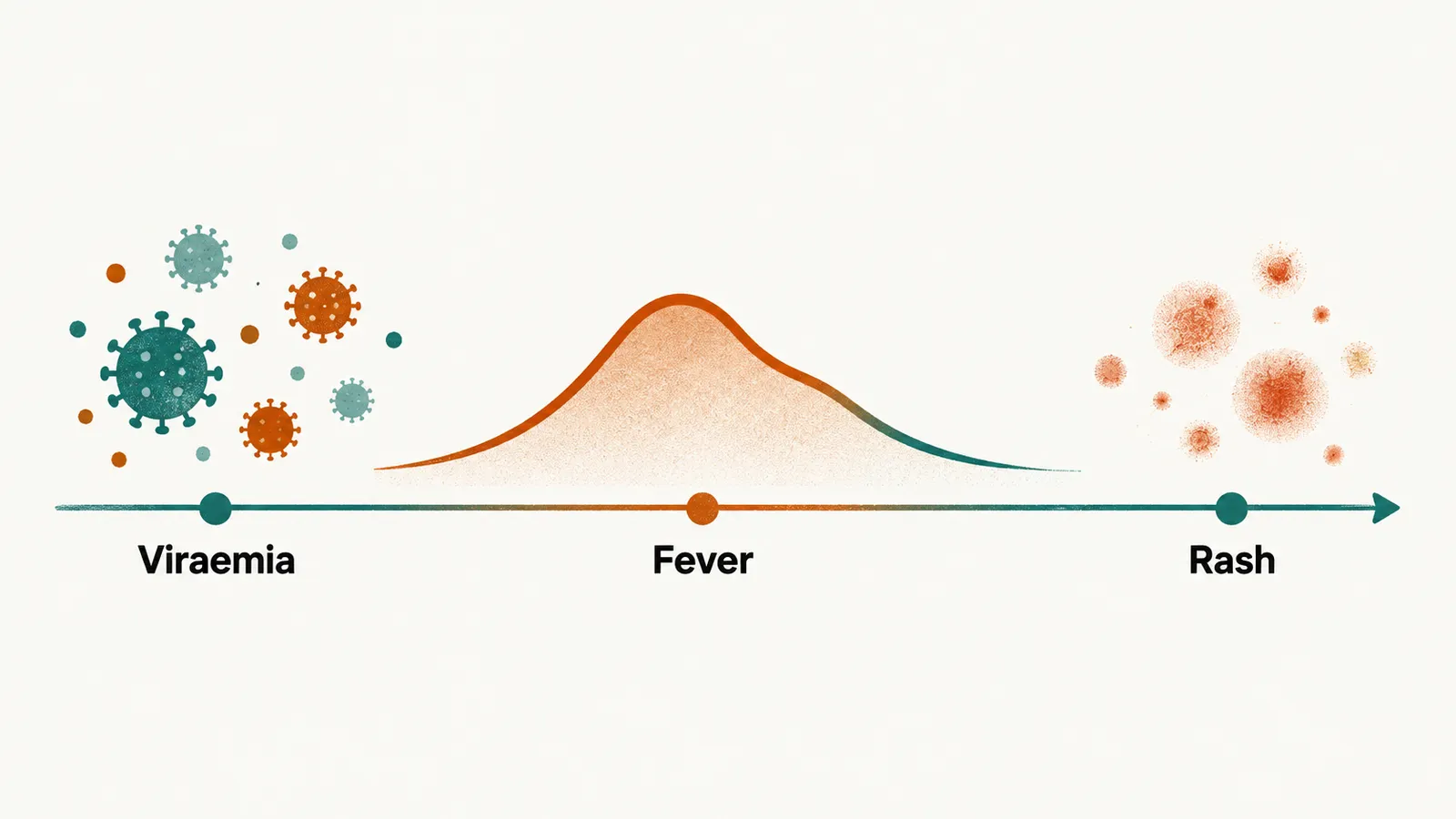
The timing is the diagnostic feature. A rash that appears at defervescence (the fall of the fever), rather than during the fever, belongs to this late, immune phase, so it cannot appear while the fever is running. Recognising the pattern avoids a sequence of investigations for a febrile infant who does not need them. The Diagnostic Framework for Childhood Exanthems gives the general rule that links the timing of a rash to the fever.
Which virus, and why does it matter that it stays?
HHV-6 is a double-stranded DNA virus of the Herpesviridae family, and the cause of roseola is predominantly the HHV-6B variant. The name sixth disease comes from the historical numbering of the classic childhood exanthems, in which roseola was the sixth. HHV-6 also happens to be the sixth human herpesvirus identified, but that is a coincidence, not the origin of the name.
Herpesviruses are not cleared after the first infection. Like the others, HHV-6 establishes lifelong latency and persists in a dormant state. Roseola is the illness of the primary infection. Reactivation matters only in immunocompromised hosts, because it is weakened immunity that lets a dormant virus return.
Who gets it, and how does it spread?
First infection falls where immunity is absent. Primary infection is most common between 6 months and 2 years, and most children have been infected by age 2. Cases under 3 months are rare because maternal antibody is still present, as the diagnostic framework explains. Cases after 3-4 years are uncommon because the child has already seroconverted (developed antibodies from an earlier infection). The age band likely reflects waning maternal antibody and increasing social exposure.
Transmission is respiratory, via droplets and saliva. Most cases are sporadic, without an identified exposure. This fits a virus that can be shed in saliva by people who are well, so the source is usually not known. There is no strong seasonality. The incubation period is roughly 5-15 days.
What does the fever stage look like?
The viraemic phase gives a high fever that is out of step with how the child looks. It begins suddenly, often at 39-40 °C, and lasts 3-5 days. The striking feature is the mismatch between the height of the fever and the child’s other symptoms, because the illness has no localising symptoms or signs. The other findings are mild and non-specific, and the examination is otherwise unremarkable:
- mildly injected pharynx
- mild coryza
- irritability and poor sleep
- sometimes diarrhoea
- enlarged laterocervical or occipital lymph nodes
The fever may respond poorly to antipyretics. This poor response is often what brings the family to medical attention.
What does the rash look like?
When the fever falls, the rash begins. It is erythematous, blanching, and macular or maculopapular. It is pink and non-pruritic. It begins on the trunk and neck and spreads to the face and limbs. It lasts hours to a couple of days and fades without desquamation or pigmentation.
The diagnostic step arrives only after the illness has begun to resolve. By the time the rash identifies roseola, the frightening part is over.
What can the fever do?
The fever, not the rash, carries the main complication. Febrile seizure is the main complication of the illness, and about 10-15% of children with primary HHV-6B infection develop one. These seizures occur predominantly between 6 and 18 months of age.
The mechanism is thought to be the immature brain’s response to a rapid rise in temperature, rather than direct invasion of the CNS. Seizures arise from an imbalance between excitation and inhibition in neurons, and the threshold is lower in younger children; a rise in temperature has been suggested to increase neuronal firing. The exact pathophysiology of febrile seizures is unknown, and other mechanisms, such as changes in the blood-brain barrier, have also been linked to seizures in infected infants.
The seizures are usually simple febrile seizures: generalised rather than focal, lasting a couple of minutes, and not followed by persistent neurological findings. A well-appearing infant with a brief generalised seizure and a fever with a recognisable source does not need a lumbar puncture or empirical antibiotics, because the seizure has an explanation and the child is well. The assessment follows the usual approach to febrile seizures.
The picture changes if the child is unwell, drowsy, or has focal signs or a prolonged seizure. Then the seizure is no longer the simple type, and the usual concerns about meningitis and encephalitis take priority. In that case the roseola pattern should not be assumed.
How is it diagnosed, and what is done?
Because the rash appears only as the illness ends, the diagnosis can be made at the bedside. Diagnosis is clinical: fever followed by a rash at defervescence, in an infant aged 6 months to 2 years, is sufficient. There is no role for serology, viral culture or swabs in an immunocompetent child, since the result would not change management. Blood tests are usually not indicated.
When blood is taken for other reasons, incidental findings may include neutropenia, thrombocytopenia, raised transaminases and cholestasis (impaired bile flow). These findings reflect the viraemia. HHV-6 replicates in white cells, which is consistent with the neutropenia. They are not by themselves an indication for treatment or investigation.
Management is supportive: antipyretics for comfort, and fluids. The disease is self-limited, and there is no specific therapy for roseola in a healthy child, and none is needed.
What changes when the child is immunocompromised?
In immunocompromised patients the picture is different. Immunity is what keeps HHV-6 dormant, so when it is weakened the virus can reactivate. After haematopoietic stem cell transplantation, HHV-6 reactivation can cause encephalitis and other end-organ disease. Antiviral treatment such as ganciclovir or foscarnet is sometimes used in that setting. That is a different clinical problem from roseola in an infant, and it belongs with the management of the immunocompromised host.
Roseola ends quietly with a rash of pink spots, yet another herpesvirus of childhood announces itself with fluid-filled blisters and also persists for life. What does that rash mean, and who then needs an antiviral? That is the question of Varicella.