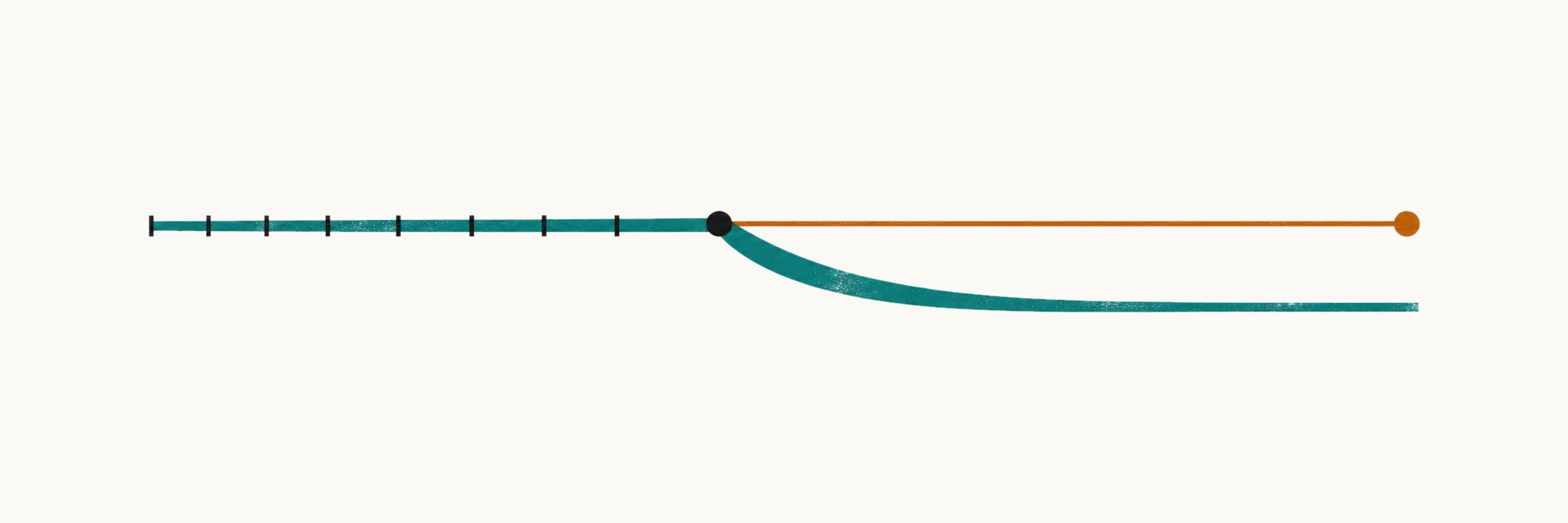
A preterm infant is born before 37 completed weeks of gestation. WHO defines preterm birth the same way.
A baby stays in the womb for a set time, and in that time its organs are built and tuned. The placenta does the work of breathing, feeding and keeping warm while the building goes on. Birth ends that work at once, so the baby must finish the building outside the womb. Gestational age counts how far the building had got when the birth happened. That is why it is the clearest single signal of how much development birth interrupted. The lungs, brain, gut, respiratory control centers, skin and cardiovascular transition each build over the whole pregnancy, so the week of birth shows how far every one of them had come before the placenta stopped supporting the infant.
Why does the week of birth tell more than the weight?
The week tells how far the organs got, so the next question is whether weight could tell it instead. Birth weight modifies risk, but it does not replace gestational age. Weight reflects size and growth, while gestational age reflects how far the organs have matured, so each measure answers a different question. A term infant and a very preterm infant of the same weight do not have the same organ maturity, because weight does not show maturity.
When birth weight is low for gestational age, a growth problem is added on top of the maturity problem. Both the maturity problem and the growth problem must be read from the chart.
How steep is the risk from one week to the next?
Weight does not answer that, so the risk must follow the week. Mortality and both acute and chronic morbidity rise as gestational age falls. Birth ends the pregnancy earlier in the build, so each week lost leaves the organs less ready. Each additional week of gestation adds substantially to organ maturity, and the gain per week is largest at the earliest gestations.
The gradient is therefore steepest near the limit of viability. There the organs are least ready, so each extra week gains the most maturity. Near the limit of viability, survival and neurodevelopmental outcome depend heavily on whether active intensive care was offered and on the quality of that care. The risk attached to preterm birth depends almost entirely on how early the birth occurred.
How common is preterm birth?
Once the risk is tied to the week, the size of the group is the next question. Preterm birth is common, and its scale has been stable. An estimated 13.4 million infants were born before 37 weeks in 2020. That was about 9.9% of all live births worldwide. The global preterm rate changed little between 2010 and 2020. The 13.4 million figure is a starting point rather than a prognosis.
What do survival figures measure?
A group this large has known survival figures, so the reader asks what those figures count. The Vermont Oxford Network dataset covers 2020–2022. It describes all inborn infants at United States level III–IV neonatal units, which provide the highest levels of neonatal intensive care.
Survival to hospital discharge was about:
- 25% at 22 weeks
- 53% at 23 weeks
- 71% at 24 weeks
- 82% at 25 weeks
The denominators include infants who died in the delivery room. Among infants who received postnatal life support, the figures were slightly higher.
Why do survival figures differ between places?
The same figure shifts with care and policy. In an international comparison of 11 neonatal networks, survival at 22 weeks ranged from 9% to 64%, and survival at 23 weeks ranged from 16% to 80%. Era, definitions, population, hospital policy and the offer of active treatment all shift the survival number. So a single survival percentage does not describe an individual infant’s prognosis. The gradient itself is the stable finding.
Which bands are there, and what does each one mean?
The single week figure has to be split into bands to be useful. WHO splits preterm birth by gestational age, and research and clinical services commonly divide the upper band further. The organs keep maturing across the whole preterm band, so an infant born at 33 weeks and an infant born at 36 weeks sit at different points on that curve and do not carry the same risks.
- Extremely preterm: below 28 weeks.
- Very preterm: 28 to below 32 weeks.
- Moderate to late preterm (WHO): 32 to below 37 weeks.
- Moderate preterm (common subdivision): 32 to below 34 weeks.
- Late preterm (common subdivision): 34 to below 37 weeks.
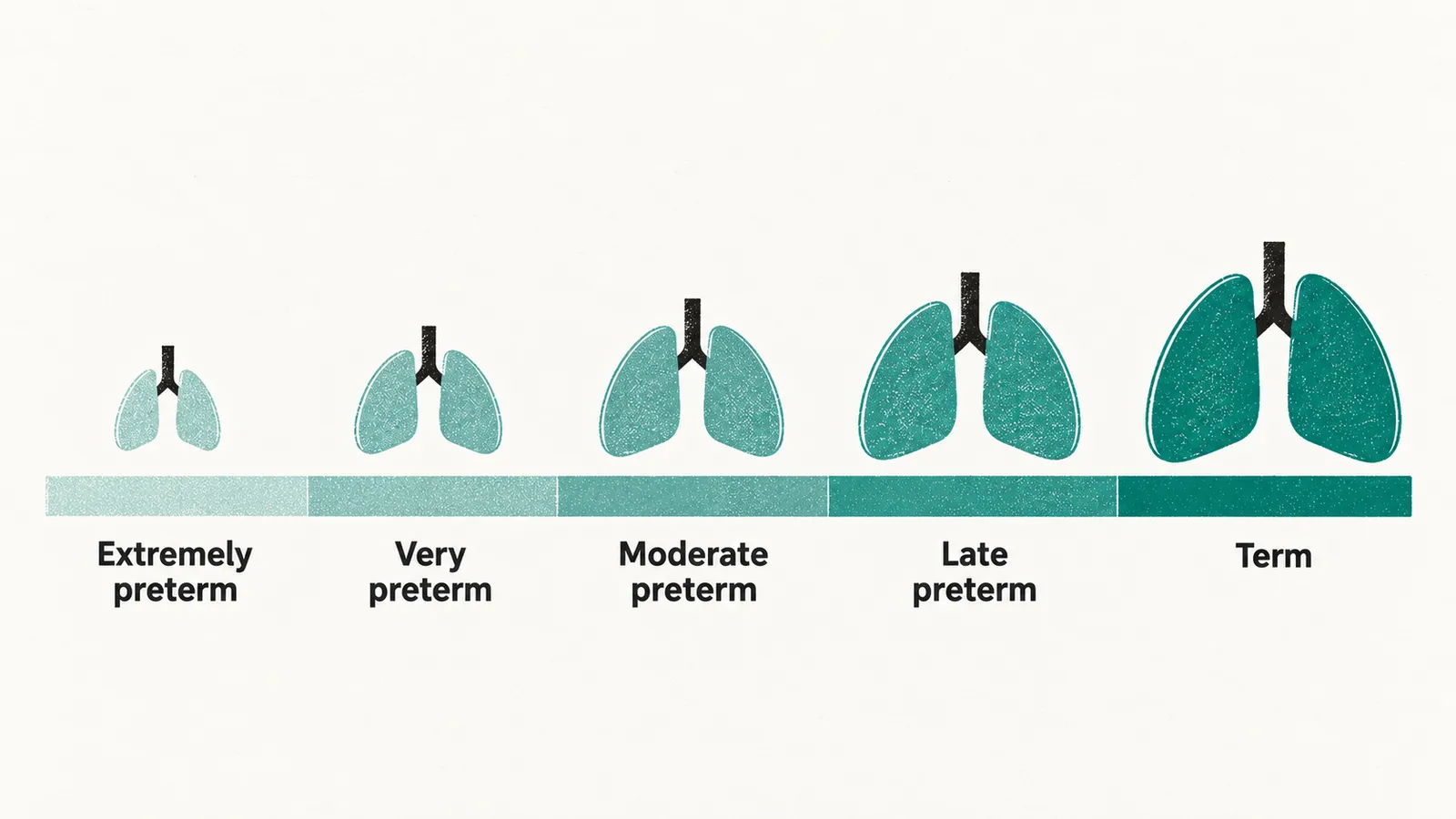
Saying only “preterm” discards most of the prognostic information.
What kind of help does each band need?
Each band carries a different risk and so a different level of help. The bands also predict the kind of help the infant will need. Very and extremely preterm infants usually need neonatal intensive care because several organ systems fail together: lungs, brain and gut are immature at the same time, so care has to support several systems at once.
Late-preterm infants often need close monitoring, thermal support, glucose surveillance, feeding support and jaundice follow-up rather than mechanical ventilation. Their immaturity is physiological and metabolic, so the help they need is monitoring and feeding support more than ventilation.
Why are late-preterm infants easy to underestimate?
Late-preterm infants are the easiest group to underestimate. Late-preterm infants are the largest group. In high-income countries they account for roughly two-thirds to three-quarters of all preterm births. The old label “near term” was abandoned because it encouraged false reassurance.
A 34- to 36-week infant may have term-like weight and appearance, but size and appearance can look term while the organs behind them are still less mature. That gap is easy to miss. Being less physiologically and metabolically mature is why such an infant may have more respiratory morbidity, apnea, temperature instability, hypoglycemia and other metabolic problems, jaundice, infection and feeding difficulty than an infant born at term.
Why can a baby who looks term still feed poorly?
The same immaturity that hides in the look of the baby also shows up in feeding. Feeding needs sucking, swallowing and breathing to work together, and that coordination matures late in pregnancy. It is not reliably established until about 34 weeks postmenstrual age. An infant born just before 34 weeks postmenstrual age may take feeds poorly even when there is no neurological or gastrointestinal disease, because the coordination is not yet mature. The problem sits in an immature system and not in the baby’s behavior, so the feeding difficulty has a developmental substrate rather than a behavioral cause. The pattern is an infant who looks term but behaves preterm.
When can monitoring come down?
Feeding and other functions that are still immature decide when watch can ease. The clinical danger is not the label. It is reducing monitoring or planning discharge before breathing, temperature, feeding and weight trend are stable. These are the functions an immature baby controls least well, so they are the ones that can still shift.
The same caution extends to early term births at 37 to 38 weeks. Early term births carry higher risk than births at 39 to 40 weeks.
Which clock counts after birth?
A preterm infant has two ages, and the question is which one to use. After birth a child has a chronological age, measured from the date of birth. A preterm infant also has a maturity clock that keeps running toward the estimated date of delivery. Before term, maturity is described as postmenstrual age. After the expected term date, clinical comparison uses corrected age.
Corrected age = chronological age − weeks born before 40 weeks.
What is a 28-week baby’s age at 12 months?
The worked example shows the two clocks in numbers. A baby born at 28 weeks was born 12 weeks before the expected 40-week date. At 12 months chronological age, that child is about 9 months corrected age.
Why does corrected age matter for development?
The age clock changes how a developmental result reads. Milestones depend on neural and organ maturation, not only on time spent outside the uterus. Scores change with the age used, so judging a 28-week infant by chronological age alone can make normal maturation look like developmental delay.
Standard practice is to use corrected age for developmental and growth assessment through at least the first year. Corrected age is used into the second year for more immature infants. For extremely and very preterm children, growth assessment may need age correction out to 36 months.
Which age goes on the record?
Corrected age is used for assessment, while the record still needs the chronological age. Administrative records still use chronological age. The two ages coexist and must be labelled whenever reported.
What does birth take away at once?
The record of the clock leads to what the infant loses at birth. Preterm birth abruptly removes placental gas exchange, continuous transplacental nutrition, thermal protection and a low-stimulation environment.
Why do the lungs and the ductus need time?
The lungs and the ductus are the first two things that have to be ready. The lung is built in stages through pregnancy, starting as a bud from the foregut, so an early birth finds it only partly built. The lungs must aerate before their architecture and surfactant system are mature.
The ductus arteriosus must close while hypoxia and prostaglandin activity still favor patency. In a normal infant it closes spontaneously within days after birth.
Why do the gut and the brain take the same hit?
The gut and brain are exposed on the same day as the lungs. The gut must accept milk before it was scheduled to. The developing brain and retina are exposed to oxygen swings, light, noise, pain and hemodynamic instability.
Why do the problems share one cause?
Immaturity underlies many of these complications, which is why the same infant may develop respiratory distress, apnea, patent ductus arteriosus, feeding failure, infection, necrotizing enterocolitis, retinal injury and white-matter or hemorrhagic brain injury. Because the complications reflect immaturity, the number of coexisting problems grows as gestational age falls: the more immature the infant, the more of them arise together. Complications interact rather than simply accumulating. They are best learned together rather than as separate diseases.
So what has to happen before any of these problems has shown itself?