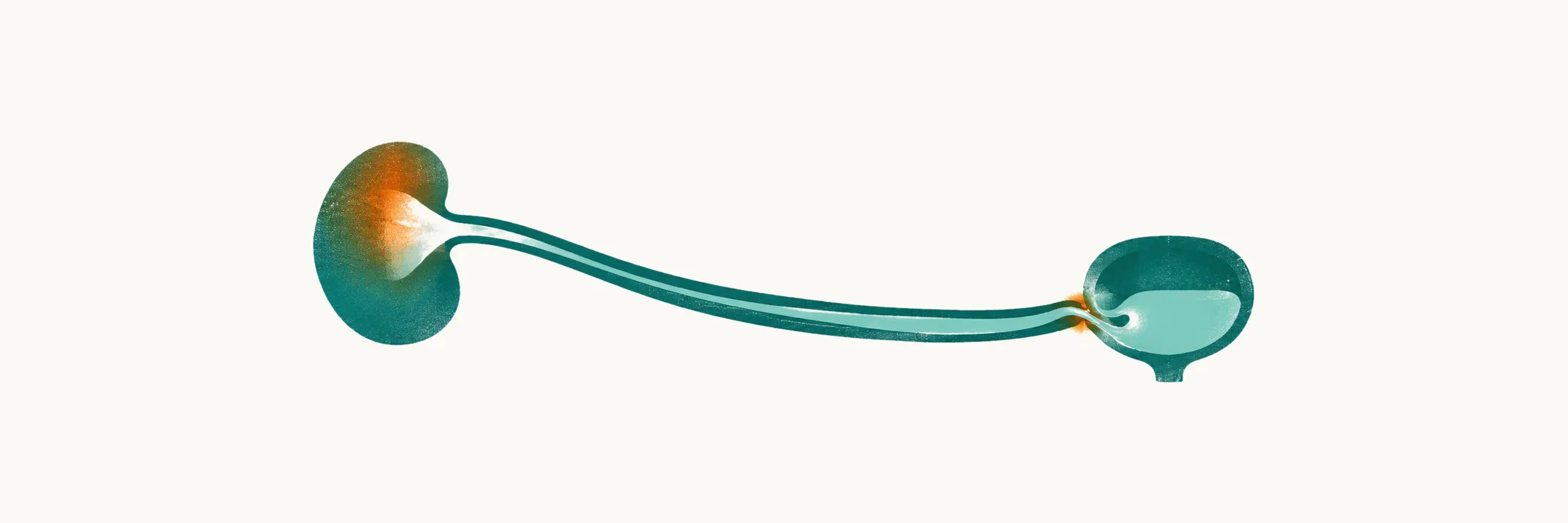
Urinary tract infection in a child is bacteria inside the urinary tract together with the body’s response to them. In a child that definition carries more weight than in an adult, because the same infection can be the first sign of a urinary tract that was malformed before birth.
Why is a first infection a question about the tract?
The same infection can be the first sign of a fault, so it asks a question of the whole tract. Picture the urinary tract as one drainage line. The kidneys make urine, the ureters carry it down to the bladder, and the urethra carries it out. Bacteria can enter at the outer end and climb that line, so an infection in a child is also a question about the line itself.
The line is built before birth, and an infection can be the first sign of a fault in it, because the infection is what brings the fault to light. The structural problems are vesicoureteral reflux (VUR), posterior urethral valves and congenital anomalies of the kidney and urinary tract (CAKUT). They are common enough that a single febrile infection triggers a structured search for them. Most of the children at risk of complications have structural abnormalities, which is why the search is made.
Imaging is how the question is answered: is the tract structurally normal? What imaging finds decides how much kidney is at risk over the following decades.
The event worth preventing is rarely the first infection. The first infection reveals an underlying problem. The event that matters for the kidney is the second and third infection, since repeated febrile infection may lead to renal scarring. Both events reach us as a child with a fever, so what happens at the first fever?
What happens at the first fever?
A first fever is the moment the tract question is put, so the first steps matter. The urethra is short, especially in girls. Inflammation in the kidney can leave permanent damage. An unexplained fever leads to a urine specimen. A first febrile UTI is treated as pyelonephritis, not as cystitis. The first three notes explain what the child looks like and how likely infection is, so what do they settle?
What do the first three notes settle?
They give the vocabulary, probabilities and age bands that the rest of the cluster assumes.
- Pediatric UTI: Foundations and Pathophysiology: how bacteria reach a child’s kidney, why E. coli causes most of these infections, and how the inflammatory response produces fever and white cells in the urine. An organism other than E. coli raises the odds of a structural abnormality.
- Pediatric UTI: Epidemiology and Pre-Test Probability: how often infection occurs at each age, how sex and circumcision shift the probability, and why that probability decides whether urine is sampled at all.
- Pediatric UTI: Clinical Presentation by Age: what the infection looks like in a neonate, an infant, a preschool child and an adolescent. Symptoms pointing to the urinary tract appear only after about age 3.
Once the probability is judged and the child examined, how is a clean urine specimen obtained, and what does it show?
What do the sampling and treatment notes settle?
The probability decides whether a specimen is sent at all. These two notes are best read as a pair, because the order of specimen and antibiotic is part of both.
- Pediatric UTI: Urine Sampling and Culture: the bag, dipstick and culture sequence, what the two dipstick markers each mean, and the colony counts that define a positive culture.
- Pediatric UTI: Acute Treatment and Compartment Logic: why the choice of antibiotic follows from where the infection sits. Fosfomycin and nitrofurantoin concentrate only in urine, and they treat cystitis and not pyelonephritis. The note also covers when to use the intravenous route and how long to treat.
After the acute episode, what does the tract look like once it is imaged?
What do the imaging and bladder notes settle?
Imaging after the acute episode is where the tract question gets an answer, and it decides which structural question comes next.
- Pediatric UTI: Imaging After a First Febrile UTI: the ultrasound-first ladder, when cystography is justified, and what each of the two nuclear scans, DMSA and MAG-3, answers.
- Pediatric UTI: Bladder and Bowel Dysfunction: the voiding history, the constipation criteria and the two opposite bladder patterns, and why the bowel is treated before imaging is repeated.
The bladder, reflux, obstruction and malformation notes carry the structural questions between them. Which structural fault is the imaging pointing to?
What do the structural notes settle?
The structural question narrows to a specific fault.
- Vesicoureteral Reflux in Children: how reflux is graded I to V, which causes lie behind it, and how the choice between surveillance, antibiotic prophylaxis and surgery is made.
- Posterior Urethral Valves and Obstructive Uropathy in Children: where the obstruction lies, why it is the most damaging congenital cause, how it presents before and after birth, and why the bladder and kidney effects continue for life.
- CAKUT and Congenital Solitary Kidney in Children: the spectrum of malformations, why childhood kidney failure looks different from adult kidney failure (the only contrast of causes included, because it explains why a first febrile UTI triggers a search for CAKUT), and how a child with one kidney is followed by a defined method.
So what becomes of the kidney in the long run?
What happens to the kidney in the long run?
The faults and the infections bear on the kidney, so the question is what remains.
- Pediatric UTI: Renal Scarring and Long-Term Outcome: which children scar after a febrile infection, why recurrence rather than the first episode drives it, and how blood pressure and kidney function are followed afterwards. This last note follows the kidney into adult life.
Which neighbouring subjects belong outside this cluster?
What stays outside this cluster?
Not every neighbouring question belongs here. The reasoning is specific to childhood, and several neighbouring subjects follow different rules.
- Adult UTI, adult recurrent cystitis and infection in pregnancy belong elsewhere.
- UTI in a child with a neuropathic bladder or an indwelling catheter belongs elsewhere.
- Glomerular disease, renal replacement therapy and wider paediatric CKD are separate subjects.
Weight-based antibiotic doses are not given; they belong to the current paediatric formulary. Resistance patterns and licensing differ by country. So where does a student begin?
Where to start
Start where the cluster starts, with Pediatric UTI: Foundations and Pathophysiology. Then read the epidemiology and clinical presentation notes, which together with it give the vocabulary, probabilities and age bands. Read the sampling and acute treatment notes as a pair, then follow the rest in learning order. First, how does a bacterium from outside reach a child’s kidney?