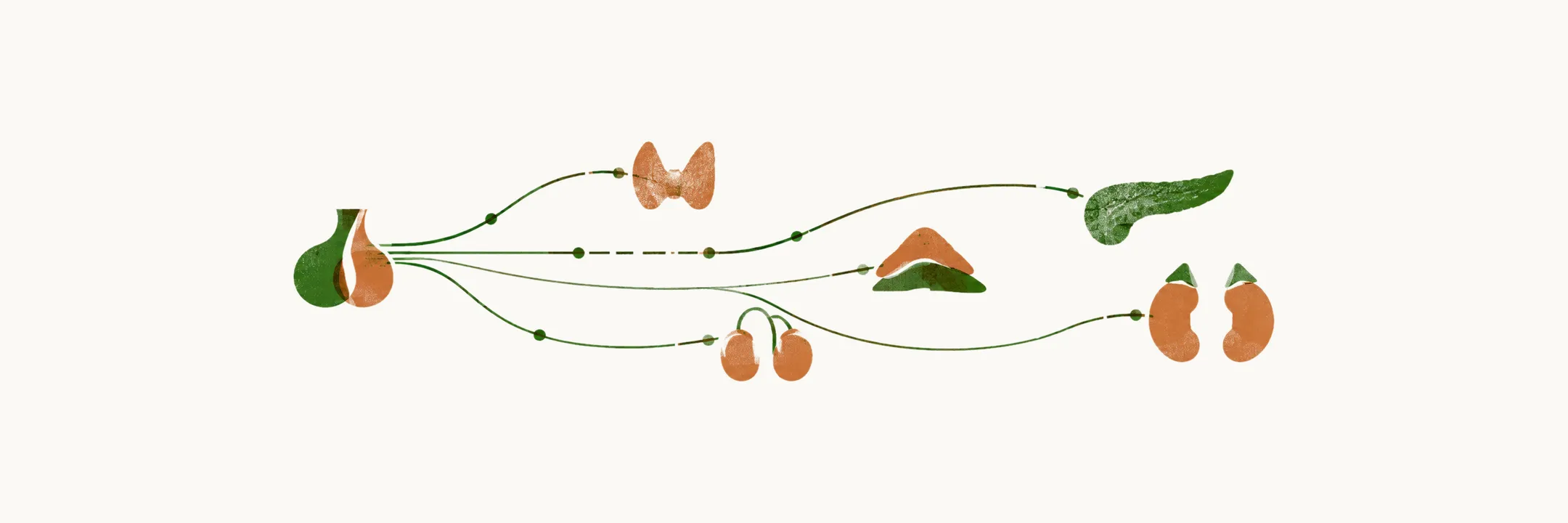
Hypopituitarism is deficient production of one or more pituitary hormones. The pituitary sits below the hypothalamus at the base of the brain and has two parts. The anterior lobe makes growth hormone (GH), the gonadotropins luteinizing hormone (LH) and follicle-stimulating hormone (FSH), thyroid-stimulating hormone (TSH), adrenocorticotropic hormone (ACTH) and prolactin. The posterior lobe stores and releases antidiuretic hormone (ADH).
One idea to hang everything on
The anterior lobe works under hypothalamic control, and each of its hormones belongs to an axis: a chain from the hypothalamus to the pituitary to a target gland. Because of this, a deficiency can arise in the gland itself or in the hypothalamus and its stalk above the gland. It can affect a single axis or several at once, and panhypopituitarism means that all pituitary hormones are deficient.
The topic is learned in three steps: why hormones are lost, how the loss shows itself, and how it is confirmed and treated.
The notes, in order
- Epidemiology of hypopituitarism: how often hypopituitarism occurs, which causes are most common at different ages, and how it affects survival.
- Causes of hypopituitarism: inherited, neoplastic, vascular, inflammatory, infectious and post-irradiation causes, organised by category.
- Developmental causes of hypopituitarism: congenital and perinatal conditions, from pituitary damage around birth to transcription-factor mutations that impair how the gland forms.
- Hypothalamic endocrine dysfunction: hypothalamic disorders that chiefly disturb GnRH, including Kallmann syndrome, Bardet-Biedl syndrome and leptin-related hypogonadism.
- Acquired hypopituitarism: tumours, trauma, vascular events, inflammatory and infiltrative disease, checkpoint inhibitors, infections and cranial irradiation, all of which damage a previously normal gland.
- Clinical manifestations of hypopituitarism: once the causes are clear, the next question is how the loss shows itself, first as a whole and then axis by axis. It covers what each deficient hormone does and how presentation differs between acute and chronic deficiency.
- Growth hormone deficiency: why growth failure appears in childhood, and how body composition and cardiovascular risk change in adults.
- ACTH and gonadotropin deficiency: loss of the ACTH axis produces secondary hypocortisolism with a preserved mineralocorticoid axis, and hypogonadism is often the first sign in adults.
- Diagnosis of hypopituitarism: the final step begins with the tests that confirm the deficiency, namely basal and dynamic tests, the cortisol thresholds that guide the search for ACTH deficiency, and the pitfalls of IGF-1, TSH and free T4 in central disease.
- Treatment of hypopituitarism: how each deficient axis is replaced, why hydrocortisone precedes levothyroxine, and the emergency management of adrenal crisis and pituitary apoplexy.
Where to start
A new reader can begin with how common the condition is and which causes dominate at different ages, then work through why each hormone is lost. So the first question is how often hypopituitarism occurs, and which causes dominate at different ages.