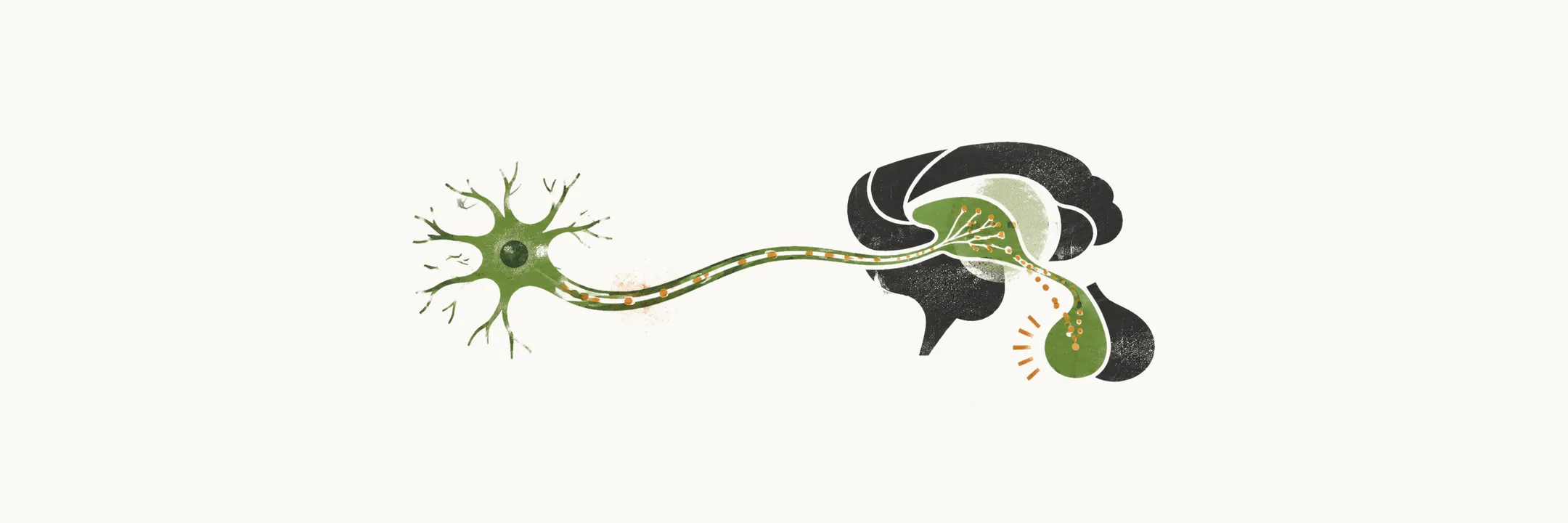
What does the hypothalamus control, and why does its disease reach beyond hormones?
The earlier notes described faults in the build of the gland. Here the fault lies in the controller above it. The hypothalamus sits above the pituitary and controls it, sending signals down to the gland. It does not govern just one hormone: it governs several endocrine axes at once. So a hypothalamic disorder can disturb more than one hormone system.
The hypothalamus also regulates temperature, the sleep-awake cycle, appetite, the autonomic system, behaviour and memory. Because one region does all of these jobs, hypothalamic disease often produces features outside endocrinology.
How does hypothalamic failure reach the gonads?
Of all the hypothalamic signals, one carries the example for what follows. Several hypothalamic endocrine effects act on GnRH. GnRH is the hypothalamic hormone that drives the pituitary’s release of LH and FSH. If GnRH is deficient, LH and FSH fall and the gonads are under-stimulated. This state is called hypogonadotropic hypogonadism.
Four examples follow. Kallmann, Bardet-Biedl and Prader-Willi syndromes were met as congenital syndromes in the causes table of the earlier note. The four reach the same end result from different mechanisms.
Kallmann syndrome: why do smell and puberty fail together?
In Kallmann syndrome, GnRH production is deficient and the patient has anosmia or hyposmia. The link between the two is developmental, not a coincidence. The same pathway that shapes other structures gives a wider picture when it fails, of which hormone failure is one part.
GnRH-producing neurons begin in the olfactory placode, outside the brain. They then migrate into the hypothalamus along olfactory pathways, so smell and the GnRH supply share one route. The product of the X-linked ANOS1 (KAL1) gene, anosmin-1, is needed for that migration. ANOS1 (KAL1) was the first gene linked to Kallmann syndrome.
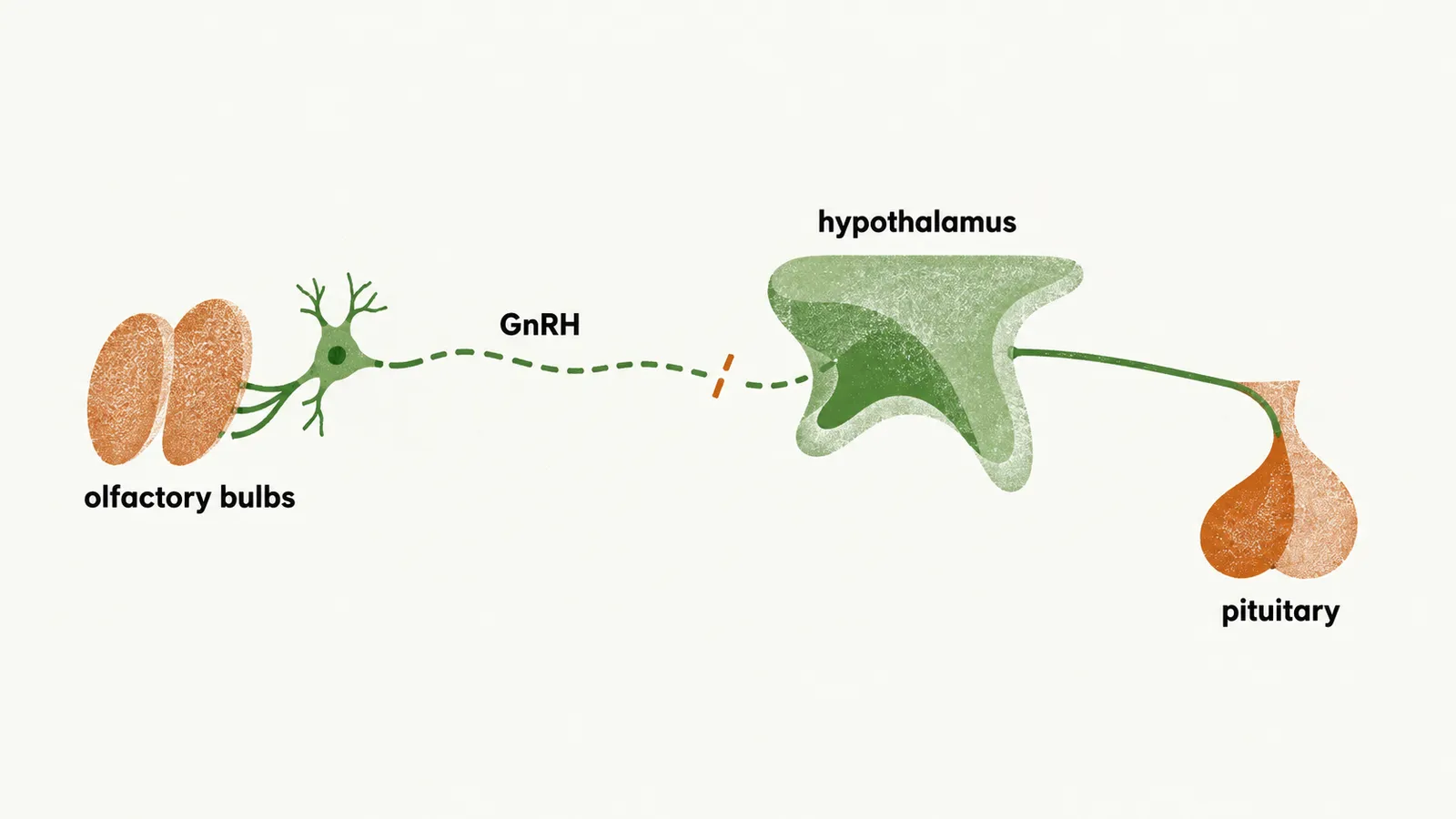
When migration fails, both the olfactory bulbs and the hypothalamic GnRH supply are affected. That is why a reduced sense of smell accompanies the hypogonadism.
Which other genes and features go with Kallmann syndrome?
If migration depends on many genes, inheritance and extra features should vary. Kallmann syndrome can also result from many other genes. Inheritance may follow autosomal or X-linked patterns, or be sporadic.
The gene or pathway acts in several developing tissues, so extra features can appear. Kallmann syndrome may include:
- colour blindness
- optic atrophy
- nerve deafness
- cleft palate
- renal abnormalities
- cryptorchidism
- neurological findings such as mirror movements
How does Kallmann syndrome present in boys and girls?
The deficit is the same in both sexes, because the lost signal lies upstream of the gonads: LH, FSH and sex steroids are all low. The presentation differs by sex. Boys show delayed puberty and micropenis. Girls show primary amenorrhoea and failure of secondary sexual development.
Bardet-Biedl syndrome: why is it multisystem?
The second example is a fault in a structure many organs rely on. Bardet-Biedl syndrome is caused by mutations in several genes that affect the function of the basal body and cilia. Because many organs rely on cilia and several genes are involved, the phenotype varies between patients.
The usual features are:
- intellectual disability
- renal failure
- obesity
- hexadactyly
- brachydactyly
- childhood retinal degeneration, which leaves most patients blind by 30 years of age
GnRH deficiency is part of the syndrome. It is present in about 75% of male patients and about 50% of female patients.
How can a lost energy signal cause hypogonadism?
The third example reaches the same GnRH pathway from a different direction. Leptin and leptin receptor mutations remove the signal that tells the hypothalamus about the body’s energy stores, rather than causing a migration or ciliary fault.
When that signal is lost, hyperphagia and obesity follow. Central hypogonadism follows too, since leptin is thought to act as a permissive signal for the reproductive axis. In central hypogonadism, reduced GnRH production lowers LH and FSH.
Prader-Willi syndrome and the shared origin
The fourth example is Prader-Willi syndrome, which also causes hypogonadotropic hypogonadism as part of its hypothalamic picture.
All of these conditions are congenital or genetic in origin.
What damages a normal hypothalamus or pituitary later in life?
Everything so far was present from birth. Damage to a previously normal hypothalamus or pituitary later in life raises a different set of causes: tumours, trauma, vascular events and other insults. How do these harm a gland that began normal? See Acquired hypopituitarism.