Developmental causes of hypopituitarism are those present before or around birth. They range from damage acquired in the newborn period to inherited disorders that impair how the pituitary forms and how its cells differentiate, meaning how cells become specialised hormone-producing cells.
Why can a newborn’s pituitary be damaged or built wrongly?
A newborn’s pituitary can fail by injury or by a faulty build, and the two routes are different. The gland can be damaged in the first days of life, and the acquired causes are breech delivery, cranial haemorrhage and asphyxia. But the main cause of hypopituitarism in newborns is inherited disorders.
The anterior pituitary is not born finished. It is assembled step by step, and genes switch each step on in turn, like a recipe followed in order. That is why inherited disorders fall into two broad kinds. The first kind affects the whole gland and its position, because the fault acts early in the recipe, before the cell types separate. The second kind affects only some hormone-producing lineages, because the fault acts late and only the cells that depended on that step are lost.
What goes wrong when the whole gland is badly built?
The first kind acts early in the recipe. The anterior pituitary is built by cells migrating from Rathke’s pouch, the same embryonic structure whose remnants give craniopharyngioma. HESX1 is one of the earliest genes in that process, so a fault in it acts before any lineage is set.
A HESX1 mutation can produce a triad: optic nerve hypoplasia, midline neurological abnormalities and pituitary hypoplasia. The three sit together because the optic nerves, the midline structures of the forebrain and the pituitary share an early embryological origin, so one early fault can harm all three. Agenesis of the corpus callosum is one example of a midline abnormality.
The endocrine consequence of a HESX1 mutation can be panhypopituitarism, which means deficiency of all pituitary hormones. The outcome varies with the mutation. An aplastic, hypoplastic or ectopic pituitary gland belongs to the same group: the gland fails to form, forms small, or lies in the wrong place.
What goes wrong when only some cell types are lost?
The second kind acts late in the recipe, and the gland is otherwise there. Here a lineage is one type of hormone-producing cell with one product, and a defect can hit one lineage or several. The phenotype depends on which transcription factor is lost, because each lineage needs its own. A transcription factor is a protein that switches on the genes a cell lineage needs.
The lineages and their products are:
- Somatotrophs make GH.
- Lactotrophs make prolactin.
- Thyrotrophs make TSH.
- Gonadotrophs make LH and FSH.
Pit-1 and PROP-1: why do they remove several hormones?
With that list in hand, the effect of each factor can be read off. Pit-1 (POU1F1) is needed in somatotrophs, lactotrophs and thyrotrophs, so a Pit-1 mutation removes those three together and causes combined deficiency of GH, prolactin and TSH. PROP-1 is required for the activity of the Pit-1 product. It sits upstream of Pit-1, and its loss reaches more lineages: a PROP-1 mutation causes combined deficiency of GH, prolactin, TSH and gonadotropins.
| Pit-1 (POU1F1) mutation | PROP-1 (PROP1) mutation | |
|---|---|---|
| Hormones lost | GH, prolactin, TSH | GH, prolactin, TSH, gonadotropins |
| Early sign | Growth failure appears in the first years of life | Growth retardation |
| Later sign | TSH deficiency becomes evident later | Delayed puberty |
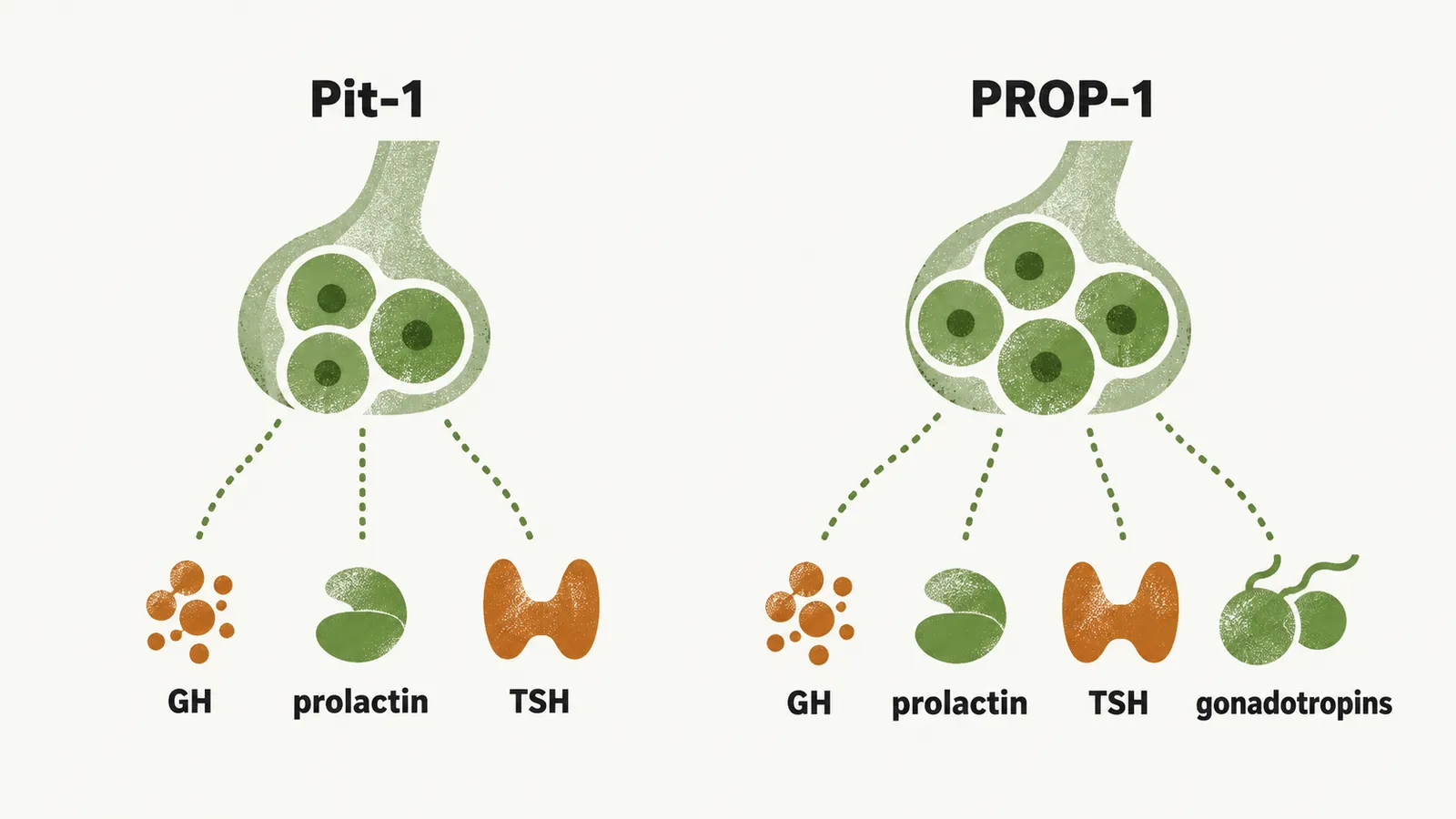
Growth failure is the visible result of GH loss, and delayed puberty follows from the loss of gonadotropins. Recessive PROP1 mutation is the most frequent genetic cause of combined pituitary hormone deficiency, and PROP1 mutation is more common than POU1F1 mutation.
TPIT and NR5A1: a single lineage, or beyond the pituitary
Not every factor serves several lineages. TPIT (TBX19) is needed for the POMC lineage, so a TPIT mutation causes isolated ACTH deficiency.
NR5A1 impairs development of gonadotropic cells. The same factor also drives adrenal and gonadal development, so a fault in it impairs that development as well, and its effect reaches beyond the pituitary.
What range does inherited pituitary failure cover, and when does it appear?
Inherited pituitary dysfunction ranges from isolated hormone deficiency, through combined pituitary hormone deficiency (CPHD), to diabetes insipidus. Isolated deficiency means one hormone is lost; combined means several. The age at which each deficiency appears differs between genes.
Where else can the fault lie?
Everything so far concerns the developing pituitary itself. But the hypothalamus above the pituitary controls the anterior lobe, and the hypothalamus can also be the site of the fault. If the pituitary is built normally, how can a fault in the hypothalamus above it still leave the gland without its signals? That question is taken up in Hypothalamic endocrine dysfunction.