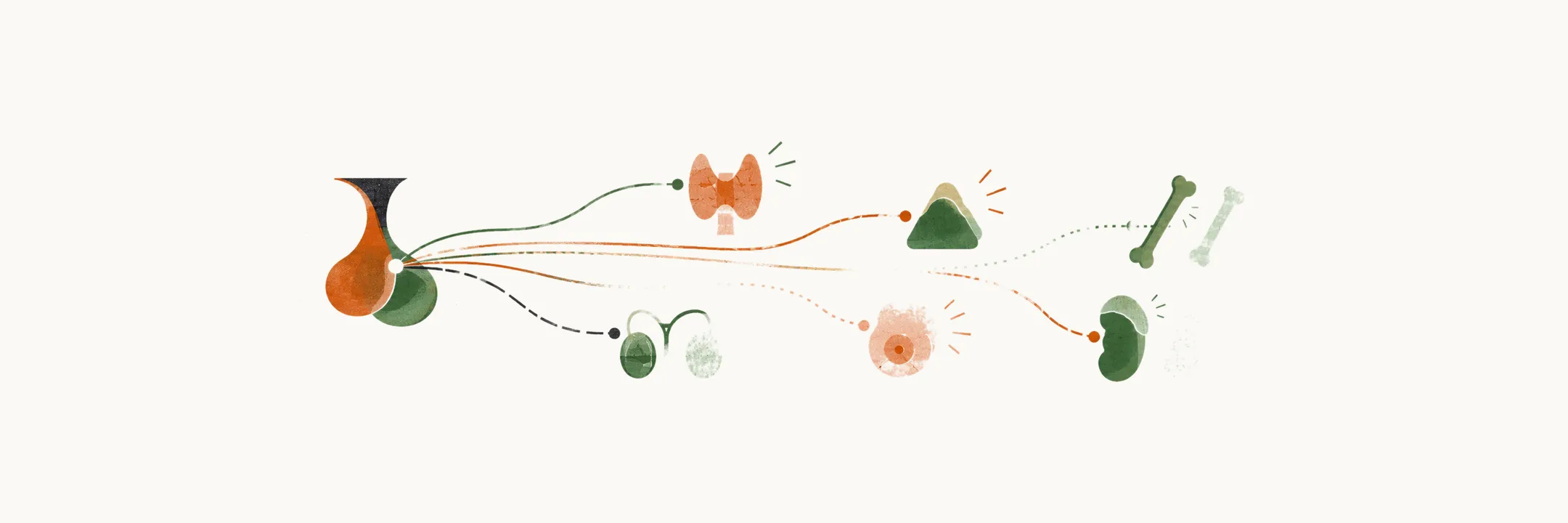
What decides how hypopituitarism looks?
The pituitary is a relay: its hormones tell the thyroid, the adrenal glands and the gonads what to do, and they drive growth. Each anterior hormone is a command to one target, GH to growth and body composition, LH and FSH to the gonads, TSH to the thyroid, ACTH to the adrenal cortex and prolactin to the breast. When a command stops, the target loses its drive. So the manifestations depend on which hormone is affected, and each loss has a distinct effect. Many of the symptoms resemble those of failure of the target gland itself, with a few exceptions.
Two more things shape the picture: the severity of the deficiency, and the age at onset. A child is still growing and developing, so the same missing hormone gives a different picture in a child than in an adult. The speed of onset matters too. Loss is usually slow, but it is occasionally sudden, and a slowly developing deficiency is tolerated differently from a sudden one.
Symptoms and signs can be grouped by hormone, by children and adults, by men and women, and by acute and chronic presentation.
Which axes usually fail later?
Which hormones show first? TSH deficiency and ACTH deficiency develop later in the course of pituitary failure than the other axes, because TSH and ACTH are more resilient to pituitary disease.
Growth hormone
Growth failure is often a child’s first visible sign of GH loss, so GH comes first. A child is still growing, so a lost growth signal shows as slowed growth. In children GH deficiency produces growth retardation, short stature and increased adiposity.
In an adult growth is complete, but the effect on body composition remains. Adults with GH deficiency show:
- reduced exercise capacity;
- impaired psychological well-being;
- increased cardiovascular risk;
- increased central obesity;
- reduced lean body mass.
Gonadotropins
The next lost command is the one to the gonads. Gonadotropin deficiency means loss of LH and FSH. With the gonads under-stimulated, this is hypogonadotropic hypogonadism. The gonadotropins run the gonads’ sex-steroid production, sexual development and fertility, so their loss has different effects in each group.
In children, puberty is the stage when gonadal sex steroids start to act, so gonadotropin deficiency shows as delayed puberty.
In women the gonadotropins run the cycle and fertility, so their loss causes menstrual disorders and infertility. The other features follow the low sex steroids:
- amenorrhoea;
- oligomenorrhoea;
- infertility;
- loss of libido;
- dyspareunia;
- fine wrinkles;
- breast atrophy;
- osteoporosis;
- premature atherosclerosis.
In men, sex-steroid and sperm production fall, so secondary sexual traits are lost and sexual function decreases. The features are:
- impaired fertility;
- impotence;
- reduced libido;
- decreased muscle mass and strength;
- decreased bone mass;
- decreased erythropoiesis and hair growth;
- fine wrinkles;
- testicular hypotrophy.
Thyroid-stimulating hormone
When TSH is lost the thyroid loses its drive. Thyroid hormone is needed for growth in a child, so in children TSH deficiency, like GH deficiency, causes growth retardation. In adults low thyroid hormone slows the body, and the features resemble those of primary hypothyroidism: fatigue, cold intolerance, constipation, weight gain, dry skin and slow relaxing reflexes.
ACTH and cortisol
ACTH is the signal that tells the adrenal cortex to make cortisol, and without it the adrenal glands are not driven, so cortisol cannot rise under stress. ACTH deficiency produces the secondary form of adrenal insufficiency, which is cortisol deficiency arising from the pituitary, not from the adrenal gland itself.
One thing differs from failure of the adrenal gland itself. In secondary adrenal insufficiency, hypocortisolism occurs with preserved mineralocorticoid production, because aldosterone is driven largely by the renin-angiotensin-aldosterone system rather than by ACTH. Because mineralocorticoid production is preserved, the hyperkalaemia of primary adrenal insufficiency does not appear.
The picture depends on how fast cortisol is lost.
- Acute ACTH deficiency: fatigue, weakness, dizziness, nausea, vomiting and circulatory failure. The picture is as in Addison’s disease, because cortisol is lacking in both, except for the lack of hyperpigmentation and the absence of hyperkalaemia.
- Chronic ACTH deficiency: a slower, non-specific picture of tiredness, pallor, anorexia, nausea, weight loss, myalgia and hypoglycaemia.
Prolactin
One more anterior hormone remains. Prolactin is needed for milk production, so when prolactin is decreased the result is failure of lactation.
Prolactin can also appear the other way round, as an increase. This is not a deficiency. The hypothalamus controls the anterior lobe through releasing signals sent down the stalk, and for prolactin that control is dopamine, which holds prolactin down. Stalk disruption removes this hypothalamic dopamine regulation, so prolactin rises while the other hormones fall. Raised prolactin can cause galactorrhoea, oligo/amenorrhoea and loss of libido.
Why does the posterior lobe behave differently?
The posterior lobe is not driven by the anterior releasing signals. Its hormone, ADH, is made by neurosecretory cells of the hypothalamus whose nerve endings end in the posterior lobe. ADH deficiency is almost never a primary feature of hypopituitarism associated with a pituitary adenoma. It occurs mostly with granulomatous and metastatic masses in the hypophysis.
Without ADH the kidneys cannot hold on to water, so urine volume rises and thirst follows. The result is polyuria and polydipsia, including nocturnal polydipsia.
Growth failure is often the first visible sign, and its effects differ between child and adult. Why does the absence of one growth signal stop a child growing, and what does it do to an adult’s body and heart? The answer is in Growth hormone deficiency.