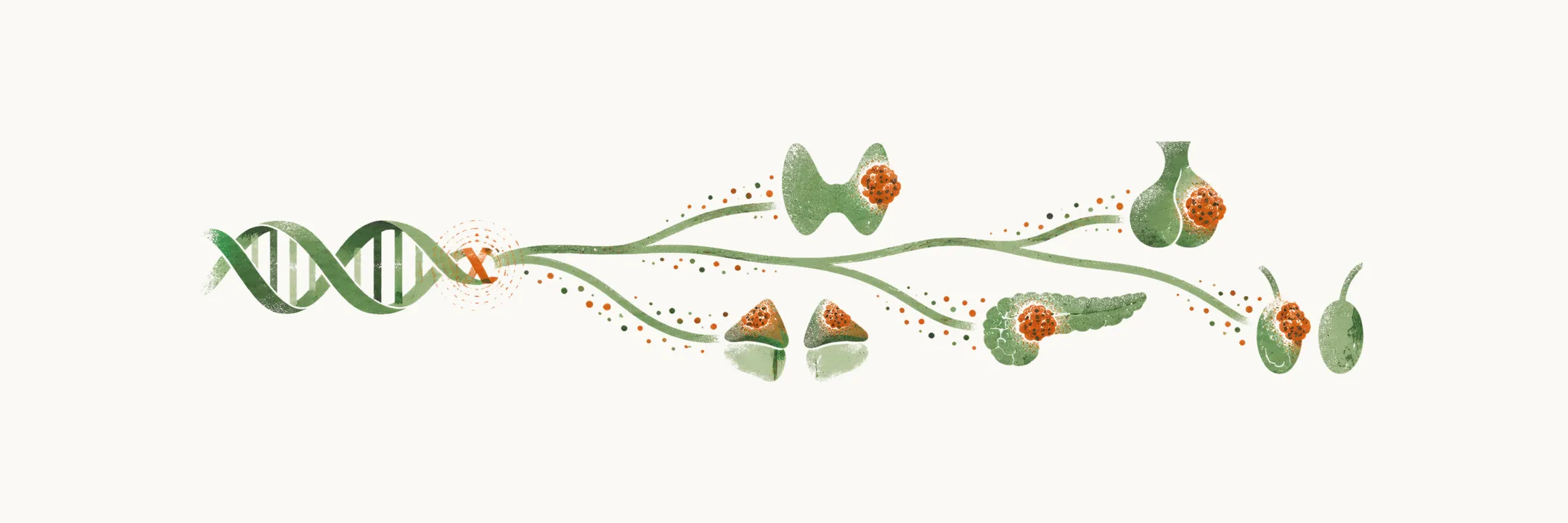
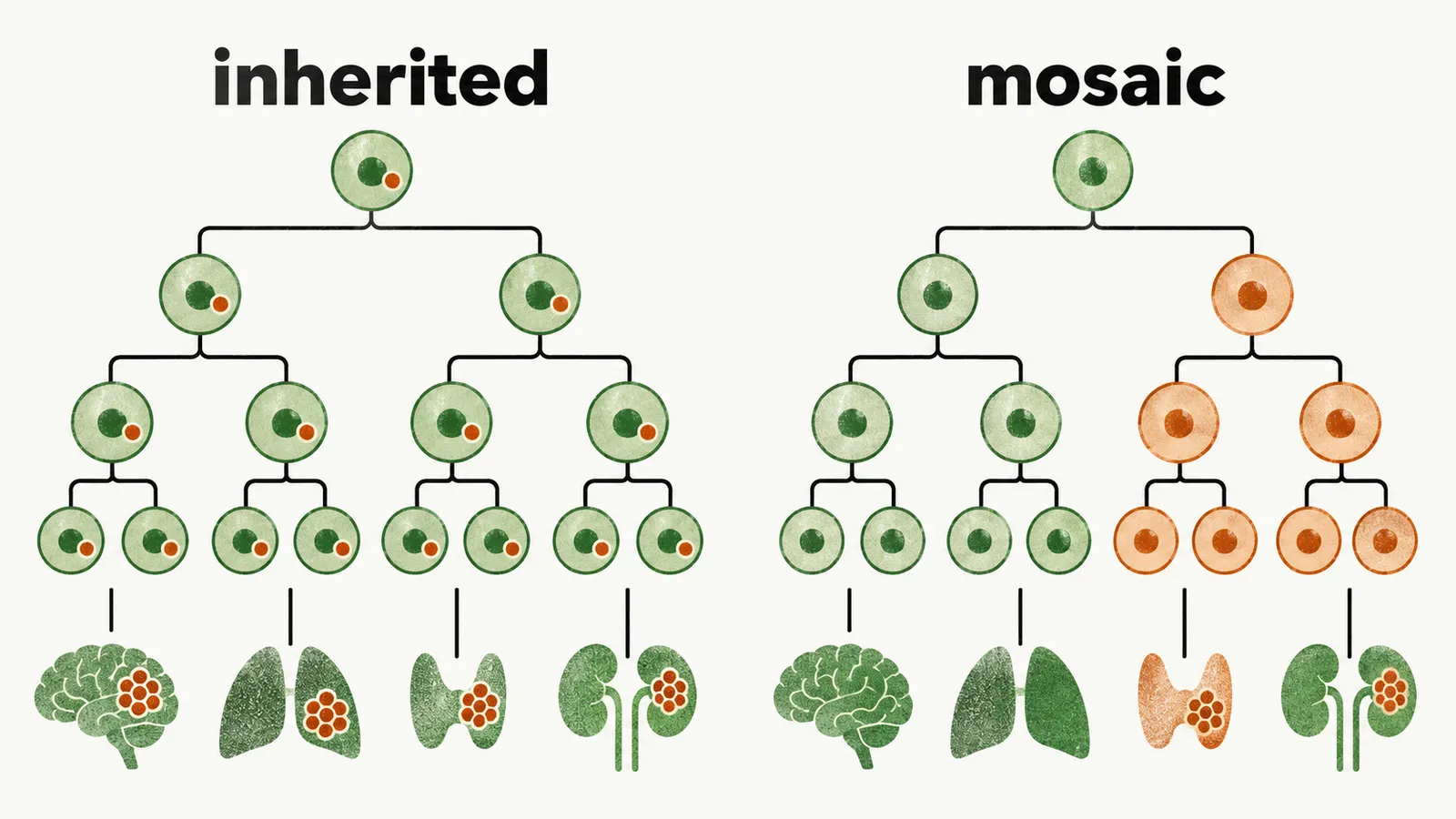
Most pituitary adenomas are sporadic. A sporadic tumour starts when one anterior pituitary cell gains a change and its descendants form the adenoma. Several familial syndromes are also associated with pituitary tumours, and in them the change is inherited instead.
What changes when a tumour runs in a family?
An inherited change is present in every cell, so tumours can appear in more than one place. That is why, in each syndrome, the pituitary tumour is one of several tumours appearing across the body or across a family.
Each syndrome is also tied to a particular gene. Familial cancer syndromes come from inherited loss of tumour suppressor genes, which hold cell growth back, so losing one removes part of that brake. The rest takes one syndrome at a time: what its gene does, and which tumours follow.
What is multiple endocrine neoplasia?
A gene that gives tumours in several places leads to the best-known example, MEN (multiple endocrine neoplasia). MEN is an autosomal dominant syndrome, which means it is inherited when one copy of the altered gene is enough. MEN predisposes to parathyroid, pancreatic islet and pituitary adenomas, and because the altered copy is in every cell, all these glands are at risk.
One altered copy is not yet a tumour, though. A tumour needs the second copy lost as well, in one cell (Knudson’s two-hit model). So one inherited copy is enough to pass the syndrome on, while the tumour step still needs a second hit in a single cell.
Why does one faulty MEN1 copy matter?
An inherited dominant pattern raises the question of what the single gene does in the cell. MEN is caused by mutations in the MEN1 (menin-1) gene. The altered copy is in every cell from birth. If the second copy is also altered in a cell, that cell has no working menin, and this lets it grow into a tumour.
What is the related MEN-like syndrome?
MEN1 is one brake on growth, and a second gene gives a related picture. A related MEN-like 1 phenotype is caused by mutations in the CDKN1B gene. This gene encodes a negative regulator of the cell cycle, so losing it removes a brake on division.
Which pituitary tumours appear in MEN?
Once the gene is known, the question is which tumours it brings in the pituitary. About half of patients with MEN develop prolactinoma. Cushing’s disease and acromegaly are rare in MEN.
What is Carney complex?
The next syndrome also gives tumours across several sites, with skin changes added. Carney complex is characterized by spotty skin pigmentation and by endocrine tumors such as testicular, adrenal and pituitary adenomas. Of the patients with Carney complex, 20% manifest Cushing’s disease.
A proposed explanation for the spread across organs is that protein kinase A is the main effector of cAMP signalling in all tissues. A change in its regulator can therefore reach more than one organ.
Why does PRKAR1A matter?
Carney complex is tied to a gene, and in a subset of patients the syndrome is associated with a mutation in the PRKAR1A gene. This gene encodes the R1α regulatory subunit of protein kinase A. The regulatory subunit restrains the enzyme’s active subunit, so an inactivating change removes that restraint in the cells where it occurs.
What is McCune-Albright syndrome?
The last two syndromes do not both come through a family. McCune-Albright syndrome is caused by a post-zygotic mosaic mutation. The change arises in one early embryonic cell, so only that cell’s descendants carry it, and normal and changed cells sit side by side in the body.
What does the GNAS change do?
Once the change is patchy, the question is what it does inside each affected cell. The mutation is in the GNAS gene, which encodes the Gs protein. The mutation decreases the GTPase activity of the G protein. A Gsα switch that cannot turn itself off keeps cAMP high, so decreased GTPase activity causes constitutive production of cAMP and the cell keeps dividing and releasing hormone.
Which tissues does it affect?
With the switch explained, the question is which tissues carry the changed cells. Because they descend from one early cell, bone, skin and endocrine glands can each carry patches of them. So the syndrome is manifested by polyostotic fibrous dysplasia, skin pigmentation, and multiple endocrine tumors such as acromegaly, adrenal adenoma and autonomous ovarian function.
What is familial acromegaly?
The mosaic syndrome is not inherited, and familial acromegaly returns to an inherited pattern. It is a rare disorder in which family members have either acromegaly or gigantism. A subset of these families harbor AIP mutations. AIP normally holds back the cells that make growth hormone, and in these families a change in AIP removes that restraint, so the mutations predispose them to acromegaly.
Do these tumours make hormone?
The pituitary tumors named in these syndromes are hormone-secreting, because an adenoma keeps the hormone of the cell it grew from. Adenomas that produce no clinically active hormone give no hormonal warning. A formed tumour harms in two ways, through the hormones it secretes and through the structures it compresses, so these adenomas come to attention through the compression they cause. How does a tumour that makes no hormone come to attention?