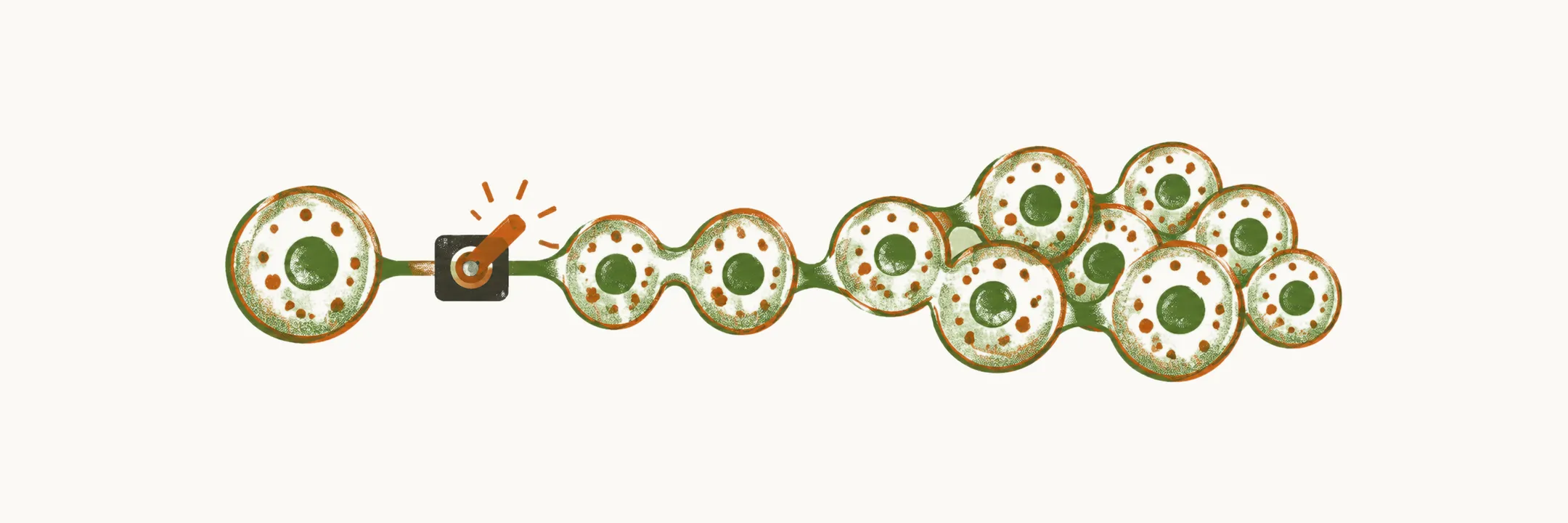
A pituitary adenoma usually begins with one anterior pituitary cell that acquires changes letting it divide when its neighbours do not. That cell keeps making the hormone of its own cell type, which is why the adenoma later makes that hormone too. Every cell of the tumour descends from this single cell, so the tumour is monoclonal: it is a clone, not an enlarged gland.
What must a clone acquire before it can grow?
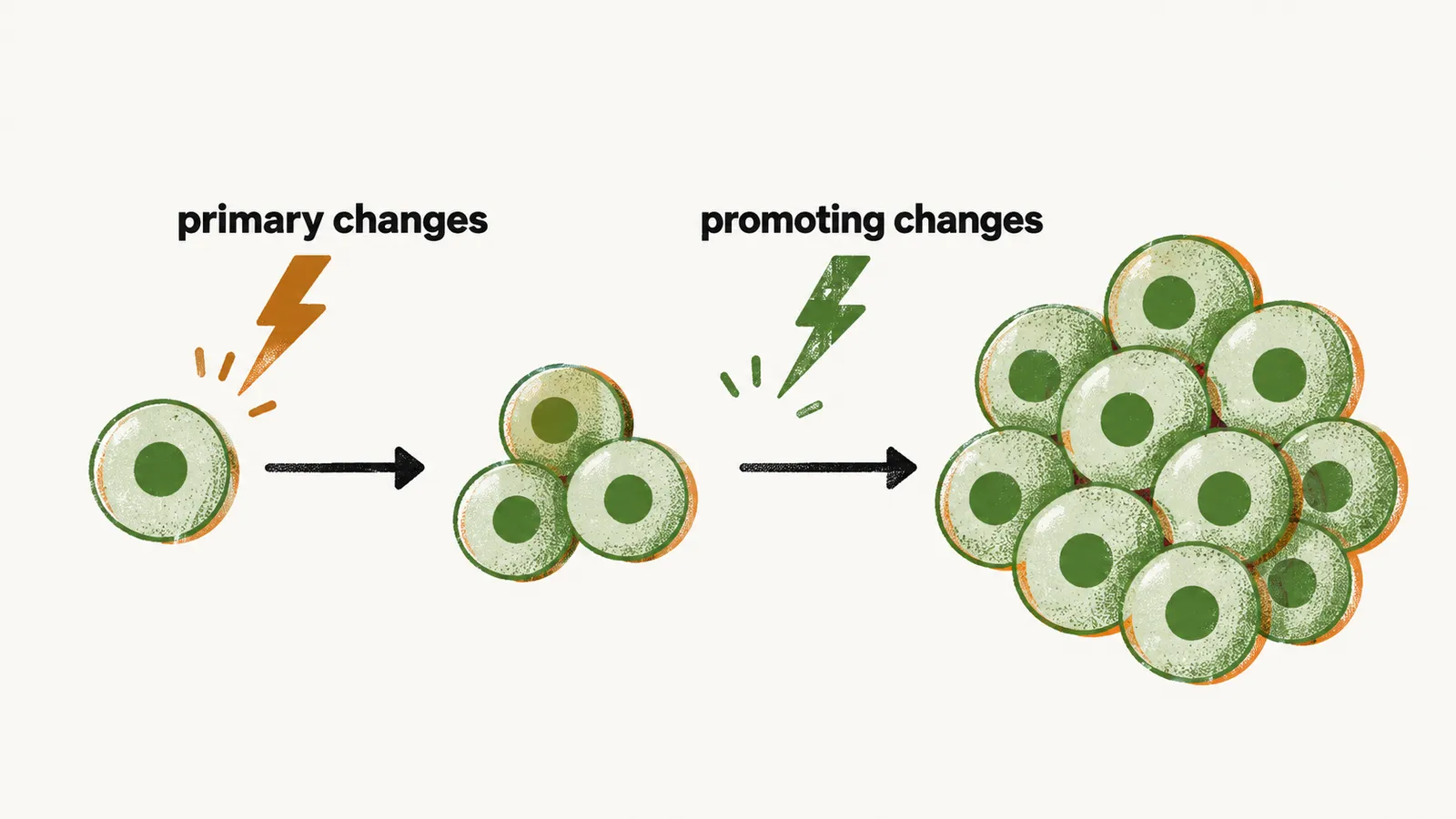
The lead ends on one cell that divides when its neighbours do not, so the next question is what that cell must acquire. One change is not enough. Two kinds of change cooperate.
The primary changes start the clone. Either an oncogene is activated, or a tumour-suppressor gene is inactivated. Once an oncogene is changed, it keeps pushing the cell to divide even when the cell is not needed. A tumour-suppressor gene normally restrains division, and once it is lost the restraint is gone.
The promoting changes let the clone grow. They do not start it; they add to the growth of a clone that already exists. They are an excess of a growth factor, loss of the normal feedback that restrains the cell, or loss of an inhibiting factor.
Why can different genes end in the same result?
The two kinds of change include a switch that many genes can reach. The cell reuses the same few signalling steps in many settings, so mutations in different genes can converge on the same result.
Several mutations in somatotrope adenomas act on one such node: the Gsα protein. Gsα switches on adenylyl cyclase (AC), which makes cyclic AMP (cAMP). Gsα switches itself off through its own GTPase activity, so a mutation that removes this activity leaves the switch on.
What does a stuck switch do to a somatotroph?
The switch is Gsα, and when it is locked in its active form the cAMP route stays on and cAMP stays high. Normally the growth hormone-releasing signal from the hypothalamus turns this route on through its receptor. In the mutant cell the route is on without that signal.
High cAMP activates protein kinase A. High cAMP drives the somatotrope cell both to divide and to release growth hormone.
Which gene makes the switch, and how often is it changed?
The stuck switch is driven by one gene, so which gene is next. The GNAS gene encodes the Gsα subunit of the G-protein-coupled receptor complex. A GNAS mutation produces constitutive activation of adenylyl cyclase, meaning that its activation no longer depends on a signal.
GNAS is the only recurrent genetic alteration found in somatotrope adenomas, and it is mutated in 15-58% of them.
Is there a second gene behind early gigantism?
GNAS is not the only gene that reaches this family of receptors. GPR101 is an orphan G-protein-coupled receptor (its natural activating molecule is not known). It also couples to Gsα and raises adenylyl cyclase activity. It belongs to the receptor family and is expressed in regions of the hypothalamus and in the fetal pituitary, so its signal can reach the same kind of switch.
Children with early-onset gigantism and growth hormone excess can carry a heritable microduplication of chromosome Xq26.3. In these tumours GPR101 messenger RNA is increased about 1000-fold. Because the duplication is tied to the disease, the extra copy is taken as the cause and not as a bystander. The familial form is called X-linked acrogigantism (X-LAG).
What happens when a brake gene is lost?
GNAS and GPR101 push the cell forward, while AIP works as a brake. The AIP gene is mostly associated with somatotrope adenomas and behaves as a tumour suppressor. The mutations found in AIP are nonsense mutations that destroy the protein.
The AIP protein is believed to restrain the cell, and its role is to keep cell replication in order, so losing it leaves division less restrained. What AIP does is still only partly understood.
Why does an inherited AIP change matter?
A lost brake can be inherited, so the next question is how it is passed on. A germline AIP mutation is present in every cell and passed down in a family. It is relatively common among young adults with acromegaly (5-14%). It also explains a share of familial acromegaly, which means rare families in which members develop acromegaly or gigantism.
Several of the genes above are germline and cause inherited syndromes.
How do AIP-related tumours behave?
The inherited form shows up as larger, more aggressive tumours. Adenomas are benign in their cells but can grow into neighbouring tissue, and in patients with an AIP mutation the tumours tend to be larger and more invasive. They are also more likely to recur.
They are less responsive to somatostatin analogues. In patients without an AIP mutation, treatment with a somatostatin analogue raises AIP expression.
Does another signal reach the same cell?
AIP tumours respond less well to somatostatin analogues, so the next question is what else acts on the somatotrope. Ghrelin is a growth factor acting on the pituitary. GHSR is the gene encoding the ghrelin receptor.
Why does the receptor pattern decide treatment?
Ghrelin acts through its own receptor, and drug response turns on receptors in the tumour. Somatostatin analogues act through somatostatin receptors, so the receptor pattern on the tumour is relevant to treatment.
Which receptors do the two granule types carry?
The pattern tracks granule type, so which receptor each type carries comes next. The pattern of somatostatin receptor expression differs between the subtypes of somatotrope adenoma. Densely granulated adenomas express mainly somatostatin receptor type 2 (SSTR2), and they respond better to SST2-selective drugs than sparsely granulated adenomas do. Sparsely granulated adenomas express mainly somatostatin receptor type 5 (SSTR5).
Why does more SSTR2 mean a better response?
SSTR2 is the receptor that matters for densely granulated tumours. The more SSTR2 a tumour expresses, the more likely it is to respond to somatostatin analogue treatment. The difference in response between the two granule types is suggested to rest on SSTR2 expression levels.
Can treatment change the receptor pattern?
The receptor pattern is a property of the tumour, so the next question is whether treatment changes it. It does: the pattern of somatostatin receptor expression is changed by treatment with somatostatin analogues.
What does a formed tumour do to the body?
Whatever the genetic route, a formed tumour causes harm in two ways: through the hormones it secretes and through the structures it compresses. Once a tumour has formed and is causing harm in these two ways, how does it show itself in a patient?