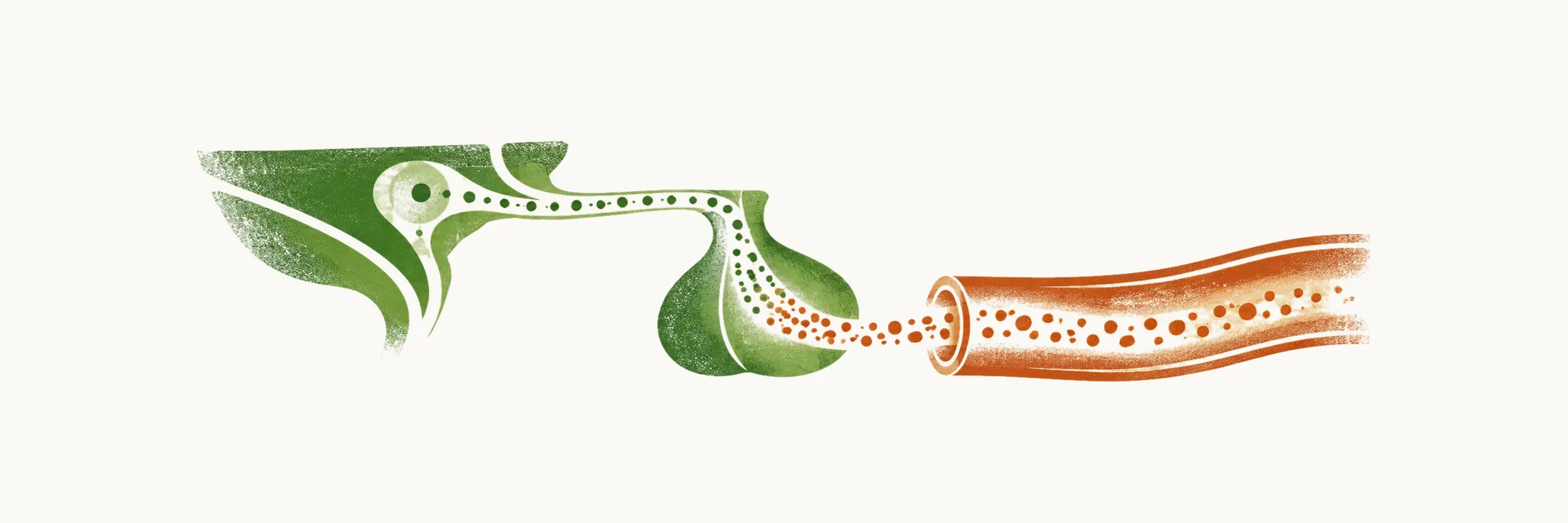
The pituitary is a small endocrine gland at the base of the brain. It is enclosed in the sella turcica and depends on signals from the hypothalamus above it. This matters later: anything that cuts the signals from above changes what the gland secretes.
Why does the gland have two parts?
The gland is small and sits in a bony space under the brain, so how can it do two different jobs? It develops from two distinct embryological origins. They give an anterior part, the adenohypophysis, and a posterior part, the neurohypophysis.
The posterior part grows from the infundibulum, so it is brain tissue in origin. The two parts are controlled in different ways. The adenohypophysis lies anteriorly and makes its own hormones; it secretes most of the pituitary hormones. The neurohypophysis gets its hormones from the hypothalamus, where they are made.
How does the hypothalamus steer the front part?
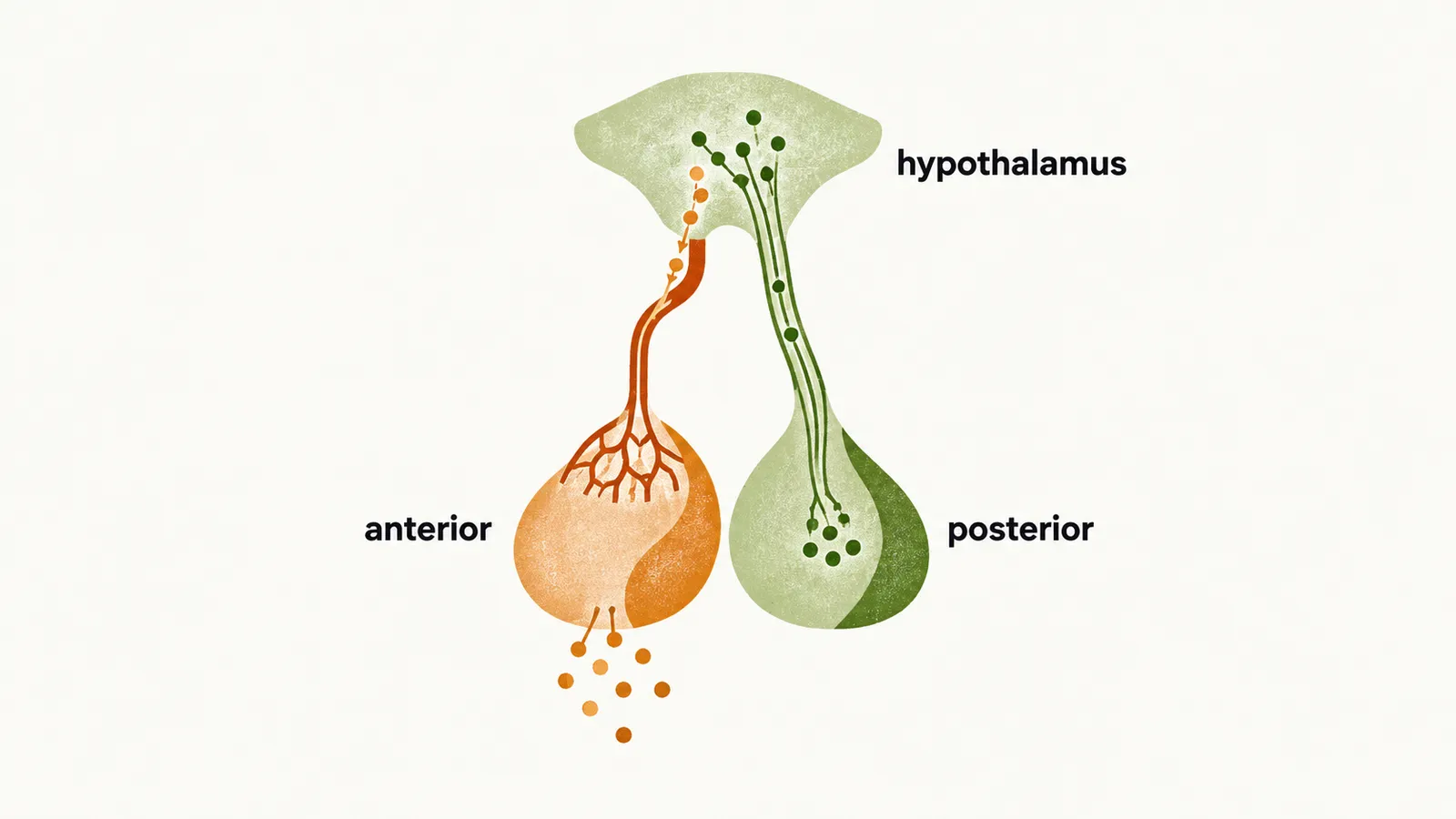
If the front part makes its own hormones, something must set how much it makes, and that is the hypothalamus. Its output is controlled by releasing and inhibiting hormones that the hypothalamus releases into the hypothalamic-pituitary portal system. The signals travel down the stalk to the gland in that system.
Because the signals travel in the stalk, damage to the stalk looks like damage to the gland: the gland loses its signals.
Which signals raise output, and which hold it back?
The signals are specific: each hypothalamic hormone acts on particular pituitary hormones:
- CRH increases ACTH production.
- GHRH increases growth hormone production.
- GnRH increases FSH and LH production.
- TRH increases TSH and prolactin production.
- Somatostatin decreases growth hormone and TSH production.
- Dopamine decreases prolactin and TSH production.
Somatostatin is the signal that holds growth hormone back, opposing GHRH. Dopamine comes down the stalk from the hypothalamus and acts on the cells that make prolactin.
Why does each hormone answer its own signals?
Signals are one part of control. Each anterior pituitary hormone responds to some of these signals, not to all of them. Several of them also respond to feedback or to a daily rhythm.
What does growth hormone depend on?
Growth hormone is one of the front-part hormones shaped by these signals. It is released in response to GHRH, and somatostatin is the opposing signal. These are the two hypothalamic peptides that control its secretion. In healthy people growth hormone is also released in response to exercise, fasting and stress; these influences act on growth hormone through the same two hypothalamic signals. Its effects are protein synthesis, lipolysis and gluconeogenesis.
Why does dopamine hold back prolactin?
Prolactin is the hormone whose control runs the other way, and that is where a stalk problem shows. Its release is inhibited by dopamine. Prolactin has a trophic effect on the mammary glands.
The dominant control of prolactin is inhibitory, by dopamine from neurons of the hypothalamus. So anything that interrupts the flow of dopamine down the stalk raises prolactin. Compression or damage to the stalk impairs the dopamine inhibition, which leads to elevated prolactin levels.
What controls TSH?
TSH release is under feedback from thyroid hormone. It is also controlled by TRH, dopamine and somatostatin. And TSH follows a circadian clock.
What controls ACTH, and when is it highest?
ACTH output is shaped by a clear daily peak. Its production is under the control of CRH, a feedback mechanism and a circadian clock. CRH drives ACTH output, cortisol feedback lowers it, and the clock shapes its rhythm. The circadian clock gives the highest secretion during the morning, before waking, and secretion declines through the day.
ACTH acts on the adrenal cortex and increases production of its hormones, except those of the zona glomerulosa; this promotes cortisol synthesis and release. ACTH also has a trophic effect on the adrenal gland.
What do LH and FSH do in the gonads?
GnRH drives the gonadotropins, and they act on the gonads. In men and women LH causes formation of androgens and estrogens. FSH is responsible for stimulating gametogenesis.
How is the back part different?
After the front part, the back part works differently. The neurohypophysis does not make its own hormones. The hormones are produced by the hypothalamus and stored in neuron endings inside the posterior hypophysis, which is where they are kept until released.
What does oxytocin do?
Oxytocin is one of the back-part hormones. It stimulates smooth muscle cells of the uterus and mammary glands during delivery and breast-feeding. When there is no breast-feeding, oxytocin has a trophic effect on the uterus and mammary glands.
What does vasopressin do?
Antidiuretic hormone, also called vasopressin, is the other back-part hormone. It is released in response to an increase in plasma osmolality. It has a contracting effect on arterioles, especially those in the kidney.
Why does gland height change with age?
The gland’s height is not fixed, so what counts as normal depends on life stage.
During childhood the height is about 6 mm. During adulthood it is about 8 mm, and the upper border of the gland is flat or slightly concave. During puberty and pregnancy the height is about 10-12 mm and the upper border is physiologically convex. In pregnancy the growth comes from lactotroph hyperplasia, which increases the volume of the gland.
What happens when the gland grows or its signals are cut?
This is the point where the gland’s size and its signal supply both matter. The gland is affected both by processes that enlarge it and by processes that interrupt hypothalamic signals. Enlargement, as in pregnancy, comes from hyperplasia. Interruption of hypothalamic signals, as in stalk damage, changes what the gland secretes. So what happens when something other than the normal gland fills that small bony space?