
Celiac disease is a permanent, immune-mediated intolerance of gluten, the protein found in wheat, barley and rye. It damages the mucosa, the lining of the small intestine, and it does so when gluten is eaten. Once the diagnosis is made, what is the treatment? Diagnosis itself is covered in Diagnosing Celiac Disease in Children.
What does treatment consist of, and why a diet?
Gluten is the necessary trigger of the immune attack on the lining. So the logic of treatment is simple: take the trigger away and the immune response loses its stimulus. That is why celiac disease is treated with diet rather than with drugs. No drug is needed to switch off a cause that can simply be removed.
The treatment is a strict, lifelong gluten-free diet. It is not a course. The intolerance is permanent even when the mucosa has healed, so the diet has to continue for life. The gluten-to-villus chain is set out in Celiac Disease in Children.
Most clinical work sits in adherence and follow-up rather than choice of therapy.
What does the diet exclude?
What exactly does a child have to avoid? The cereals to exclude are wheat and its variants (spelt, kamut), barley, rye and triticale. Triticale is a wheat–rye hybrid. Rice and naturally gluten-free grains are not restricted.
Why is cutting down not enough, and where does gluten hide?
If a little gluten is enough to matter, how strict does the diet have to be? The diet is not a matter of reducing gluten. Mucosal inflammation is triggered by very small amounts of gluten. Patients differ in how much they tolerate, and this cannot be predicted for one person. So the safe aim is complete avoidance.
Contamination matters as much as the obvious sources. Examples are shared cooking surfaces, flour in the air and sauces thickened with wheat. Hidden gluten can mean a child takes it in without knowing.
Who helps the family keep it?
A diet this exact needs expert support. A dietitian experienced in celiac disease is part of the treatment, not an optional extra. The diet is the therapy, and its practical details are where adherence is won or lost during childhood and adolescence.
How is a child followed up?
Once the diet starts, symptoms soon improve, so how is progress judged? Healing of the lining takes longer than the relief of symptoms. A child can therefore feel well while the mucosa has only partially healed, and symptoms are a poor guide. That is why follow-up is scheduled rather than symptom-driven.
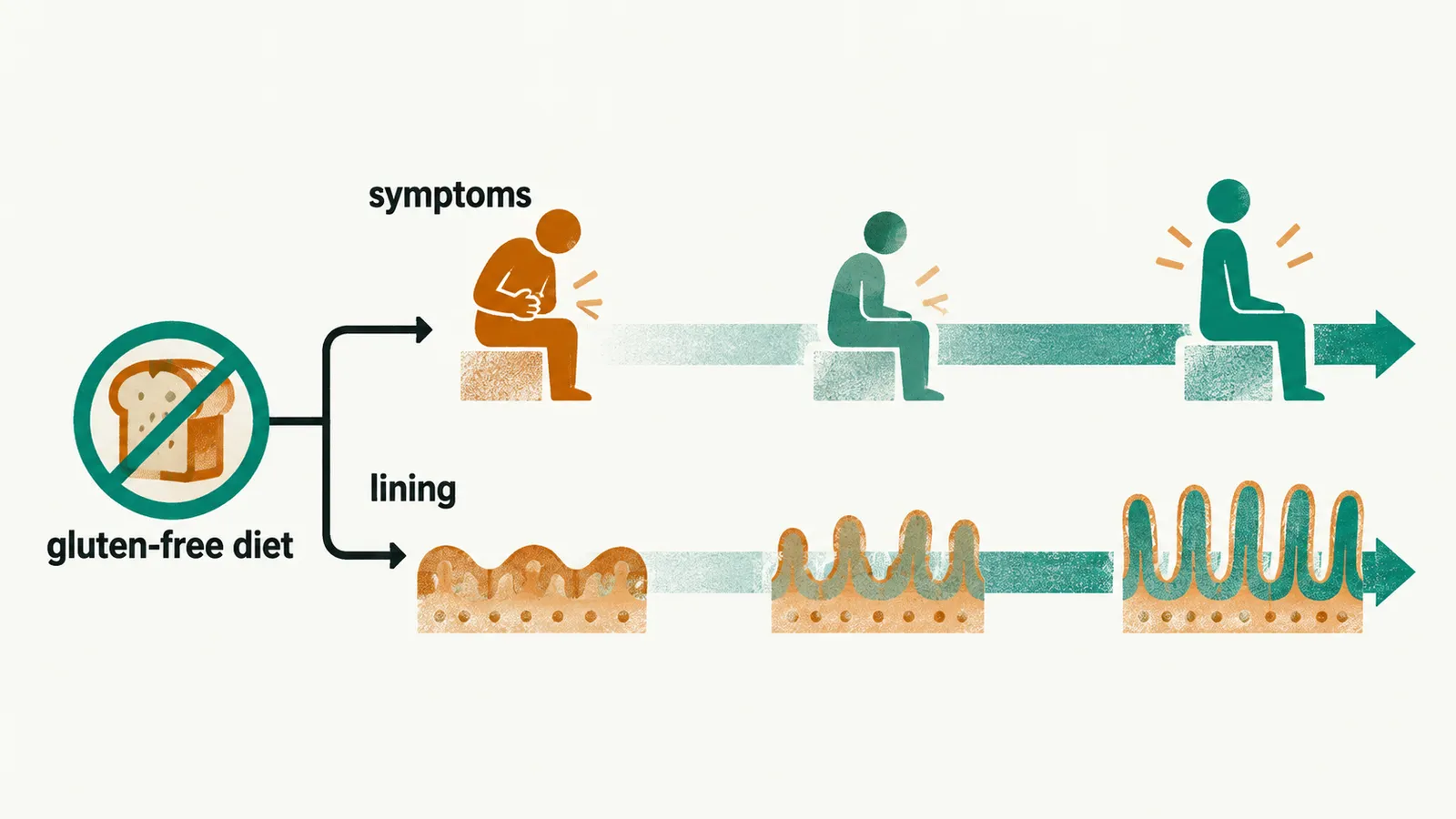
The usual framework is a clinical review every 6 to 12 months. It includes:
- growth and pubertal progress, because normal growth and development are goals of treatment in children;
- resolution of symptoms;
- dietary review.
The tests at follow-up are anti-tTG IgA, blood count, iron, folate, vitamin B12 and liver enzymes. The blood count, iron, folate and B12 follow the deficiencies that malabsorption from a damaged lining can cause. Liver enzymes are included because raised values can occur in celiac disease and are expected to settle on the diet. If they stay raised, another cause should be sought.
How is adherence judged?
A blood test is part of the review, but what does it show? Anti-tTG IgA is the antibody against tissue transglutaminase used at diagnosis. It follows the autoimmune process, so it normalizes over months on a strict diet, and falling values generally indicate adherence and healing.
| Anti-tTG IgA | What it tells |
|---|---|
| Raised | Useful marker of major gluten exposure |
| Normal | Does not prove the diet is strict, because the test is not sensitive enough to detect small amounts of gluten |
So adherence monitoring depends on both serology and a direct conversation about the diet. The review has to ask about the diet directly rather than only measuring antibodies.
This matters most in adolescents, who are the group at highest risk of abandoning the diet for social reasons. Adolescents are moving away from parental supervision, and they may also be less likely to attend follow-up.
Why is the diet permanent, and what does it guard against?
Why not stop once the child feels well? The long-term risks of celiac disease are:
- a small increase in the risk of enteropathy-associated T-cell lymphoma, a lymphoma arising in the intestinal wall, and of other malignancies;
- reduced bone density, which can follow from malabsorption of calcium and vitamin D by the damaged lining;
- association with other autoimmune diseases, thought to reflect shared genetic susceptibility, notably the same HLA haplotypes.
These risks are the reason the diet is permanent rather than convenient. Excess risk is associated with continuing gluten exposure and persistent villous atrophy, the flattened intestinal lining of active disease. That association is the practical argument for staying on the diet: long-term adherence lowers the risk of complications.
What makes celiac disease unusual among chronic bowel diseases?
Celiac disease is treatable by taking away its trigger, and the gluten-free diet works because that trigger is known. Inflammatory bowel disease is the other chronic disease that often first shows itself in a child as prolonged loose stools. Its cause is unknown, so there is no single dietary trigger to remove. What, then, is inflammatory bowel disease in a child, and how is it recognised when no trigger can be taken away? That is the subject of Pediatric Inflammatory Bowel Disease.