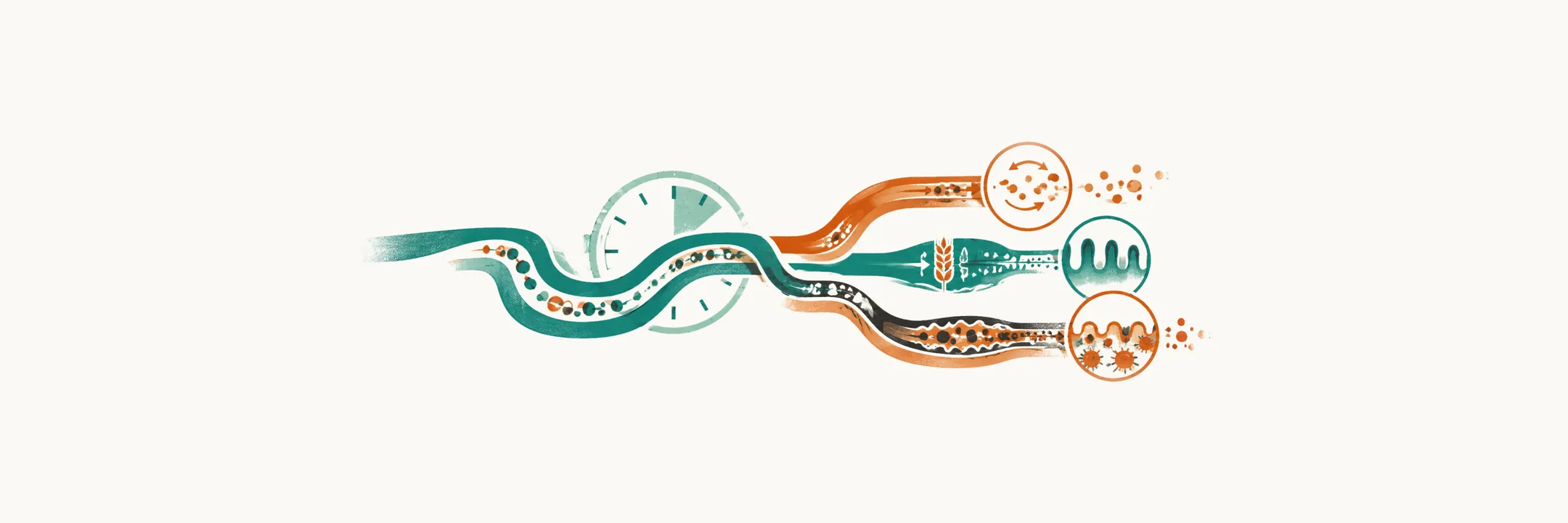
Chronic diarrhea in a child means loose or watery stools continuing for 14 days or more. This is a duration threshold, not a diagnosis. The threshold marks the point where an acute illness has failed to resolve, so the plausible causes past it are almost entirely different from those of acute gastroenteritis.
What sits behind the threshold?
Past the threshold, three things sit behind the diarrhea: a mechanism, celiac disease and inflammatory bowel disease (IBD).
The first is the mechanism. The intestine is losing water or failing to absorb what passes through it, and the stool pattern narrows down which of these is at work.
The second is celiac disease, a permanent immune-mediated intolerance of gluten that damages the mucosa of the small intestine. The third is IBD, chronic relapsing inflammation of the gastrointestinal tract. It comprises Crohn’s disease, ulcerative colitis and an unclassified intermediate group.
Celiac disease and IBD are not forms of chronic diarrhea. Both are diseases in their own right. They belong here because prolonged loose stools are often what brings the child to medical attention in the first place. All three also share a red-flag set.
A single work-up logic runs through all three: history and growth chart, then first-line non-invasive tests, then endoscopy only where it is pointed. What separates them is mechanism, definitive diagnosis and treatment. So the useful way to learn them is as a layered differential, not as three unrelated topics.
Which note answers which question?
The first three notes cover the diarrhea itself:
- Definitions and Mechanisms of Chronic Diarrhea in Children: the duration thresholds, the four mechanisms (osmotic, secretory, fat-malabsorptive, inflammatory), the bedside and stool findings that tell them apart, and how the likely causes change with the age of the child.
- Clinical Approach and Work-up of Chronic Diarrhea in Children: the gated four-step work-up, the red flags that override reassurance, and how a malabsorptive or inflammatory pattern sends the child to a different endoscopy.
- Functional Diarrhea of Toddlerhood and Overflow Around Constipation: the two non-organic patterns that dominate the differential in early childhood. One, functional diarrhea of toddlerhood, is a chronic diarrhea diagnosis; the other, overflow around constipation, only mimics chronic diarrhea.
Celiac disease then runs from the disease itself, through diagnosis, to lifelong treatment:
- Celiac Disease in Children: how common the disease is, the HLA genes that predispose to it, the mechanism behind it, the clinical forms including ones without diarrhea, and how it differs from wheat allergy and non-celiac wheat sensitivity.
- Diagnosing Celiac Disease in Children: the blood antibody tests, total IgA with anti-transglutaminase IgA; the European pathway that diagnoses some children without a biopsy; and the biopsy and histology that are still needed in some cases.
- Treating and Monitoring Celiac Disease: the strict, lifelong gluten-free diet, contamination that matters as much as the obvious gluten sources, follow-up every 6 to 12 months, and the long-term risks that make the diet permanent.
IBD runs from recognition and diagnosis to treatment:
- Pediatric Inflammatory Bowel Disease: how Crohn’s disease, ulcerative colitis and IBD-unclassified differ, when to suspect IBD in a child, fecal calprotectin (a stool marker of intestinal inflammation) and how it is read, how endoscopy and imaging make the diagnosis, and what predicts a more aggressive course.
- Treatment and Monitoring of Pediatric Inflammatory Bowel Disease: inducing remission, nutritionally in Crohn’s disease and by severity-based drug treatment in ulcerative colitis, maintenance with thiopurines and biologics, and the growth and surveillance questions specific to children.
Where to start
Reading order follows the layers. If the topic is new, begin with the notes on definitions and mechanisms and on the clinical approach. They establish the vocabulary of mechanism and the order of tests that the disease notes assume. After them, celiac disease and IBD can be read in either order.
How does this relate to acute diarrhea, and what lies outside it?
The family sits at the far end of the time axis from Acute Diarrhea and Dehydration. Acute diarrhea lasts less than 7 days, is viral in most European children and is managed by replacing fluid. The reasoning here begins where that reasoning stops. It reuses the vocabulary of osmotic and secretory mechanisms, described for the acute setting in Pathophysiology of Acute Diarrhea and Dehydration, and extends it to conditions defined by duration, for which rehydration is not the answer.
Some causes appear only as parts of the differential: cow’s milk protein allergy, cystic fibrosis, congenital enteropathies such as , parasitic infection and irritable bowel syndrome. Each has its own mechanisms and work-up, and none is covered in depth.
Deeper IBD treatment questions also lie outside the family: which biologic to choose after failure of a first agent, how to switch, and the thresholds for therapeutic drug monitoring, the measurement of drug levels to guide dosing. These follow current guidance from ESPGHAN (European Society for Paediatric Gastroenterology, Hepatology and Nutrition) and ECCO (European Crohn’s and Colitis Organisation).
Childhood presentation, diagnostic reasoning and the treatment framework are taught; nothing here is intended as patient-specific advice.
When does diarrhea count as chronic, and which of four mechanisms is producing the stools?