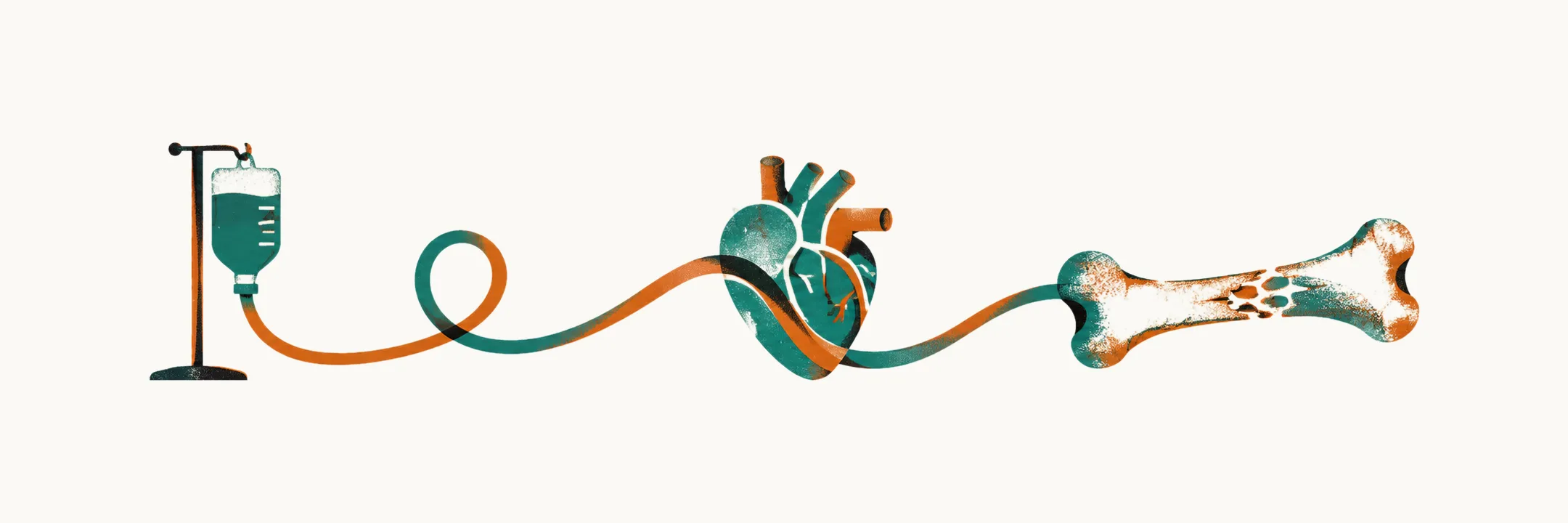
Why does curing leukemia leave a mark?
Childhood acute lymphoblastic leukemia (ALL) is treated with cure as the goal, and contemporary protocols reach it in most children. The cure comes from a backbone of several drugs, and the drugs that kill the leukemia also act on healthy tissue. A child’s organs are healthy when treatment starts, so the injury is silent. Treatment itself leaves a mark that outlasts the therapy.
That mark is not a complication of the leukemia. It comes from the treatment. For osteonecrosis, the leukemia’s own features, such as marrow infiltration, white cell count and immunophenotype, were not linked to the risk. The exposure matters more than the disease.
What is a late effect, and when does it show?
Late effects appear months to years after treatment ends.
They do not follow the same timetable as the treatment. The injury is laid down while the child is on therapy, stays quiet, and declines on its own, later schedule. A child who finishes chemotherapy at 6 years of age may meet late effects in adolescence or adult life.
If the mark is silent and late, what decides who gets it?
What decides which late effects a child faces?
Which late effects a person faces depends less on the diagnosis than on the exposure. Each drug class has its own target organ, so what the child received decides what goes wrong. Several things change the profile:
- the drugs used, and the cumulative dose of each;
- whether the brain or chest was irradiated;
- whether the disease relapsed or needed stem cell transplant, because both mean more treatment and therefore more exposure.
Follow-up after childhood ALL is therefore organized around the treatment the child actually received. It continues for life rather than ending when chemotherapy stops.
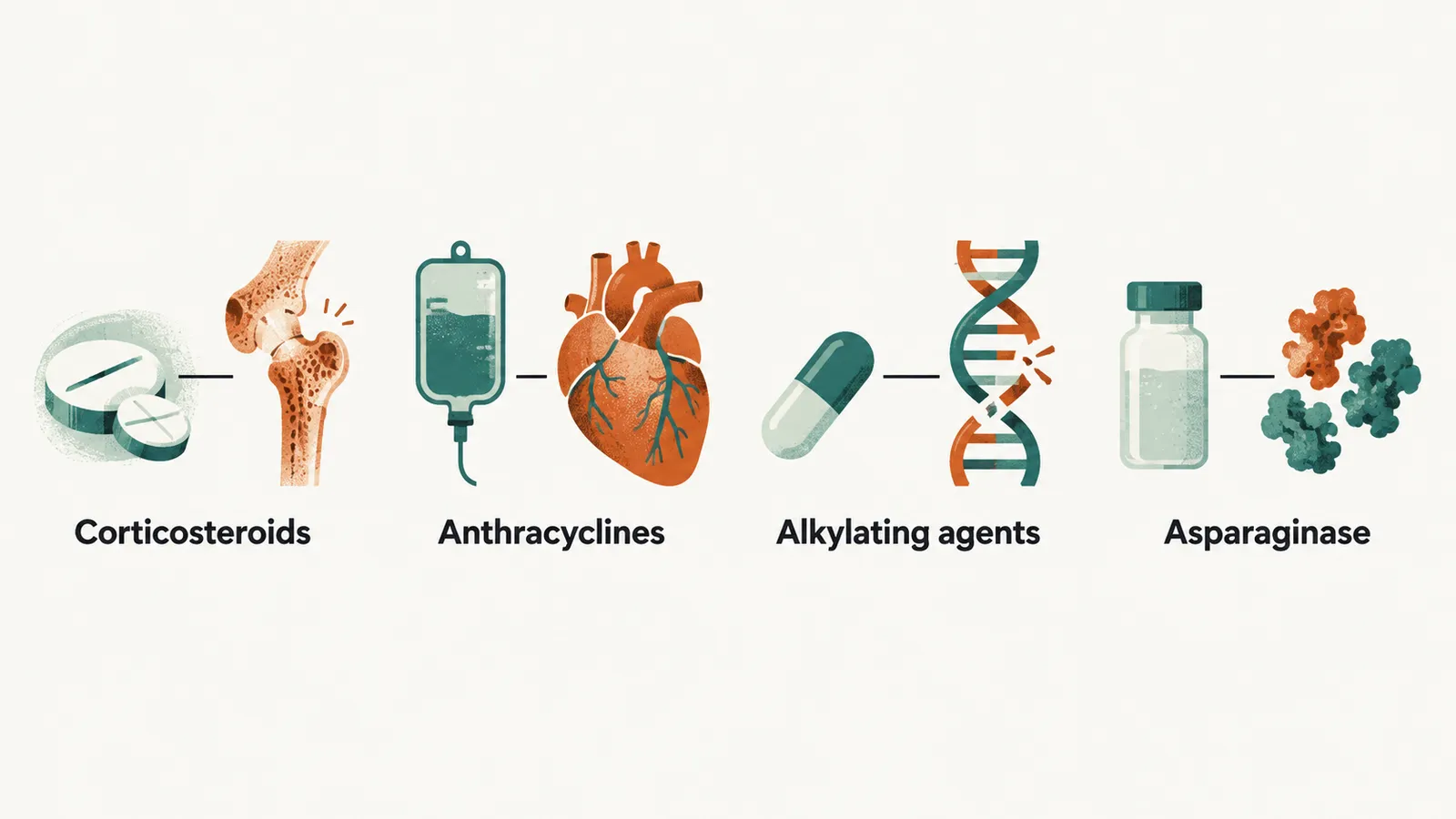
Four drug-class associations stand out. Which drug does what?
Why do corticosteroids damage bone, and why adolescents?
Corticosteroids (dexamethasone, prednisone) are associated with osteonecrosis, avascular necrosis, especially of the hip and knee. Bone sits in a rigid compartment and is supplied by small vessels. Steroids are thought to unbalance that supply: fat-laden marrow, clots or emboli in the small vessels, and rising pressure inside the bone may all play a part. Steroids are also thought to damage bone cells and the repair of bone. The early events are poorly understood, so this is a proposed picture, not a settled one.
The risk is strongly age-dependent. Osteonecrosis is uncommon in young children. A proposed explanation is that the growth plate of immature bone gives elasticity that absorbs the rising pressure. Risk is much higher from about age 10 years. As growth plates close in adolescence, bone may no longer absorb that pressure, and puberty adds the metabolic demands of the growth spurt. Adolescents are the highest-risk group.
Females are at additional risk. A proposed explanation is that estrogen, which has procoagulant effects, may add to the demands of puberty. The evidence for a sex difference is not fully agreed.
Now a drug that hits a different organ.
Why do anthracyclines damage the heart?
Anthracyclines (doxorubicin, daunorubicin) are associated with dilated cardiomyopathy. Oxidative stress and mitochondrial injury in heart muscle cells are thought to be involved, though the mechanisms are not fully understood. The damage is thought to start as silent injury to these cells and to weaken the pump gradually.
The damage is dose-dependent. The more drug given, the more muscle cells are injured, so risk rises as cumulative dose rises.
The heart can look normal at the end of treatment and decline later. Cardiotoxicity can appear years or even decades after therapy, and the late form is typically irreversible. That is why anthracycline-exposed survivors need long-term echocardiographic surveillance rather than a single end-of-treatment scan.
Then there are drugs that damage DNA.
What do alkylating agents leave behind?
Alkylating agents (cyclophosphamide, ifosfamide) damage DNA. One consequence is secondary malignancy, particularly myeloid. Secondary myeloid leukemia is often preceded by a myelodysplastic phase and tends to appear late, a delay thought to reflect further genetic events after the first loss of chromosomal material.
The other consequence is gonadal dysfunction, which alkylating agents are associated with.
And one drug acts during treatment itself.
Why does asparaginase cause trouble now rather than later?
Asparaginase depletes asparagine, which is how it starves leukemic blasts. Healthy cells also make fewer proteins. That reduced protein synthesis is implicated in pancreatitis, although the precise pathogenesis is unknown. Asparaginase also lowers the production of proteins of coagulation and fibrinolysis, which may raise the risk of thrombosis or bleeding. The thrombosis includes sinus venous, cerebral and peripheral events. Thrombosis is multifactorial: the central venous catheter, corticosteroids, asparaginase and the leukemia itself all contribute.
The drug acts while it is given and circulating. Most thrombotic events occur in induction, when exposure is heaviest. So asparaginase effects occur during and shortly after treatment.
There is also radiation, the add-on that treatment design tries to avoid.
What does cranial irradiation add?
Where cranial irradiation is still used, it adds neurocognitive, endocrine and second-tumor risk. It acts on the brain and the hypothalamic-pituitary region, and treatments that directly affect nervous system structures may produce neurocognitive deficits.
How much of all this is there in practice?
How common is it, and has it improved?
A chronic health problem is common rather than exceptional among long-term survivors. In the Childhood Cancer Survivor Study, the 25-year cumulative incidence of a severe, life-threatening or fatal condition after childhood ALL was about 21% for children treated in the 1970s and 1980s.
Survivors treated on more recent risk-stratified protocols have lower rates of severe chronic conditions than earlier cohorts. The burden has not disappeared, though. Contemporary treatment has reduced cranial irradiation and anthracycline exposure without removing either.
So what does care after treatment look like?
What does survivorship care involve?
Survivorship care is a distinct part of pediatric oncology rather than a follow-up appointment.
Consider a teenager who finished ALL therapy five years ago. The teenager still carries risk of hip osteonecrosis from steroids, anthracycline cardiomyopathy, secondary malignancy from alkylating agents and asparaginase-related thrombosis.
Surveillance follows the exposure record. Echocardiography, for example, is used for a child who received anthracyclines, because the heart is where the injury is expected.
Surveillance is lifelong because the gap between treatment and the first sign of a late effect can be measured in decades.
This burden is one reason treatment design has changed.
Why does late-effect burden now shape treatment choice?
Reducing late-effect burden has become one of the aims of treatment design. Risk-adapted therapy was introduced partly for this reason. The newest agents are judged on late-effect burden as well as cure rate, by how much anthracycline, alkylating agent and corticosteroid they allow to be left out of a child’s treatment.
If the aim is to leave anthracyclines, alkylating agents and corticosteroids out of the backbone, what can do the leukemia-killing in their place?