Adrenal insufficiency means that the adrenal cortex’s glucocorticoids, mineralocorticoids and androgens are reduced or absent, in their production or in their action. It is a serious condition, and before synthetic glucocorticoids were introduced it was fatal.
How is the disease organised?
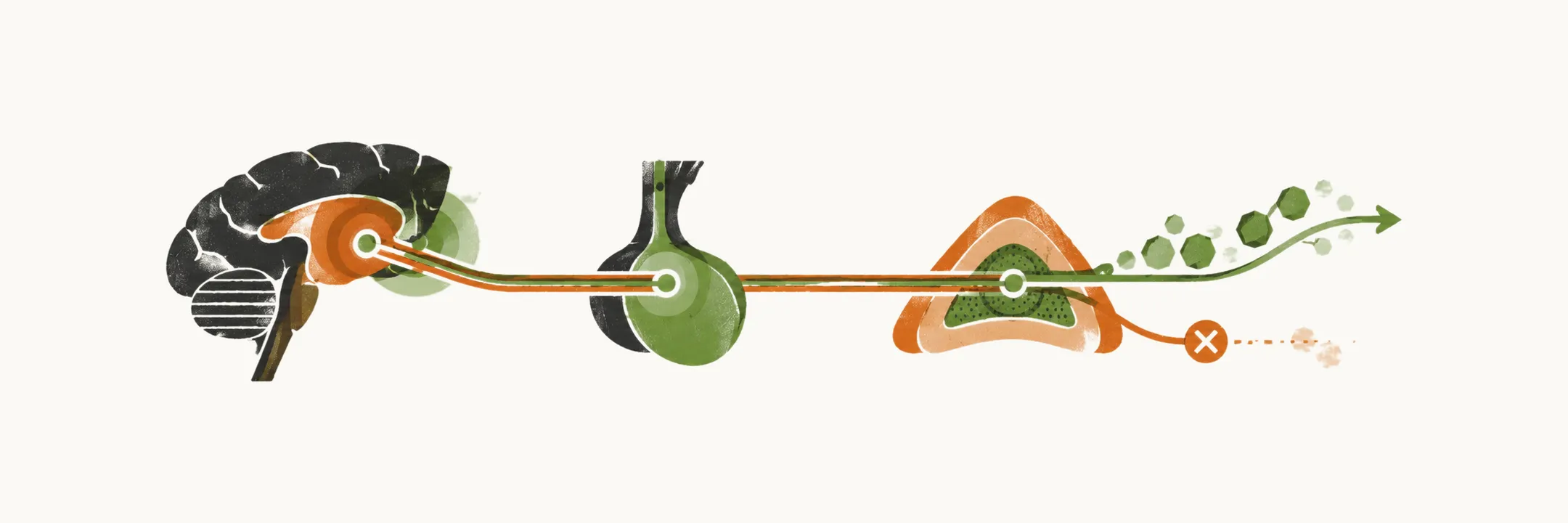
The adrenal cortex does not work alone. It is driven by a chain of signals: the hypothalamus supplies CRH (corticotropin-releasing hormone), and the anterior pituitary supplies ACTH (adrenocorticotropic hormone). If the cortex is driven by a chain, a failure can sit at any link, so adrenal insufficiency is classified by the level at which the axis fails:
- Primary: the adrenal gland itself is affected.
- Secondary: the anterior pituitary cannot supply enough ACTH.
- Tertiary: the hypothalamus cannot supply enough CRH.
The level of failure decides which hormones are lost, and therefore what the patient shows. That is why level organises most of the topic.
Where should a reader start?
Since the level explains the picture, the place to start is where the three forms are told apart. The first five notes follow adrenal insufficiency in general and are best read in this order:
- Pathophysiology of Adrenal Insufficiency is the recommended start, because later notes rely on how the three forms differ. It covers why symptoms appear only once more than 90% of the adrenal cortex is destroyed, and why the secondary and tertiary forms keep normal mineralocorticoid secretion.
- Causes of Adrenal Insufficiency gives the epidemiology and the causes of the primary, secondary and tertiary forms.
- Clinical Manifestation of Adrenal Insufficiency covers the chronic signs and symptoms, the acute adrenal crisis and its precipitants, and the features that separate the secondary and tertiary forms from the primary form.
- Diagnosis of Adrenal Insufficiency covers the laboratory tests, the standard- and low-dose ACTH stimulation tests, the hormone patterns that separate the three forms, and the workup for the underlying cause.
- Treatment of Adrenal Insufficiency covers glucocorticoid and mineralocorticoid replacement, the prevention and emergency treatment of adrenal crisis, and the long-term outlook.
What if the fault is one enzyme rather than one level?
Sorting failure by level is one way to see the disease, but a different failure lies inside the steroid pathway itself. Congenital adrenal hyperplasia (CAH) is a group of inherited defects in that same pathway. Here the disorder lies in a single enzyme of hormone synthesis rather than in a level of the axis. CAH is best read after the general notes, beginning with the overview:
- Congenital Adrenal Hyperplasia: Overview introduces CAH, its inheritance and the two most common enzyme deficiencies.
- Congenital Adrenal Hyperplasia: Pathophysiology explains how the block in cortisol synthesis raises ACTH and shunts precursors into androgens, the classical and non-classical forms, and the origin of salt wasting.
- Congenital Adrenal Hyperplasia: Clinical Manifestation covers virilization of the external genitalia, the effects on puberty, fertility and stature, salt wasting, and the phenotypes of 21-hydroxylase deficiency.
- Congenital Adrenal Hyperplasia: Diagnosis covers when to suspect CAH in a newborn, steroid assays and newborn screening, and the confirmatory test.
- Congenital Adrenal Hyperplasia: Treatment covers replacement therapy, monitoring, and the approach to non-classical disease.
What actually happens when the chain fails at one level, and why do the three forms lose different hormones?