What is congenital adrenal hyperplasia?
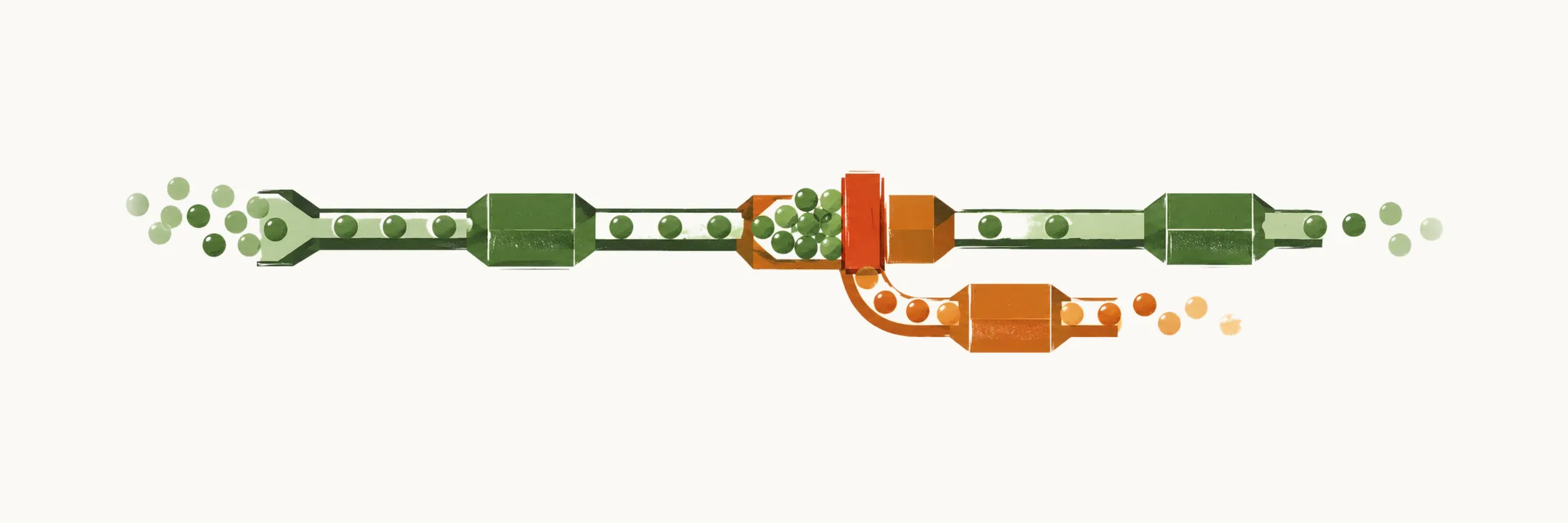
The adrenal cortex builds its steroid hormones from cholesterol through a chain of enzyme steps, much like a production line. The layers differ in what comes off the line: the zona glomerulosa makes mineralocorticoids, while the inner layers, the zona fasciculata and zona reticularis, answer to ACTH from the pituitary.
Congenital adrenal hyperplasia (CAH) is the name for all disorders with a genetic defect affecting steroidogenesis, the production of steroid hormones in the adrenal gland. Each disorder of the family is a defect in one enzyme of that chain.
CAH is inherited as an autosomal recessive condition. A child is affected only when both copies of the responsible gene carry a defect, so the child receives one defective copy from each parent. Each parent of an affected child is usually an unaffected carrier, with one defective and one working copy.
Where does the cortisol line break, and what follows?
If one enzyme step can stop the line, it matters how many steps there are. The zona fasciculata is the layer that makes glucocorticoids, and their production is governed by 5 different enzymatic steps. Each step needs a working enzyme, so a mutation or deficiency in any of these enzymes leads to deficient glucocorticoid production in the adrenal gland.
Cortisol is also the brake on the pituitary. With low glucocorticoids, negative feedback on the pituitary gland is removed, and ACTH production rises. ACTH is the growth signal for the gland as well as the signal to work, so its over-production has a proliferative effect on the adrenal gland. The usual explanation is that constant high ACTH enlarges the zona fasciculata, and the result is hyperplasia of both glands.
The name follows the mechanism, step by step: an inherited (congenital) defect blocks cortisol synthesis, ACTH rises, and the adrenal glands become hyperplastic.
Which enzyme is usually the one, and what piles up behind it?
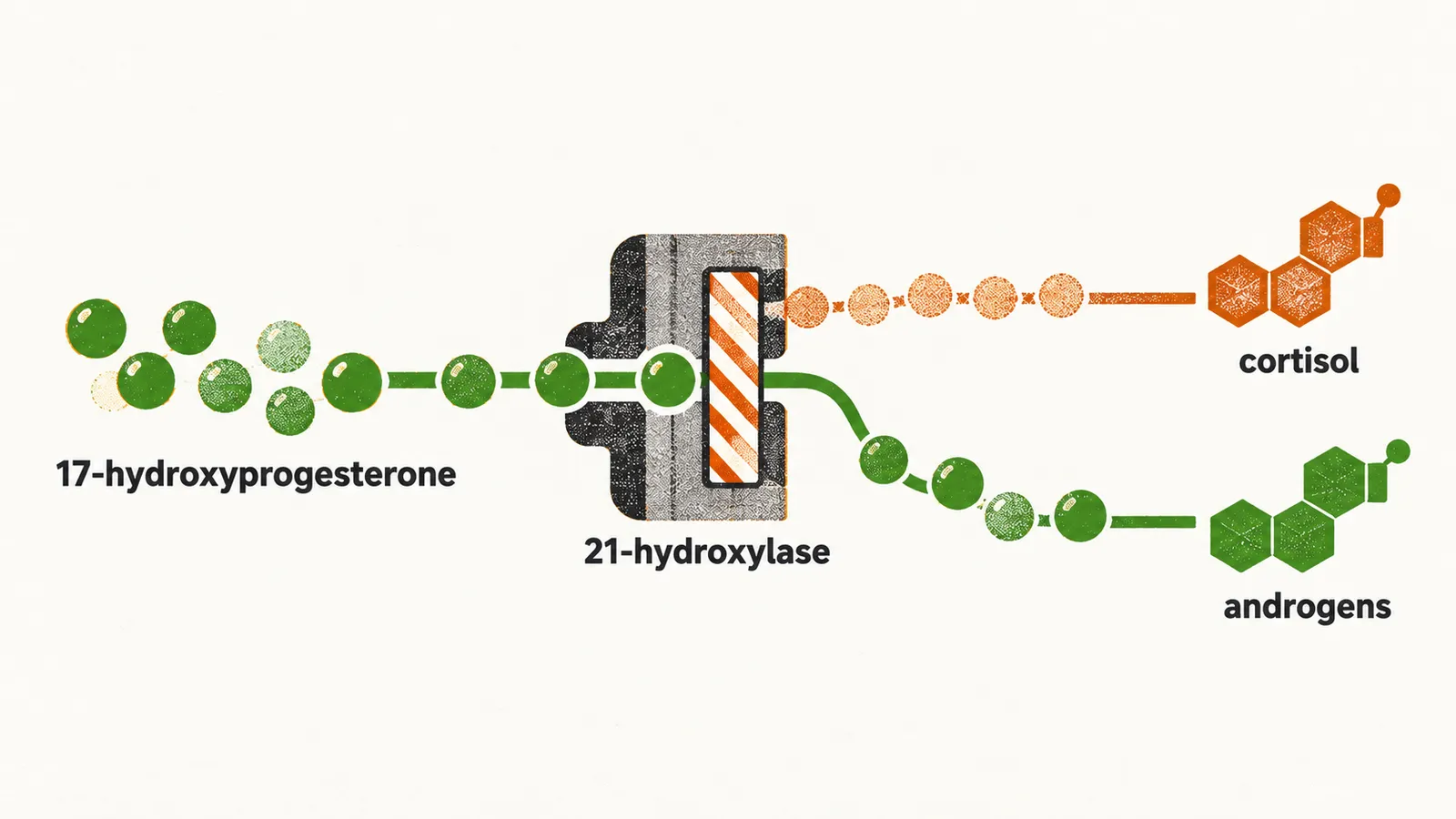
The block does not sit at the same step in every patient. More than 90% of CAH cases have a mutation in 21-hydroxylase, and this form is called 21-hydroxylase deficiency (21OHD) CAH.
When an enzyme is blocked, the substance it should convert piles up in front of the block. For 21-hydroxylase, that substance is 17-hydroxyprogesterone, the substrate of the enzyme in the glucocorticoid pathway, so in 21OHD CAH 17-hydroxyprogesterone accumulates. The same precursors also lie on the road to androgens, so the accumulated 17-hydroxyprogesterone can be shunted to the androgen production pathways.
The estimated frequency of 21OHD CAH is 1:13,000 to 1:15,000 cases.
Is there another common form?
Yes. A different enzyme in the line gives a different block. The second most common form of CAH is a mutation in 11β-hydroxylase. 11β-hydroxylase deficiency makes up 5-8% of all CAH cases, and 11β-OHD CAH occurs in 1:100,000 live births.
Both blocks leave the cortex short of cortisol, and in 21OHD CAH the substance in front of the block is pushed toward androgens. What exactly does that do to the baby, and why does the severity of the block set the form of the disease?