What does treating CAH have to achieve?
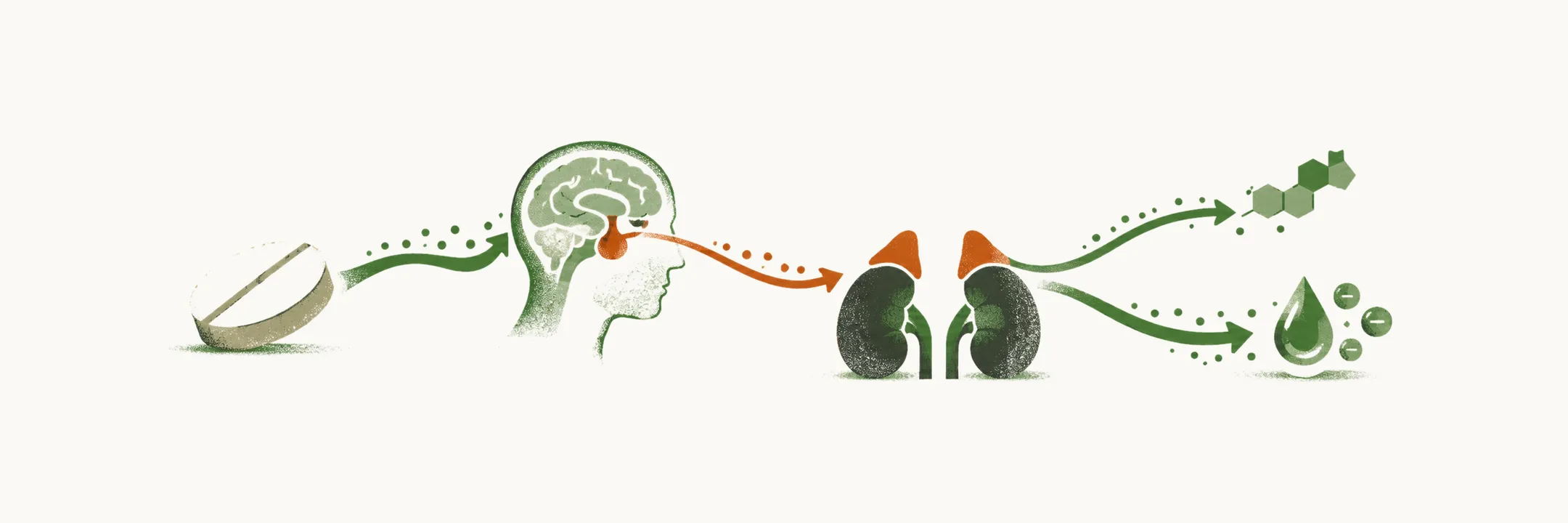
Treatment replaces the cortisol and aldosterone that the adrenal gland cannot make, as in any adrenal insufficiency. But CAH has a second problem. With cortisol low, ACTH is high, and the cortex pushes its precursors toward androgens (see Congenital Adrenal Hyperplasia: Pathophysiology). So treatment also has to suppress the excess androgen drive.
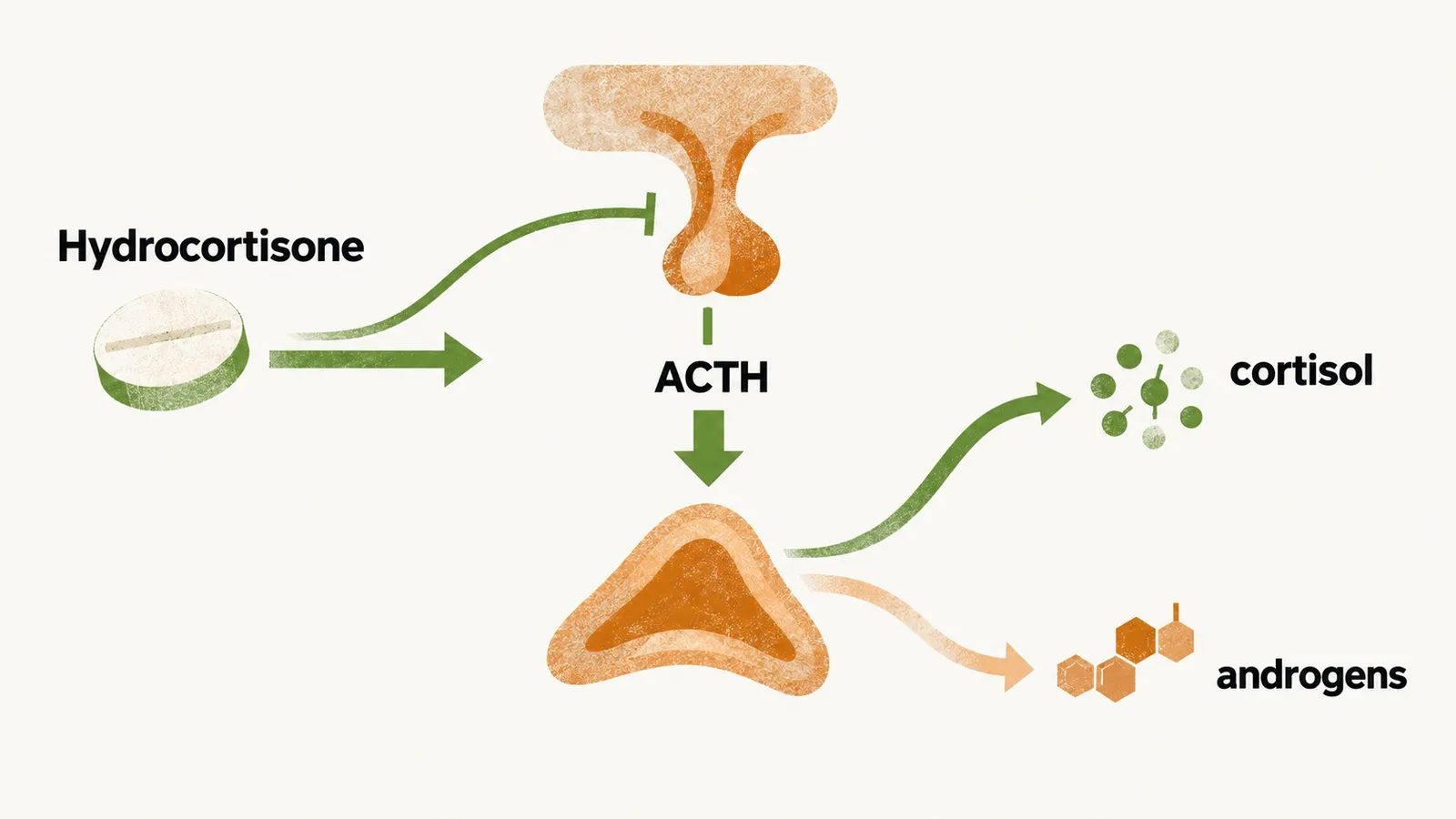
One drug does both jobs. A glucocorticoid supplies the missing cortisol and also restores the negative feedback, so ACTH falls and the push toward androgens eases. The catch is that treatment aims to avoid the harm of giving too much glucocorticoid. Pushing androgens all the way down takes more glucocorticoid than replacement needs, and an excess harms in its own right. Treatment is therefore a balance, and each choice (which steroid, what dose, what is measured and when) follows from it.
Which glucocorticoid, and why not a stronger one?
Because the same drug must replace cortisol and stay easy to adjust, growing children with classic CAH are treated with hydrocortisone. It has a shorter half-life and fewer side effects, such as growth suppression, than other glucocorticoids. The dose is typically 10-15 mg per square meter body surface area per day, divided into three doses. Hydrocortisone is short-acting, so a single dose cannot cover the day.
Long-acting potent glucocorticoids such as dexamethasone are avoided during growth. The reason is that dexamethasone-type drugs suppress linear growth, and growth is what a child is meant to be doing. They also carry a higher risk of iatrogenic Cushing syndrome. Once growth is complete, the growth objection falls away and a longer-acting preparation can be used instead.
Why do salt-wasting infants also need fludrocortisone and salt?
In the salt-wasting form the second hormone is lost too. Aldosterone is missing, so these infants lose sodium. Infants and young children with the salt-wasting form therefore also receive fludrocortisone, 0.05-0.2 mg per day, to replace the aldosterone. They also receive sodium chloride supplements, 1-2 g per day, to replace the lost sodium.
The supplements are needed because breast milk and ordinary infant feeding do not supply the sodium these patients lose, so feeding alone cannot make up the loss.
Fludrocortisone retains sodium and water, so too much of it raises blood pressure. Blood pressure is therefore monitored closely in infants on mineralocorticoid. The immature renal tubule responds variably to the dose, so the dose cannot be set once and trusted.
How is the dose judged, and why is normal not the target?
With both hormones being given, the dose is judged against measurements and signs. It is adjusted to keep androgens under control without producing glucocorticoid excess.
Two markers are measured: 17-hydroxyprogesterone and androstenedione. Their levels vary with the time of day and the time of the last dose, so they are measured at a fixed point, before the morning dose, because that is when they peak.
The aim is to keep 17-hydroxyprogesterone within a target range, not to normalize it completely. Driving it fully down requires over-treatment, and over-treatment produces iatrogenic Cushing syndrome, a state of glucocorticoid excess caused by treatment.
Because the two errors are opposite, monitoring looks in both directions at once. It looks for signs of cortisol excess, and it looks for signs that androgen production is not adequately suppressed.
What protects the patient on the day the dose is not enough?
A fixed dose cannot rise on its own, and patients with classic CAH lack cortisol. They are therefore at risk of adrenal crisis and need the same precautions as any patient on glucocorticoid replacement (see Treatment of Adrenal Insufficiency):
- Stress-dose instructions: raising the glucocorticoid dose during illness or stress, because extra demand needs extra cortisol.
- An emergency card: it tells a clinician who does not know the diagnosis what is needed.
- Injectable hydrocortisone: for use when oral treatment cannot be taken, since an oral dose is not absorbed then.
What about surgery and prenatal treatment?
In some girls the androgen excess has already acted before birth, and the open questions there are not about doses. Virilized external genitalia in females may be treated surgically. The timing and the operation carry uncertainty, because the evidence on the benefit and risk of early versus late surgery is not strong. The decision is shared between the family and a multidisciplinary team, and it is not made routinely at birth, so there is time to discuss it.
Prenatal treatment aims to act on the fetus. Dexamethasone can reach the fetus because the placenta does not inactivate it. Even so, prenatal dexamethasone to prevent virilization is not recommended outside research settings.
When is non-classical disease treated?
The milder form changes the balance. Non-classical CAH is milder than the classic forms, because the enzyme keeps part of its activity and the partial deficiency is largely compensated by raised ACTH, so crisis is usually not a feature. It does not always need treatment.
Glucocorticoid therapy is offered to patients with symptoms of androgen excess, for example hirsutism, irregular menses or infertility. It is withheld from asymptomatic individuals, because the long-term risks of glucocorticoid therapy outweigh any benefit when there is no clinical problem to treat. A proposed additional concern is that a daily glucocorticoid suppresses the body’s own ACTH drive, which could raise the risk of crisis under severe stress.
So what does a person without symptoms gain that would justify taking a glucocorticoid for years?