What does a block in cortisol synthesis do to the patient?
The earlier notes showed how the enzyme block removes feedback, raises ACTH and shunts precursors into androgens. In 21-hydroxylase deficiency (21OHD) the clinical picture therefore combines the effects of androgen excess with, in the classical forms, loss of aldosterone. Androgens act on every androgen-responsive tissue, so what the patient shows depends on the age at which the excess acts. Aldosterone loss is a separate, second problem. How much enzyme activity remains decides how many of these effects appear and when, and the clinical picture falls into groups that follow the severity of the enzyme defect.
What happens to a female fetus?
The androgen excess acts first on the fetus, while the genitalia are forming. In females with 21OHD CAH, androgen accumulates and interferes with sexual differentiation during the 9th to 12th week after gestation. The external genitalia respond to androgen, so the result is different degrees of virilization, especially of the external genitalia. At one end of the range is clitoral enlargement; at the other is a penile urethra.
The internal genitalia are different. The uterus, fallopian tubes and ovaries do not respond to androgen in this way, and in females with CAH they develop and function completely normally. Therefore these females are fertile, despite the developmental changes from high androgen. Fertility can still be limited later in life, for hormonal reasons.
What do androgens do after birth?
After birth the excess continues, and in both males and females with 21OHD CAH it causes puberty abnormalities. Androgens drive pubic and axillary hair, skin and external genitalia, so the findings are:
- progressive penile and clitoral enlargement, with masculinization of the external genitalia in females;
- premature pubic hair and axillary hair;
- acne;
- male-pattern alopecia.
In females the menstrual cycle is also affected: menarche is delayed and cycles are irregular. This is often attributed to progesterone that is not suppressed.
Behavior can also be altered. Females with CAH can show altered gender role behavior (gender dysphoria): masculinized behavior and less attraction to heterosexual relations. Males with CAH show no behavioral changes or lack of heterosexual desire, unlike females.
Why is growth fast but final height short?
Androgens also act on bone. High androgen makes somatic and epiphyseal (growth plate) growth happen very early, and the growth plates also close very early. Growth is brought forward and then stops sooner, which causes under-development of stature: a child who grows fast early ends up short.
Why can fertility still be limited?
The hormonal disturbance that alters puberty also affects fertility, and for different reasons in each sex. This qualifies the normal internal anatomy of affected females.
In females with CAH, fertility can be limited by:
- amenorrhea;
- secondary polycystic ovary syndrome (PCOS), which may be triggered when adrenal progesterone and androgens are inadequately suppressed;
- a serum progesterone level that cannot be suppressed, the same disturbance that is often thought to lie behind the delayed, irregular menarche;
- irregular menses.
In males with CAH, fertility can be limited by a reduced sperm count. Suppressed gonadotropin release leaves the testes small, and the sperm count falls with them.
When does aldosterone loss add salt wasting and crisis?
So far every effect has been androgen. A severe enzyme defect adds a second problem. Low aldosterone, especially in the classical forms of 21OHD CAH, leads to salt wasting. Aldosterone normally retains sodium and water and excretes potassium (see Clinical Manifestation of Adrenal Insufficiency), so without it sodium and water are lost and potassium is kept. Salt wasting is characterized by:
- dehydration;
- hyponatremia;
- hypotension;
- hyperkalemia;
- metabolic acidosis;
- vomiting.
Adrenal crisis can happen in patients with severe lack of 21-hydroxylase. Both cortisol and aldosterone are short in them, so stress can tip the patient into shock. The crisis is more common in the classical forms, which have the severe enzyme loss.
How do the forms divide?
Severity of the block decides how much of each effect appears. Residual enzyme activity sets three phenotypes.
Simple-virilizing 21OHD CAH: 21-hydroxylase activity is reduced but still detectable. That activity is enough to drive androgen excess without salt wasting. The result is virilization and early rapid growth, leading to short stature. It is more obvious in females because of their ambiguous external genitalia. In males other signs must be looked for, such as hyperpigmentation and an enlarged phallus.
Salt-wasting 21OHD CAH is the more severe form, with almost no 21-hydroxylase activity. Because aldosterone is also lost, salt wasting is added to the androgen effects. Hyperandrogenism signs and symptoms are common to both classes, so the difference between salt-wasting and simple-virilizing is due to the difference in aldosterone production.
Non-classical CAH (NC-CAH), also known as late-onset CAH, begins with mild-to-moderate enzyme activity in early life. Activity is lost gradually over time, with accumulation of clinical manifestations. Therefore there is no virilization at birth in females, and hyperandrogenism appears during adolescence.
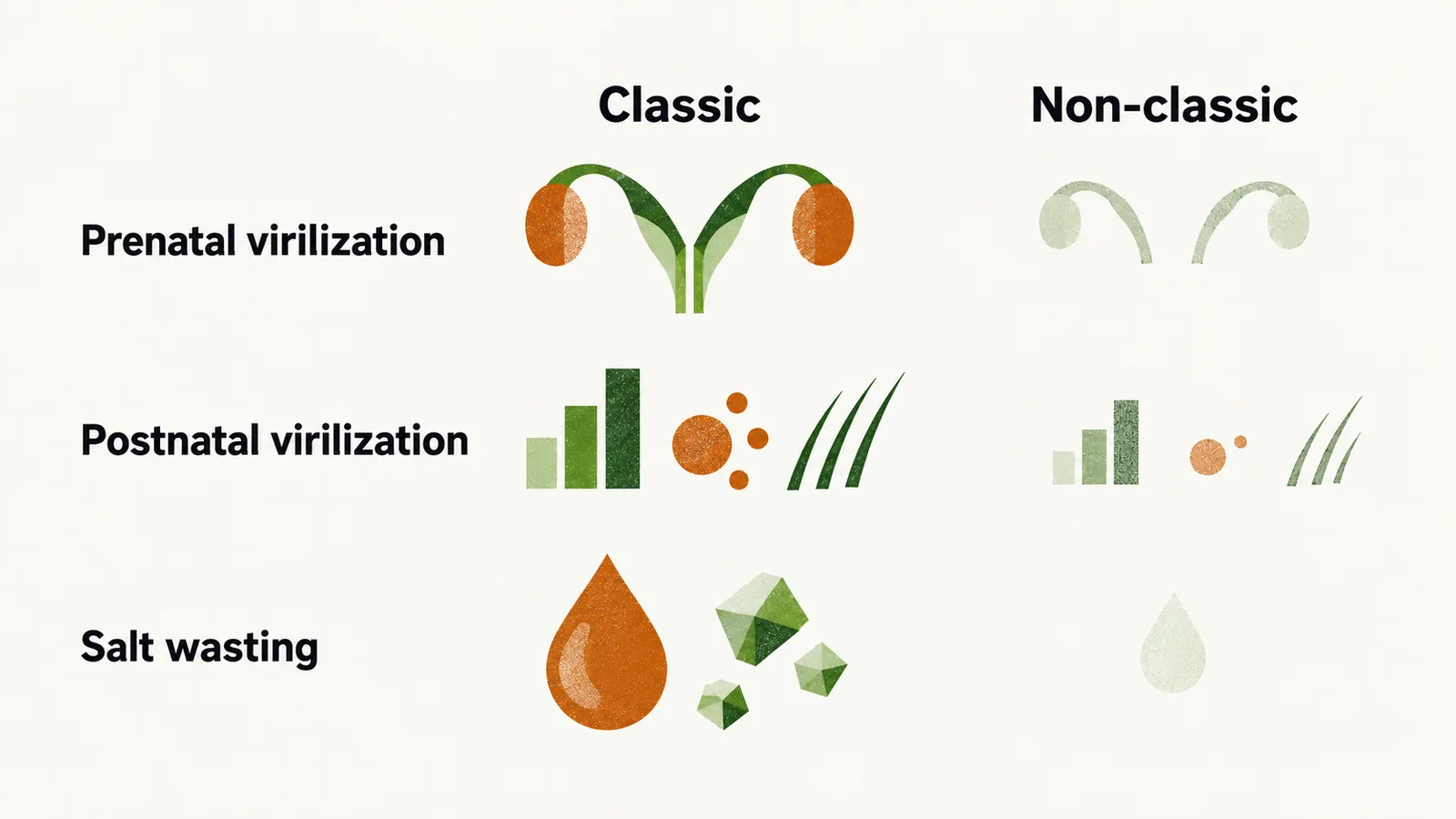
| Classic | Non-classic | |
|---|---|---|
| Prenatal virilization | Females only | Absent |
| Postnatal virilization (hyperandrogenism) | Females and males | Typical |
| Salt wasting | ~75% of all individuals | Absent |
In a male newborn the genitalia are not ambiguous, so other signs have to be sought. How is CAH recognised and confirmed in a newborn, especially a male one?