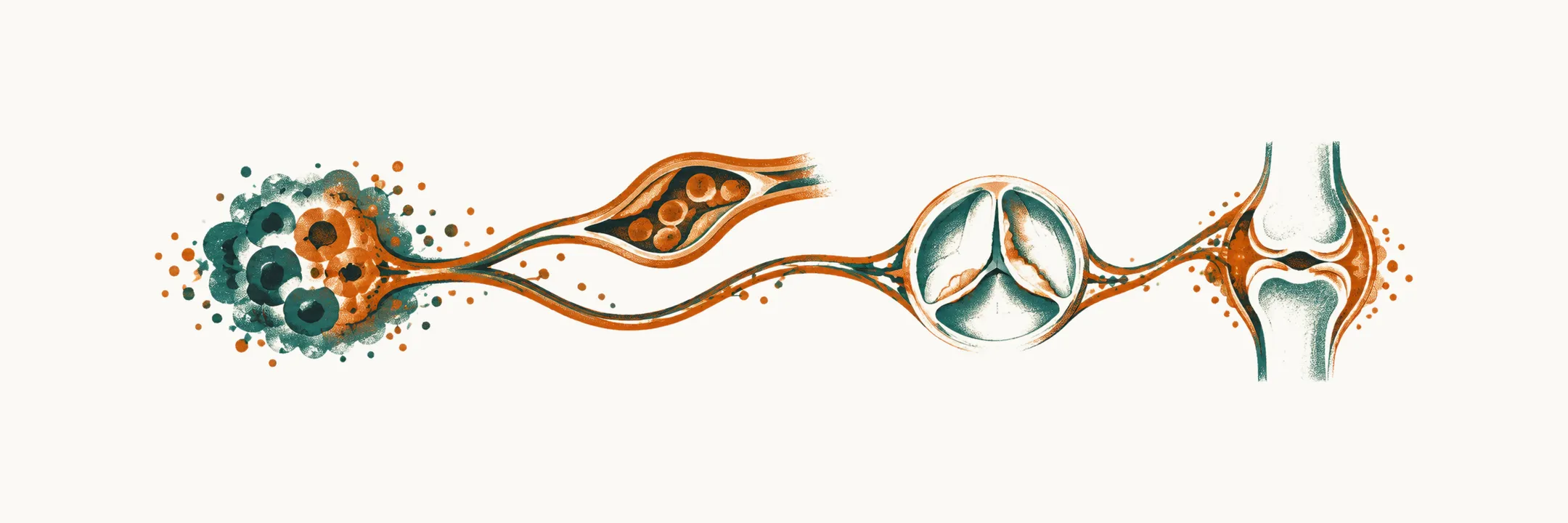
Rheumatological diseases are conditions in which the immune system inflames the body’s own joints, blood vessels, heart or other connective tissue. Each one is uncommon in children, and three dominate the group: Kawasaki disease, acute rheumatic fever and juvenile idiopathic arthritis.
What do these diseases have in common?
They present in a small number of recurring shapes: a fever that will not settle, a rash that comes and goes, a joint that will not straighten, an eye that looks normal but is not. The three diseases share enough of these surface features to be confused for one another. The same child can present with any of the three.
What differs is the tissue, and how soon it must be protected
Because the three look alike, the question becomes what separates them. The first answer is the tissue each one hits.
- Kawasaki disease is a vasculitis of medium-sized arteries in infants and young children, and the artery it damages is the coronary artery.
- Acute rheumatic fever is an immune cross-reaction that follows streptococcal pharyngitis. The immune response raised against the bacterium also attacks the child’s own tissues, and the damage it leaves permanently is in the heart valves.
- Juvenile idiopathic arthritis is chronic inflammation of joints that begins in childhood and lasts years. It threatens joints, growth and eyes.
The second answer is time. The three diseases matter out of proportion to their frequency because each carries a decision with a deadline. Kawasaki disease must be treated inside 10 days of fever onset to protect the coronary arteries. Streptococcal pharyngitis must be treated inside 9 days to prevent a first attack of rheumatic fever. Juvenile idiopathic arthritis must be treated early enough to prevent joint damage that cannot be undone later. In all three, time rather than severity decides the outcome. Rheumatic fever also has a known bacterial trigger, and it is the one of the three that can be prevented as well as treated.
So the question to ask of any child is which tissue is being hit, and how little time is left to protect it.
Which note answers which question?
Each disease has its own tissue and its own deadline, so each has its own note, and the notes that follow a disease cover its diagnosis, complications, treatment and prevention.
- Kawasaki Disease: who the disease affects, its principal features, the phases in which they appear, and why the coronary arteries are the target.
- Diagnosing Kawasaki Disease: the rule for complete and incomplete Kawasaki disease, the laboratory findings that support it, and the echocardiogram grading that shows coronary involvement.
- Treating Kawasaki Disease and Protecting the Coronary Arteries: intravenous immunoglobulin and the 10-day window, aspirin at its two doses, the children treated with corticosteroids from the outset, and the follow-up set by the coronary findings.
- Acute Rheumatic Fever: how the disease follows a streptococcal sore throat, and what happens to the valves afterwards.
- Diagnosing Acute Rheumatic Fever: the 2015 Jones criteria in low-risk and moderate- to high-risk populations, the evidence of a preceding streptococcal infection they require, and how to read the antistreptolysin O titre.
- Treating Acute Rheumatic Fever: clearing residual streptococcus, anti-inflammatory treatment stratified by how much the heart is involved, and the management of Sydenham’s chorea.
- Preventing Acute Rheumatic Fever and Its Recurrences: the 9-day antibiotic window and the regimens that meet it, and long-term benzathine penicillin prophylaxis and how long it is continued.
- Juvenile Idiopathic Arthritis: why it is a group of diseases rather than one, the categories of the ILAR classification, and the articular subtypes with the prognosis of each. The category a child has decides which threat, joints, eyes or whole body, matters most.
- Uveitis and Eye Screening in Juvenile Idiopathic Arthritis: why anterior uveitis produces no symptoms, how risk factors set how often a child is screened, and the stepped treatment once it is found.
- Systemic Juvenile Idiopathic Arthritis and Macrophage Activation Syndrome: the daily fever spikes and evanescent rash, the malignancies that mimic the disease, and the macrophage activation syndrome that turns it into an emergency.
- Treating Juvenile Idiopathic Arthritis: treat-to-target, the drugs from intra-articular corticosteroid to biologic agents, and the sequence most guidelines follow.
- Telling Kawasaki Disease, Acute Rheumatic Fever and Juvenile Idiopathic Arthritis Apart: the comparison of the three by fever pattern, rash, joint pattern, cardiac finding and laboratory result, with the wider differentials and the order in which to work through them.
Where should a reader start?
The list is a route through the notes, but a child does not arrive in list order. For a child with fever and rash, start with the comparison note, then go to the disease note it points to.
Several conditions of paediatric rheumatology in the broader sense lie outside these notes, and a child who fits none of the three may have one of them: IgA vasculitis, lupus, the hereditary autoinflammatory syndromes, PFAPA syndrome, and neonatal and reactive presentations.
So when a child has fever and rash, which of the three is it?