
Acute rheumatic fever is a delayed immune reaction to a streptococcal sore throat, and it appears 2-4 weeks after the throat has resolved. The damage comes from that reaction, not from the bacterium itself. So how does a doctor decide that a child with joint pain or a fever has it?
Why is there no single test?
A blood test can show that the bacterium was present, or that antibodies against it exist. It cannot show that the immune reaction has reached a valve or a joint. That is why no single test confirms or excludes the disease, and why it is diagnosed clinically. The diagnosis is a rule about findings, and the question becomes what the rule asks for.
What are the two parts of the rule?
The rule uses the Jones criteria as revised by the American Heart Association in 2015. It has two parts. The first is a set of findings that the immune reaction produces. The second is evidence that a group A streptococcal infection has actually occurred.
The diagnosis needs that evidence plus either two major manifestations or one major plus two minor manifestations. The second part is not optional. The criteria describe a reaction that only follows the infection, so the infection has to be shown. The criteria are necessary but not sufficient: without evidence of recent infection, the findings alone do not make the diagnosis.
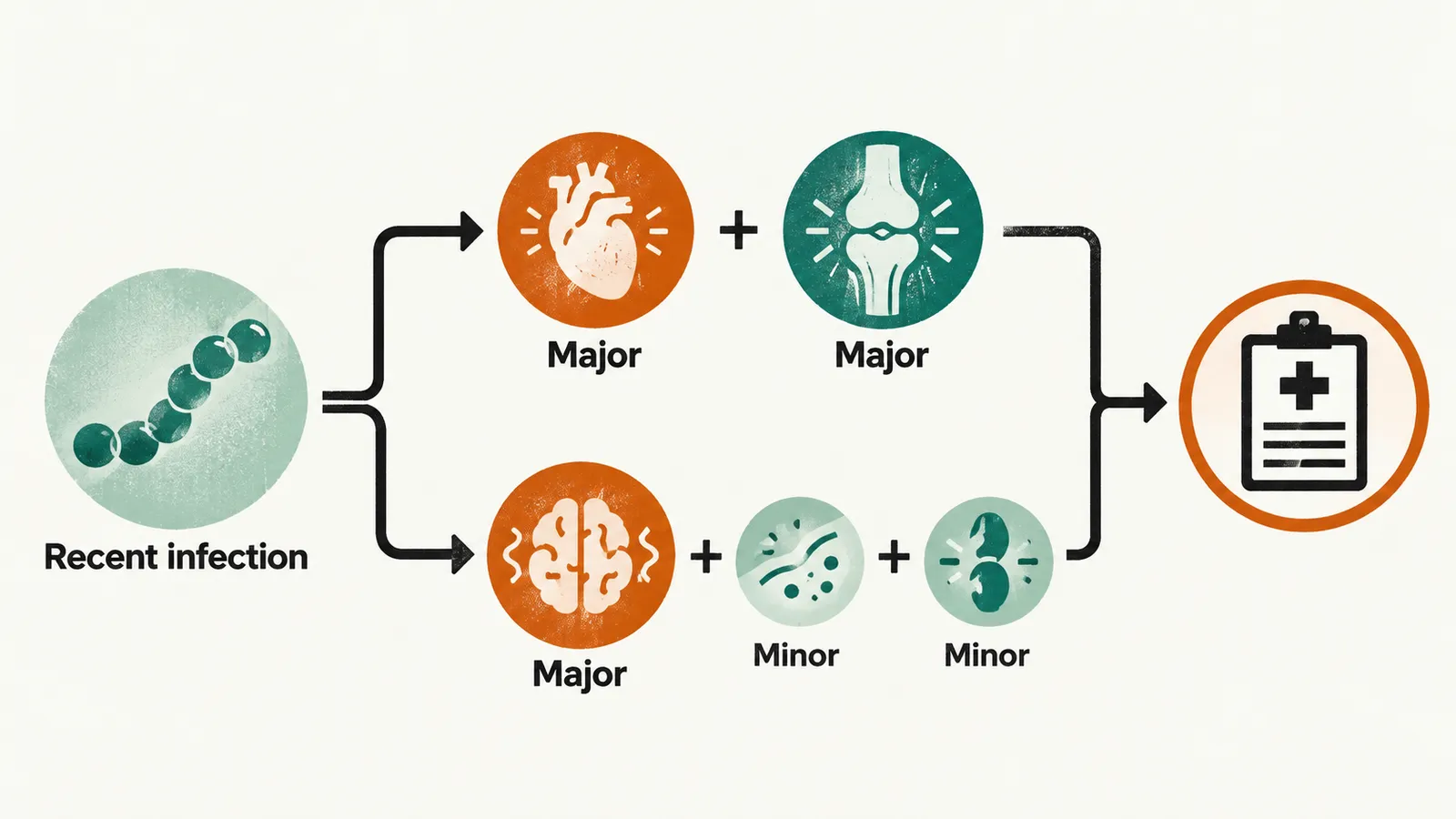
Which findings are major?
The major manifestations are the five characteristic findings of the disease: carditis, arthritis, chorea, erythema marginatum and subcutaneous nodules. Chorea, erythema marginatum and subcutaneous nodules are major in both low-risk and moderate- to high-risk populations. Carditis is also major in both, and it can be clinical or subclinical. That last word needs a closer look.
Why does carditis that only the echo shows count?
A murmur is the sound of turbulent flow. A leak can be silent. Echocardiography shows the leak itself. The 2015 revision therefore accepted subclinical carditis as a major criterion: valvular regurgitation seen on echocardiography without an audible murmur.
This was one of two changes in the 2015 revision. The other was to separate low-risk from moderate- to high-risk populations. That second change needs its own explanation.
Why are there two versions of the rule?
The same finding carries different weight where the disease is common and where it is rare. The criteria were revised for the epidemiology of each population, so the same finding counts differently.
The low-risk population is defined in either of two ways:
- an incidence of 2 or fewer cases per 100,000 school-aged children per year;
- a prevalence of rheumatic heart disease of 1 or less per 1,000 population per year.
Any other population is moderate- to high-risk.
The clearest difference is in arthritis:
- In low-risk populations, only polyarthritis is major.
- In moderate- and high-risk populations, monoarthritis, polyarthritis or polyarthralgia are major.
Monoarthritis and polyarthralgia without objective joint signs therefore count as major only in moderate- to high-risk populations. In low-risk populations, joint pain without inflammation is a minor manifestation.
What are the minor findings?
The minor manifestations are less specific findings: joint pain, fever, raised inflammatory markers and a prolonged PR interval. They use the same population split.
| Minor finding | Low-risk | Moderate- to high-risk |
|---|---|---|
| Joint pain | polyarthralgia | monoarthralgia |
| Fever | 38.5 °C or higher | 38 °C or higher |
| ESR | 60 mm/hour or more | 30 mm/hour or more |
| CRP | 3.0 mg/dL or more | 3.0 mg/dL or more |
The inflammatory markers are the erythrocyte sedimentation rate (ESR) and C-reactive protein (CRP). Either marker at its threshold counts as one minor manifestation.
A prolonged PR interval is first-degree atrioventricular block. It counts as minor in both populations, adjusted for age. It does not count if carditis is already counted as major.
How is the infection shown?
The rheumatic manifestations appear weeks after the sore throat. By then the direct tests for the bacterium are often already negative. Evidence can come from any one of the following:
- a raised or rising antistreptolysin O (ASO) or anti-DNase B titre;
- a positive throat culture or rapid antigen test, which is often negative by the time the rheumatic manifestations appear, particularly if antibiotics were given early;
- recent scarlet fever, which serves as clinical evidence of the infection.
Antibody tests are one of the ways to show the infection. Which antibody is most used?
What does the ASO titre measure?
The ASO titre is the antibody response to streptolysin O. Anti-DNase B is the same idea for a second product: ASO and anti-DNase B are antibodies against two products the streptococcus releases, so the blood keeps a record of the infection.
The ASO titre is widely over-read. The antibody rises after the infection and falls slowly, so the titre reflects past exposure to group A Streptococcus, not current infection. Where streptococcal infection is common, many children carry raised titres from infections that have passed. Children of 6-9 years, the age of peak exposure, commonly have raised titres from remote infections. A raised value does not by itself prove that the infection behind this illness has just happened. The titre also does not correlate with disease severity.
How should the titre be read?
The antibody takes time to build. The ASO peaks about 3-6 weeks after infection. It then stays elevated for weeks to months, so a single high value cannot be dated.
The ASO is also not universally positive in acute rheumatic fever. It is elevated in roughly 85% of patients with the disease, so a normal ASO value does not exclude it. The two antibodies are made against different products, so a child may have one and not the other. Testing anti-DNase B as well increases the yield, because a proportion of patients negative for one antibody are positive for the other.
Titres are interpreted against age-specific upper limits. The same numerical value that is unremarkable in a 15-year-old may be raised in a 7-year-old.
The most informative approach is serial testing:
- A significant rise between a sample at presentation and one 2-3 weeks later shows that the response is happening now, and so indicates recent infection.
- A stable titre fits an antibody persisting from an earlier infection, and suggests a remote infection.
What can the criteria not say?
The criteria identify the disease. They do not on their own tell how much the heart is involved. The extent of carditis during the episode, and the risk of a further attack in the years afterwards, decide how the valves look a decade later. Once the child is known to have the disease, how is the attack treated?