
What prevention acts on
The sore throat is the route in, and the attack comes weeks later as an immune reaction against the child’s own tissue. That gives prevention something to aim at. Unlike most rheumatic disease of childhood, acute rheumatic fever has a known trigger, group A streptococcal pharyngitis, so the disease can be prevented at two separate points.
- The first point is before the first attack. The pharyngitis is treated properly.
- The second point is before every later attack. The child is protected from further streptococcal infections.
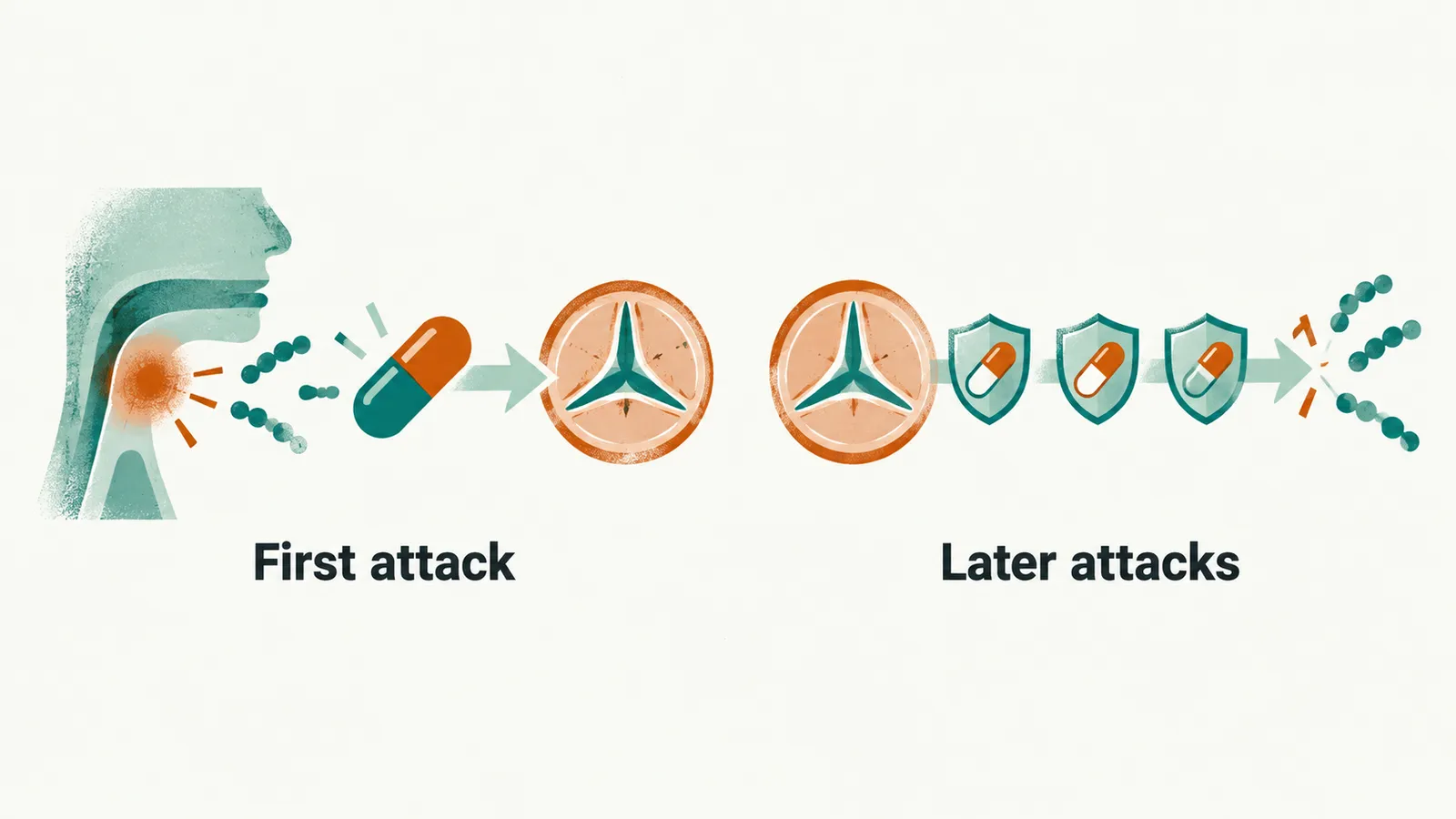
Both points act on the bacterium, because the bacterium is the trigger that is known. This works in acute rheumatic fever because that trigger can be found and treated.
Why does this matter so much for a sore throat that is only uncomfortable? Because valves scarred during an attack do not recover, and each recurrence adds to the damage. Primary prevention is the single most effective intervention.
The first point has a time limit, so we start there.
Treating the sore throat in time
Antibiotic treatment for streptococcal pharyngitis, started within 9 days of the onset of the sore throat, prevents the first episode of rheumatic fever. The attack follows the immune response to the bacterium.
Treatment started later still treats the infection, but it no longer prevents the rheumatic complication.
This window also explains something practical. There is time to confirm the diagnosis with a culture or a rapid test, so the child need not be treated blindly.
Within that time limit, which antibiotic should be used?
Which antibiotic
Three regimens are used for group A streptococcal pharyngitis:
- Amoxicillin by mouth, 50 mg/kg once daily (maximum 1,000 mg), or 25 mg/kg twice daily (maximum 500 mg per dose), for 10 days.
- Penicillin V by mouth, 250 mg two to three times daily in children, for 10 days.
- Benzathine penicillin G intramuscularly, as a single dose: 600,000 units if the child weighs 27 kg or under, and 1,200,000 units if over 27 kg.
Group A Streptococcus has never been shown to be resistant to penicillin. That is why amoxicillin is sufficient and clavulanate adds nothing.
Clavulanate also has a wider spectrum, and here that is unnecessary. It works against antibiotic stewardship.
But some children cannot take penicillin.
The child allergic to penicillin
A cephalosporin, clindamycin or a macrolide can be used. These belong to other classes, so a penicillin allergy does not rule them out. Local resistance patterns should be kept in mind when choosing among them.
The goal is the same, clearing the streptococcus in time, with a different drug. Before any drug, though, someone has to decide which children to test.
Who to test
Screening scores such as the McIsaac score help decide who should be tested. Its items are:
- absence of cough
- tender anterior cervical nodes
- fever
- tonsillar exudate or swelling
- age 3-14 years
Because the score only estimates a probability, it is a triage tool and not a diagnostic rule. Clinical judgement overrides it. The score picks who is tested, then the test confirms, and treatment follows within the window.
That covers the first point. What changes after a child has already had an attack?
The second point: after an attack
Once a child has had rheumatic fever, each subsequent streptococcal infection risks another attack and further valve damage. Protection is long-term.
This protection is called secondary prophylaxis. The standard regimen is intramuscular benzathine penicillin G.
This is the same drug as in the treatment of pharyngitis, but it is now used in a different way.
The long-acting injection
The dose is set by weight, the same as for treatment:
- 600,000 units if the child weighs 27 kg or under
- 1,200,000 units if over 27 kg
The depot wears down over time, so the injection is repeated before the level drops. The interval is every 4 weeks. In settings of high streptococcal exposure it is every 3 weeks, because the chance of reinfection in the gap is higher there.
Oral penicillin V twice daily is an alternative where injections are not feasible. In penicillin-allergic patients, sulfadiazine or a macrolide is used.
The injection is only as good as the schedule, so how long must it continue?
How long
The duration is decided by the cardiac findings and by local guidelines, which differ in detail. The longer a child lives with valve damage, the more another attack costs. Prophylaxis therefore runs longer after carditis that leaves valve disease. The widely followed thresholds are:
- No carditis: 5 years after the last attack, or until 21 years of age, whichever is longer.
- Carditis with no residual valvular disease: 10 years after the last attack, or until 21 years of age, whichever is longer.
- Carditis with persistent valvular disease: 10 years after the last attack, or until 40 years of age, whichever is longer.
For carditis with persistent valvular disease, lifelong prophylaxis is sometimes recommended.
These are the widely followed thresholds, not a single rule. Some national protocols use 18 rather than 21 years as the age threshold. Some use 21-30 days rather than 28 days as the injection interval. The schedule in use where the patient is managed determines the exact numbers.
If a further episode of rheumatic fever occurs during prophylaxis, prophylaxis continues and is usually intensified.
Where prevention stops
Prevention works in acute rheumatic fever because the trigger is a known bacterium that can be found and treated. A chronic arthritis that begins without any identifiable trigger cannot be approached this way. It has to be recognised from its pattern instead. So how is such an arthritis recognised when there is nothing to remove?