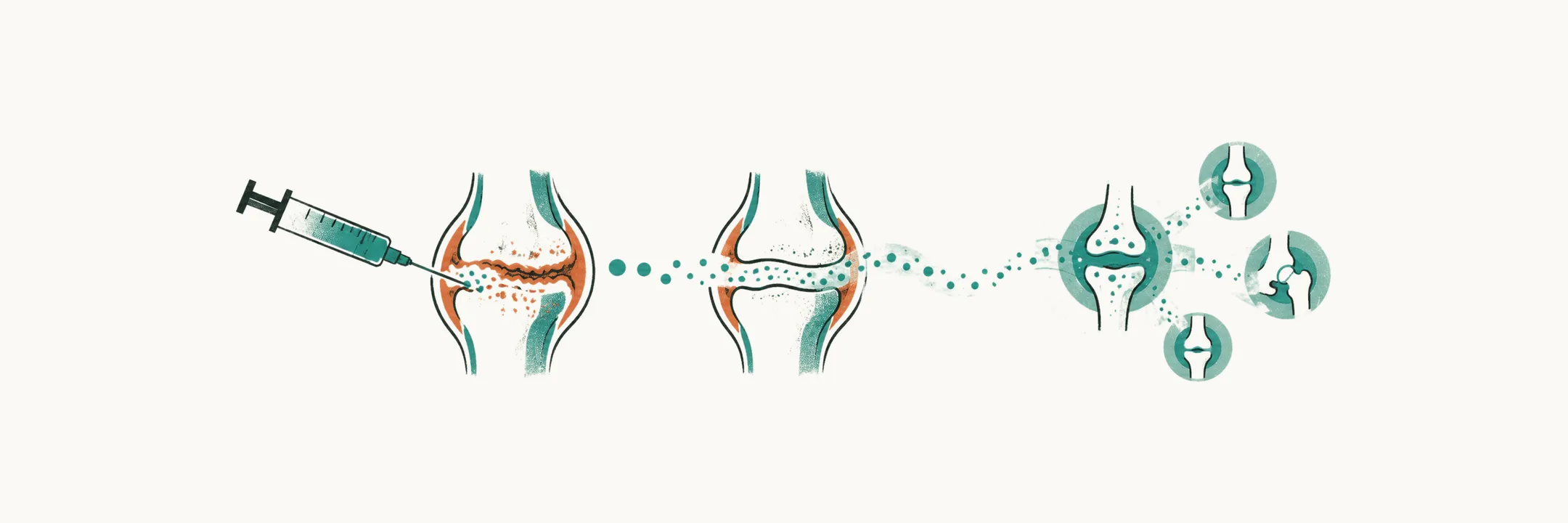
Why must the target be the inflammation itself?
In a chronically inflamed joint the inflammation stays on, and the joint lining keeps eroding the cartilage and bone at the joint’s edges. That damage does not heal back (see Juvenile Idiopathic Arthritis). This is the organising idea of treatment: joint damage allowed to accumulate cannot be undone.
Juvenile idiopathic arthritis begins before the 16th birthday, persists for more than 6 weeks and has no identifiable cause. It is a group of categories, not a single disease. Some categories affect up to 4 joints (oligoarthritis), some affect 5 or more joints (polyarthritis), and in systemic juvenile idiopathic arthritis fever and inflammation outside the joints dominate.
Because damage is permanent, the aim is to suppress the inflammation completely and to do it early. So the goal is to switch the inflammation fully off while damage can still be avoided.
Treatment in an individual child depends on the category and on how much joint disease is active. A single inflamed knee in a toddler who is positive for ANA and a fever-driven systemic illness are managed with different drugs. The approach to treatment changed fundamentally with the arrival of biologic drugs.
What does each kind of treatment actually do?
If damage cannot be undone, the question becomes which treatments act on the inflammation and which only ease the symptoms.
The current strategy uses five kinds of treatment. They differ in whether they only relieve symptoms or change the course of the disease.
- NSAIDs give symptomatic control. In JIA they do not modify the disease.
- A DMARD suppresses the underlying inflammation rather than just the symptoms.
- Intra-articular corticosteroids, systemic corticosteroids and biologic agents make up the rest of the five kinds.
Each biologic drug is an engineered protein that blocks a single immune signal.
Why did the older approach start at the bottom?
Knowing which drugs act on the disease explains why the order in which they are tried matters.
The older pyramid approach used NSAIDs first, then immunosuppressants, and kept biologics for refractory disease. The pyramid approach allowed damage to accumulate while treatment escalated slowly, and it failed many patients.
The current strategy is the reverse of the pyramid.
What counts as enough treatment?
The reverse order works only if a child is measured against a goal, so the next question is what that goal is. This is treat-to-target, and it has four parts:
- Start effective treatment early, before erosions develop. Children treated during the early window are the ones most likely to avoid permanent joint damage.
- Set a target of inactive disease and minimal long-term damage.
- Withdraw medication sequentially once the target is reached, rather than continuing it indefinitely.
- Review the target at fixed intervals and escalate if it is not met.
A target has several goals, not one. A child with quiet joints but an inflamed eye, or with growth falling away from the curve, is not at target even when the joint count looks reassuring. Most steps in the sequence are triggered by disease that is still active, so treat-to-target only works if the target is measured.
Why inject a joint rather than give a steroid tablet?
A drug that acts in one joint is not the same as a drug that acts in the whole child, and the difference is what the choice rests on.
Intra-articular corticosteroid (triamcinolone hexacetonide) is first-line for oligoarticular disease. In polyarticular disease it serves as a bridge while a DMARD takes effect.
Using an intra-articular rather than a systemic steroid in non-systemic JIA is deliberate. The injection controls the local inflammation in the joint, which is what drives contracture and leg-length discrepancy. It also avoids exposing the child to the growth suppression and other systemic effects of corticosteroids.
Local adverse effects are uncommon. Subcutaneous atrophy is the most frequent. Rare complications include periarticular calcification, crystal-induced synovitis, avascular necrosis of bone, transient cushingoid features, septic arthritis and anaphylaxis.
In joints that matter for growth and gait, the balance is usually in favour of injecting.
When is a steroid given to the whole child?
A systemic dose reaches the whole child, so it is kept for the case that needs it. Systemic corticosteroids are reserved largely for systemic JIA with uncontrolled systemic features. They are used at the lowest effective dose and for the shortest possible time.
Why is methotrexate the workhorse?
Methotrexate is the first conventional DMARD and is the workhorse of JIA treatment. It is given once weekly, by mouth or by injection.
It is a folate analogue. It resembles folic acid and interferes with its use.
How are methotrexate’s side effects handled?
Methotrexate blocks the use of folate, which is why folic or folinic acid is part of its use. Folinic acid acts as an antidote to that block. Folic or folinic acid is given about 24 hours after the methotrexate to reduce adverse effects.
Nausea and vomiting are the commonest adverse effects and a frequent reason for stopping the drug. They can often be reduced by switching to the subcutaneous route or by antiemetic strategies. Raised liver enzymes also occur; they are usually mild and reversible. The drug is monitored by periodic blood tests.
What do the biologic drugs block?
When methotrexate is not enough, the next drugs block one signal each.
- TNF inhibitors: etanercept, adalimumab and infliximab. They reduce the expression of molecules involved in chemotaxis, invasion and adhesion of immune cells, so fewer immune cells move into and stick in the inflamed tissue.
- The IL-1 inhibitor anakinra.
- The IL-6 inhibitor tocilizumab.
- The T-cell costimulation blocker abatacept.
In the systemic category, IL-1 or IL-6 blockade is favoured; Systemic Juvenile Idiopathic Arthritis and Macrophage Activation Syndrome covers the mechanism.
What changes for infections and vaccines on these drugs?
Blocking immune signals changes what a child can safely receive, so the vaccine question comes next.
Methotrexate is usually withheld during an acute bacterial infection until the antibiotics have finished. Immunisation should be kept up to date, including influenza and pneumococcal vaccines. Non-live vaccines are considered to have adequate safety profiles and are recommended for children with rheumatic disease.
Live vaccines are generally avoided while a child is on higher-dose immunosuppression. The evidence on live boosters during methotrexate use suggests they are safe. A systematic review in clinically stable children supports cautious use of live measles-mumps-rubella and varicella boosters under specialist supervision.
In what order are the building blocks used?
Most steps are triggered by disease that is still active, so the sequence depends on how the child is measured. The building blocks are combined in a sequence that depends on the number of joints involved and on whether systemic features are active. The exact agents and thresholds differ between guidelines; what follows is the shape of a common European algorithm.
Arthritis in 4 or fewer joints
- Low disease activity: an NSAID alone.
- Moderate or high disease activity: intra-articular corticosteroid injection, with or without methotrexate.
- Disease still active after about 3 months of methotrexate, or poor prognostic features: a TNF inhibitor.
Arthritis in 5 or more joints
- Methotrexate, usually with a bridge of an NSAID or intra-articular injection.
- Still active after about 3 months of methotrexate: a TNF inhibitor.
- Still active after about 4 months of a TNF inhibitor: a second TNF inhibitor or abatacept.
Systemic JIA with active systemic features
- Low fever activity: an NSAID.
- Higher activity, or fever persisting after 2 weeks of NSAID: a systemic corticosteroid, with or without an NSAID.
- Fever persisting despite corticosteroid: anakinra, with or without corticosteroid.
Systemic JIA with active arthritis but no systemic features
- An NSAID, with intra-articular injection as needed, reviewed at about 1 month.
- Persistent disease: methotrexate.
- Persistent after about 3 months of methotrexate: a TNF inhibitor or anakinra.
- Persistent after about 4 months of a TNF inhibitor: abatacept.
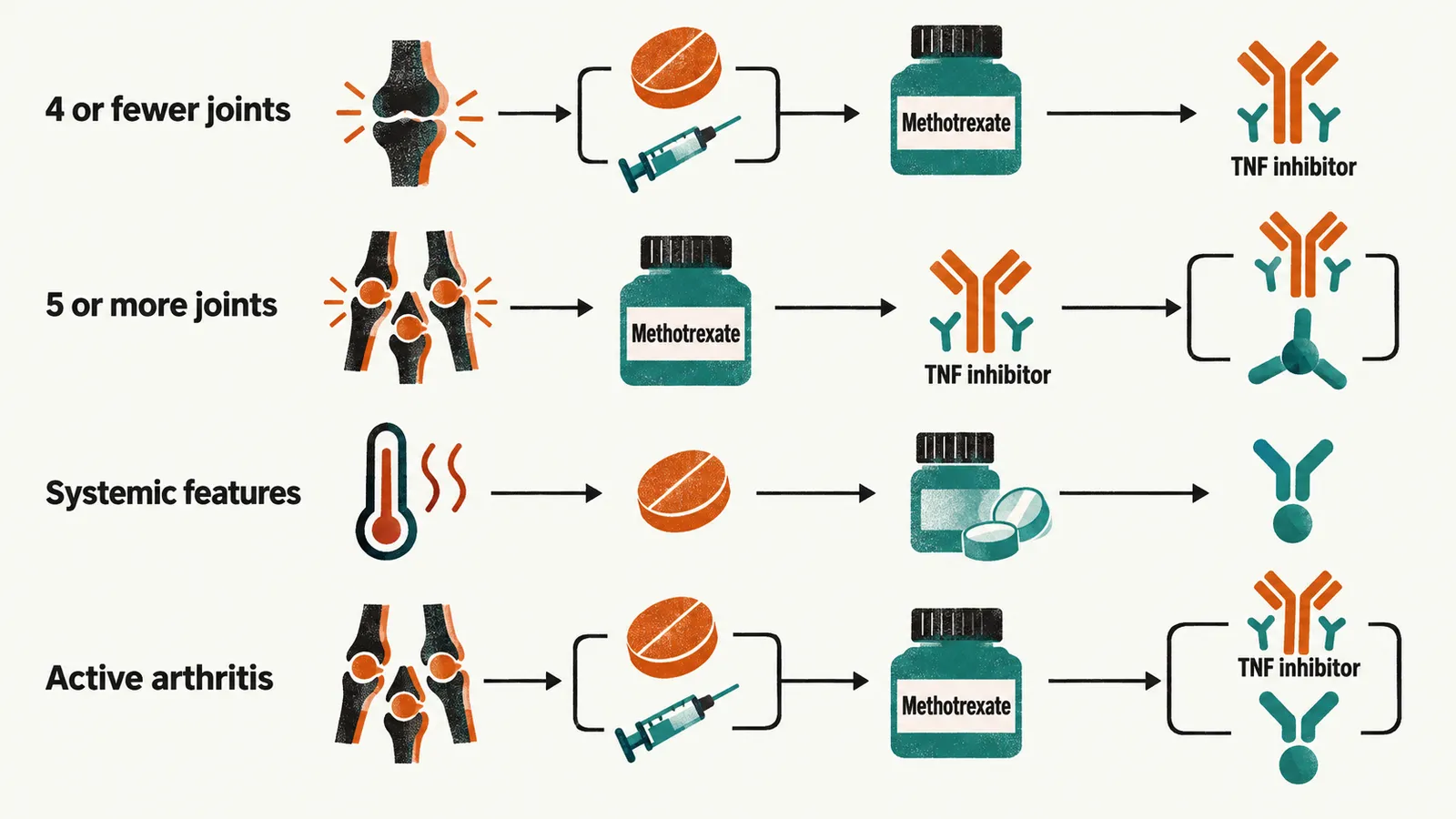
The ACR/Arthritis Foundation guidelines agree on the general sequence, though they differ in some details and in the recommended timing. They prefer methotrexate over other conventional DMARDs when NSAIDs and injections are insufficient. A TNF inhibitor is the usual next step in non-systemic disease. In systemic JIA they favour IL-1 or IL-6 blockade.
How is progress checked against the target?
A child on these drugs has to be checked on several fronts, not only the joints. The child needs regular assessment of joint counts and inflammatory markers. Blood tests look for drug toxicity, and growth and blood pressure are checked. Ophthalmological screening is also needed; Uveitis and Eye Screening in Juvenile Idiopathic Arthritis gives the schedule. A child with quiet joints but an inflamed eye, or with growth falling away from the curve, is not at target.
Which disease is it, and does the category decide the drugs?
Every treatment decision begins with knowing which disease and which category is present. The three diseases in this family are hardest to tell apart when the child is febrile and the presentation is at its least specific. So when the child is febrile and the signs are least specific, how do you tell which of the three diseases this is? Telling Kawasaki Disease, Acute Rheumatic Fever and Juvenile Idiopathic Arthritis Apart answers that.